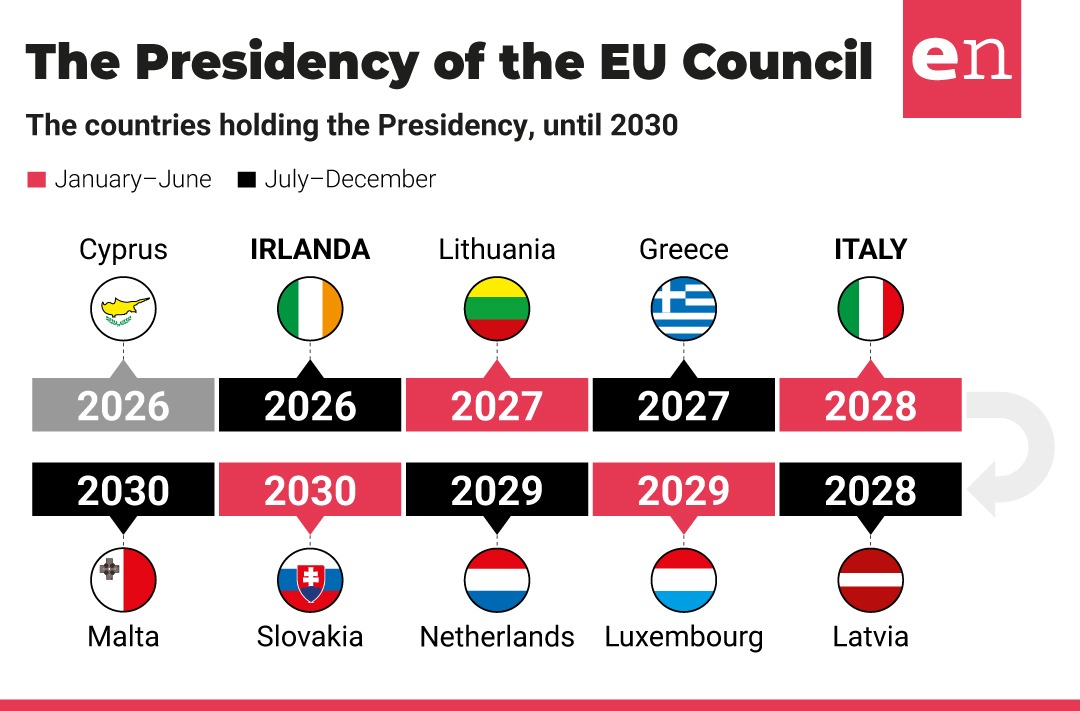
Brussels – Competitiveness, values, and security. It is around these three thematic areas that Ireland is structuring its rotating presidency of the Council of the EU, which begins on 1 July. “Throughout our term, we will work to make the Union more prosperous and safer, and to defend our shared fundamental values,” assures the Irish Prime Minister, Micheál Martin, in support of a political agenda that is largely centred on the agreement on the next Multiannual Financial Framework (MFF 2028–2034).
The main challenge facing Ireland’s eighth presidency of the Council of the EU is to try to finalise an agreement by the end of 2026 on one of the most divisive issues by definition. EU heads of state and government have already given the Irish Presidency, even before it took office, a clear mandate to bring everyone on board, and this will be the central theme of these six months. The Multiannual Financial Framework must secure the resources to fund “twelve-star” competitiveness from industrial, commercial, and technological perspectives. But the 2028–2034 budget must also guarantee security in every sense of the word, from defence and energy to employment, housing, the internet, and health.
But competitiveness, values and security depend on reforms. The Irish Presidency intends to implement the ‘One Europe, One Single Market’ roadmap, which sets out the steps the EU must urgently take in areas such as simplification for businesses and citizens, the completion and strengthening of the single market, the reduction of energy prices, decarbonisation, and the development of artificial intelligence. To this end, the Presidency’s programme provides for the reduction of unnecessary administrative burdens “by prioritising the Omnibus simplification packages.”
With regard to energy competitiveness, the Irish government intends to finalise the approval process for the European Networks Package and to drive forward the Energy Security Package, thereby ensuring a response to high energy prices. As part of this effort, a commitment has been made to “accelerate the transition to clean energy and gradually phase out dependence on fossil fuel imports.”
In terms of competitiveness, innovation, and technological security, the Irish Presidency intends to work towards an ambitious, clear, and structured European agenda through the international summit on artificial intelligence scheduled to take place in Dublin on 14 October, which will focus on harnessing the opportunities offered by digital technology and artificial intelligence, while enabling citizens to thrive in the digital society.