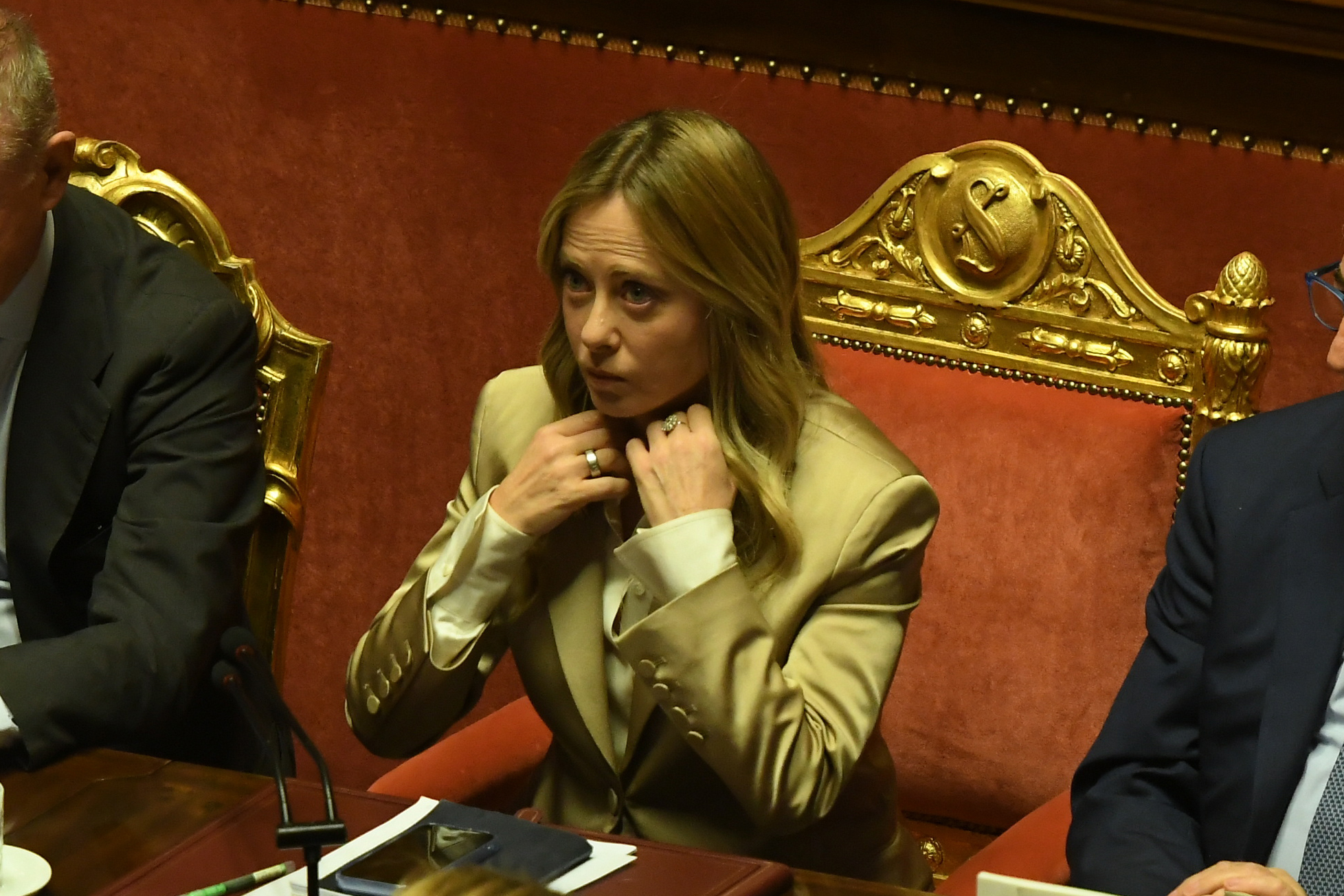
Brussels – The agreement on Russian diesel announced by Donald Trump is “a very risky move,” which could legitimise Moscow, provide new resources to fund the war in Ukraine and undermine the West’s sanctions strategy. Ahead of the European Council meeting on 15 and 16 October, Giorgia Meloni briefed Parliament on Italy’s position at the summit, which is set to tackle an agenda ranging from economic competitiveness to the war, from security to migration, and the Union’s future budget. According to the Prime Minister, Russian President Vladimir Putin is constantly “provoking” Europe by threatening attacks to “divert attention” from the course of the conflict on the ground and is “seeking a new enemy, which could be Europe.” Rome’s strategy is not to give Putin “this advantage” and to “remain calm, particularly at this time.”
The rise in fuel prices is “primarily linked to the war in Iran and not to the conflict in Ukraine,” explains the Prime Minister. For this reason, the benefits of the agreement announced by Trump remain “dubious,” while the political and economic risks are clear. “Legitimisation for Moscow while its bombs continue to fall on Ukrainian cities, new revenue to fund the war, and an implicit weakening of the leverage provided by sanctions are factors we cannot ignore,” states Meloni, emphasising how such a decision would contradict the efforts made so far by Western states, including the United States, to bring Putin to the negotiating table. This is also because, as she went on to explain in her reply to the Chamber of Deputies, Russian gas “does not cost Italians less; it costs the Russians less, which is a different matter.” The price of gas in Europe is set by the Dutch TTF exchange and, once it arrives, it is sold at a single price. Even in the years when Italy imported the most Russian gas, the Russian component accounted for less than 40 per cent of the total, meaning that the price was predominantly set by other suppliers. “So a resumption of Russian gas imports would not lead to a reduction in price, at least not for several years,” Meloni points out.
For the Prime Minister, energy costs represent the main obstacle to the competitiveness of the European economy. The Prime Minister reiterates that EU businesses cannot be expected to compete with major global players if they continue to face energy costs that are structurally higher than those of their competitors. “Decarbonisation cannot mean deindustrialisation,” she states, highlighting the need to reconcile the environmental transition with the protection of Europe’s manufacturing base, particularly at a time marked by geopolitical instability and supply chain tensions. The response, according to the Prime Minister, must be “coordinated and swift.” The agreement reached within the G7, which provided for the release of a significant quantity of fuel onto the markets, is a step in this direction. The initiative, Meloni explains, also aims to prevent the risk of a freeze on US exports, which would have serious consequences for European economies.
On the domestic front, the government is also continuing its discussions with the European Commission on the “Utility bills” decree. The aim is to find a solution compatible with EU rules that will reduce the impact of gas-fired generation costs on the overall price of electricity. “Not another line in the conclusions of a summit, but a lower energy bill for a household, one lower cost for a business,” emphasises the Prime Minister, pointing to the tangible effects on households and the business sector as the criterion by which to assess the results of the European negotiations.
Meloni assures us that Italy’s position on the war in Ukraine remains unchanged. Support for Kyiv, concern for the civilian population, pressure on Moscow and Euro-Atlantic unity remain the cornerstones of the government’s approach. “No one will convince me that the surrender of those defending their freedom can be called peace,” states the Prime Minister, emphasising the need to pursue a solution that goes beyond merely halting the fighting, but guarantees long-term stability. “The peace we want, and which we are working to build – even at the cost of losing some public support – is a just peace, because only a just peace can last; only a just peace safeguards Europe and our interests.”
Another issue concerns security of supply and Europe’s dependence on critical raw materials. Lithium, cobalt, graphite, and rare earths are essential for the energy transition, digital development, and defence, but Europe continues to import them largely from abroad, often from a single country. “If we do not tackle this issue, we risk moving from one dependency only to fall into another,” warns Meloni. It is against this backdrop that Italy has put itself forward to host one of Europe’s first strategic storage sites for these resources in Porto Marghera. The government envisages that the project could become a pilot scheme at EU level, helping to diversify supplies and strengthen the Union’s strategic autonomy.
Security will be another key topic at the Brussels summit. Meloni draws attention to hybrid threats – phenomena that do not necessarily manifest themselves through an open military conflict, but which can target infrastructure, institutions, and public opinion. From drones flying over airports and military bases to damage to undersea cables in the Baltic, and from cyber-attacks against hospitals, ports, and public administrations to sabotage of railway networks, the picture painted by the Prime Minister is one of European security exposed to multiple and interconnected risks. Added to these are disinformation campaigns, attempts to influence elections and the exploitation of migration flows as tools of political pressure. “Hybrid warfare is not declared and has no front line,” observes Meloni, identifying the protection of critical infrastructure as one of the priorities that Italy will bring to the European table. The response, she insists, cannot be entrusted solely to individual states, but requires a common strategy and greater capacity for prevention and defence.
On the forthcoming Multiannual Financial Framework, the Italian government is taking a firm negotiating stance: Italy will not sign an agreement simply to meet a deadline, but intends to secure a budget that meets the needs of both the country and the Union. The new strategic priorities, from defence to security, must be allocated adequate resources without compromising the traditional policies that form one of the pillars of European integration. “Italy will not accept a budget that scales back the Common Agricultural Policy, fisheries, and cohesion,” states Meloni. Agriculture and fisheries, she points out, are not merely about supporting productive sectors, but also about food security, which is considered an essential component of European strategic autonomy.
English version by the Translation Service of Withub![[Copyright: European Union]](https://www.eunews.it/wp-content/uploads/2026/10/euco-261015-350x250.png)


![[Copyright: European Union]](https://www.eunews.it/wp-content/uploads/2026/10/euco-261015-120x86.png)