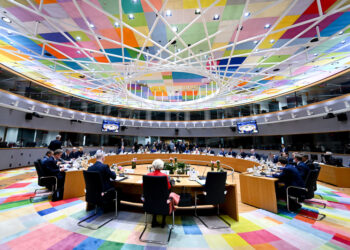
Brussels – More time to comply with European regulations on methane emissions. The European Parliament today (22 October) approved a three-year postponement of the obligations applicable to fossil fuel importers, going beyond the one-year extension proposed by the European Commission. The decision was put to a vote today (22 October) in plenary and received 341 votes in favour, 225 against and 6 abstentions. The aim is to give companies more time to demonstrate that imported fuels meet requirements equivalent to those in the EU regarding the monitoring, reporting, and verification of emissions. The text will now have to be negotiated by the Parliament with the Council of the EU to arrive at a final version.
The motion was carried by a coalition stretching from the European People’s Party to the far right – comprising Patriots for Europe (PfE) and Europe of Sovereign Nations (ESN) – via the European Conservatives and Reformists (ECR). The progressive groups voted against it: S&D, the Greens and the Left. The Renew group of liberals was divided: 25 in favour, 40 against and two abstentions. On the Italian front, those in favour included Forza Italia, Fratelli d’Italia, the Lega and Futuro Nazionale, as well as Elisabetta Gualmini of Azione and Pina Picierno of Spazio Pubblico. Opposed were the M5S, AVS, and the PD, with Giorgio Gori abstaining.
According to the European Parliament’s position, importers of crude oil, natural gas, and coal will have until 31 May 2031 to demonstrate that supply contracts concluded or renewed from 4 August 2024 onwards include measures equivalent to those laid down in European legislation. The postponement relates to import obligations, while the legislation on methane aims to reduce emissions from the energy sector.
The Commission’s proposal, presented on 14 October, instead provided for the monitoring, reporting, and verification obligations – originally due to come into force on 1 January 2027 – to be postponed by one year. Brussels justified the revision by citing tensions in the energy markets and risks to security of supply, against a backdrop of global supply difficulties and pressure on prices.
The European People’s Party (EPP) supported the postponement, citing the need to safeguard energy security and keep costs down for households and businesses. “We must not impose new rules any faster than energy suppliers can adapt,” said Dimitris Tsiodras, an EPP MEP and the group’s negotiator on the dossier. According to Tsiodras, obligations introduced too quickly risk making gas imports more difficult and expensive.
With the three-year postponement of the methane regulation, “we have amended the Commission’s proposal, which provided for just one year: an insufficient timeframe, as 22 governments, 70 industry organisations, and the majority of this House had already pointed out this summer during the last plenary session, following a debate we had requested,” commented the FdI-ECR MEP and Vice-Chair of the ITRE Committee, Elena Donazzan. “Today, with the ‘Giorgia’ majority, we have achieved this,” she emphasised, noting that this is “confirmation that, when the European centre-right is united, pragmatism prevails over ideology and the interests of industry and energy security return to the heart of the Union’s decision-making.”
The Greens are calling it an absolute scandal. “The demand by the Conservatives and the far right to postpone the methane regulation for three years is an absolute scandal. Once again, the Conservatives and the far right are pursuing policies that undermine climate action and favour the interests of the fossil fuel industry,” commented Green MEP Jutta Paulus, the European Parliament’s chief negotiator for the methane regulation. “Implementing the Regulation would strengthen our energy security and significantly reduce emissions of the second most important greenhouse gas. Instead, the Commission and Parliament are bowing to pressure from the fossil fuel lobby and blackmail from the Trump administration. It is utterly incomprehensible that, in the midst of an energy price crisis, gas is being needlessly flared or allowed to leak into the atmosphere,” she emphasised.
The review reignites the debate between the need to ensure reliable energy supplies and the EU’s climate ambitions. “Slowing down the process of reducing methane emissions risks undermining Europe’s energy security in the long term,” said Giulia Signorelli, a decarbonisation researcher at ECCO, the Italian climate think tank. “A three-year delay would prolong uncertainty for businesses and investors, penalising those who have already invested to meet the targets.” But that is not all. “We must not underestimate the costs of a delay, which would be significant. Timely implementation of the Regulation could generate around €700 billion in climatic, health and economic benefits, against 49 billion in regulatory costs. Furthermore, a three-year delay would result in a potential loss of around €185 billion in benefits against just €11 billion in savings, with around 40,000 additional premature deaths,” concluded Signorelli.
English version by the Translation Service of Withub