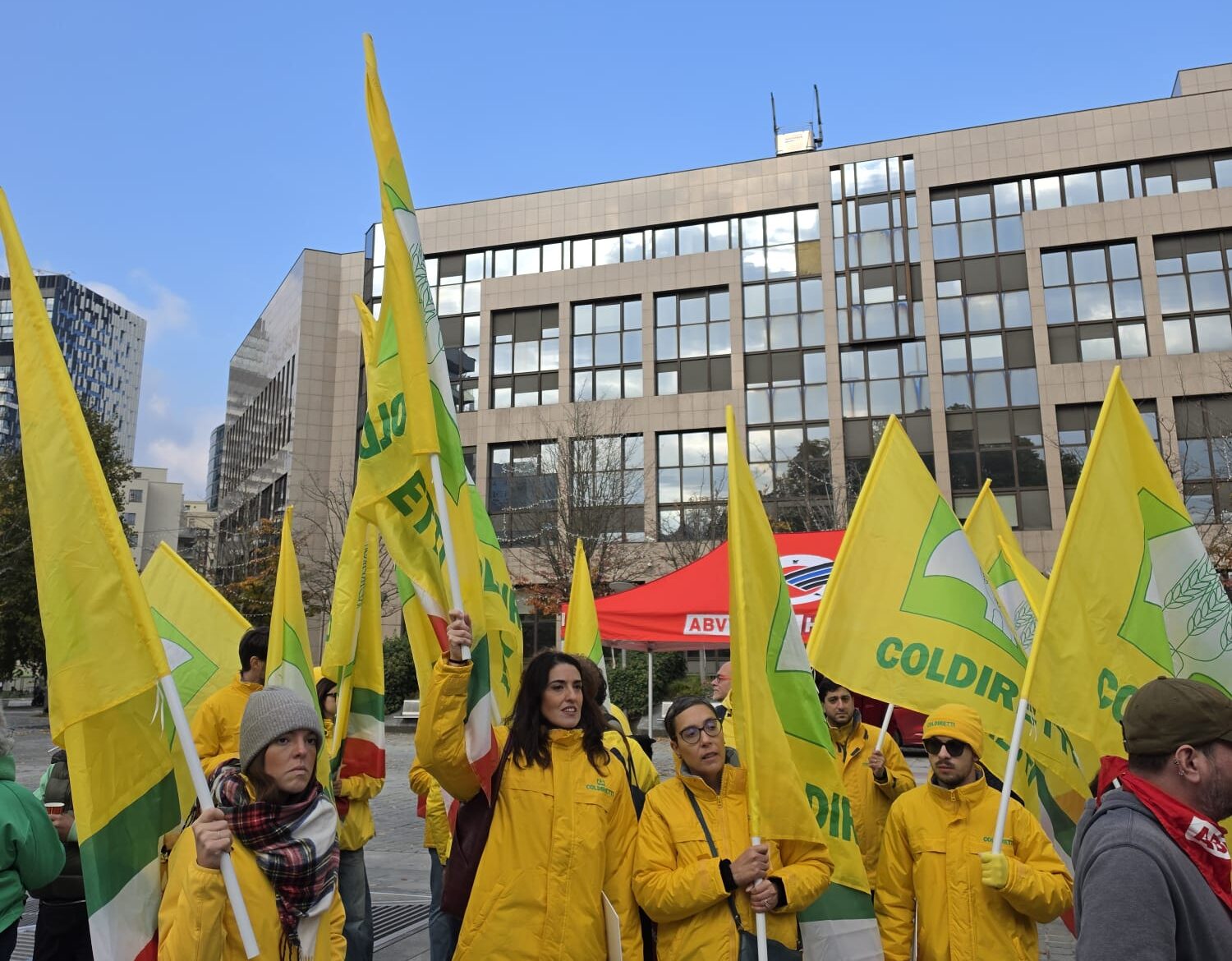
Brussels – “We cannot allow companies that engage in illegal recruitment practices, exploitation, and undeclared work to receive the Common Agricultural Policy subsidies.” This was stated today (3 November) by the head of Coldiretti’s Labour Division, Romano Magrini, at a protest in Place Jean Rey, in the heart of the EU quarter in Brussels. Today, the European Federation of Food, Agriculture and Tourism Trade Unions (EFFAT) organised a protest to “call for a fairer agricultural sector and defend social conditionality.” Coldiretti was there “to show its support for EFFAT and to champion social conditionality against its exclusion from the next CAP programming period,” explained Magrini.
Introduced as part of the 2021 CAP reform, social conditionality is a principle that makes public funds granted to employers conditional upon their compliance with workers’ rights. According to a report by EFFAT, “although it has only been applied in most Member States since 2025, it is now under serious threat in the context of the CAP negotiations for the post-2027 period.”
The spokesperson emphasised that the clause “is designed to protect agricultural workers and honest farming businesses,” noting that Coldiretti is in fact “the only Italian agricultural organisation to support it.” The Committee of Professional Agricultural Organisations of the EU (COPA), led by its president Massimiliano Giansanti, has spoken out against its inclusion in the future CAP, leading to the exclusion of the mechanism from the provisional negotiating position approved by the Council of the European Union in October 2026.
Like Magrini, the deputy representative of Coldiretti Giovani Impresa in Piedmont, Alessandro Caruso, stated that the abolition is not “a simplification in terms of what is involved in entering the world of work,” but rather “unfounded words and justifications.” “Public money cannot be used to contribute to the erosion of workers’ rights,” he added.
The Greens’ MEP, Cristina Guarda, has expressed her “full support for workers and trade unions who are calling for one simple thing: those who receive European public funds must respect the rights of those working in the fields.” She also noted that “there cannot be any agriculture supported by Europe that tolerates exploitation,” after “the Agrifish Council has come out against this principle from its position on the post-2027 CAP.”
Guarda made it clear that social conditionality represented “an important achievement,” in that “for the first time, it has effectively linked access to CAP subsidies to compliance with labour, health, and safety standards.” Conversely, he concluded, there is now a risk of “scrapping it at a time when the agricultural sector continues to grapple with irregular employment, illegal recruitment practices, unlawful labour brokering, and unacceptable working conditions.”
English version by the Translation Service of Withub