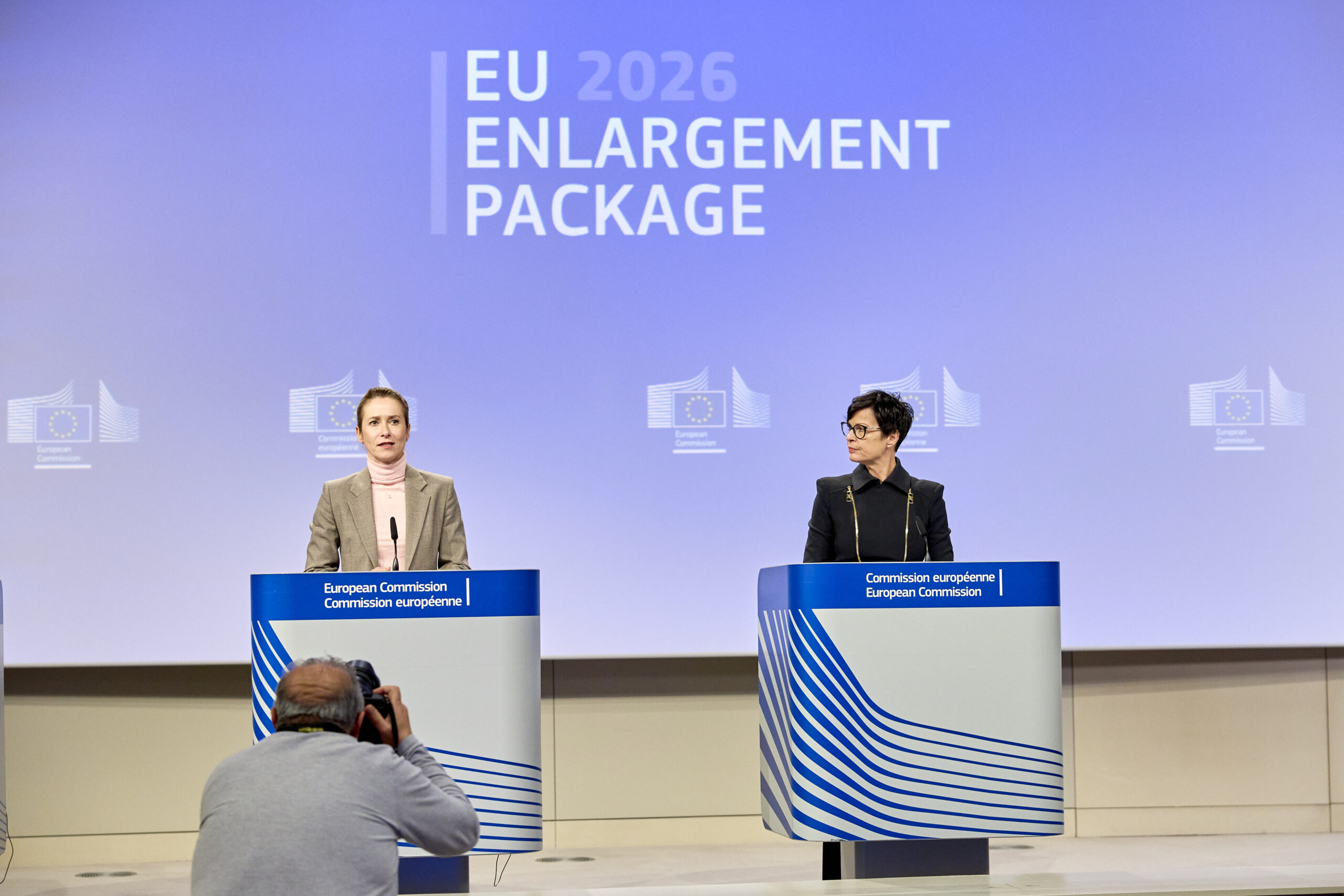
Brussels – Countries on the verge of accession, countries that still have a number of shortcomings to address, and countries that, despite being candidates, appear to be drifting further away from the goal. Having set out the conditions for preparing itself for the accession of new members, the European Union must now ensure that the candidate countries are also ready to comply with them. With the Enlargement package presented today (4 November) by the High Representative for EU Foreign Policy, Kaja Kallas, and the Commissioner for Enlargement, Marta Kos, the European Commission takes stock of the progress made by its partners and the reforms still needed to join the Union.
We must press ahead now, because “this year the enlargement process has yielded more results than at any other time in the last 25 years,” Kos pointed out. For Kallas, enlarging the Union also means “strengthening Europe’s security and increasing its geopolitical clout on the international stage,” as well as its capacity to exert influence. A perspective which, in the current international context, goes far beyond the mere extension of the Union’s borders.
After all, as the President of the European Commission, Ursula von der Leyen, pointed out, “the significant progress made by some candidate countries over the past year enables us to turn the promise of enlargement into reality.” For this reason, Brussels is proposing a series of indicative roadmaps for the four countries that are furthest advanced in the negotiations: Montenegro, Albania, Ukraine, and Moldova. “A clear path for the coming year and a solid foundation for the forthcoming negotiations,” explained von der Leyen, who believes that, “step by step, we are building a more complete and stronger Union.”
Alongside the roadmaps, the Commission is also presenting a Common framework for the gradual integration of candidate countries in strategic sectors such as energy, transport, the digital sector, and defence. The aim is “to gradually bring partner countries closer to the European market and policies even before accession, strengthening the Union’s security, reducing its vulnerabilities and creating new economic opportunities”, Kos said at a press conference.
The nearest countries: Montenegro, Albania, Ukraine, and Moldova
The Berlaymont Building is focusing on the four countries that have made the most progress. Montenegro is leading the way, having opened all 33 negotiation chapters and provisionally closed 21 of them. There has been talk of its success in the accession process ever since the head of the European Commission had travelled to Podgorica for her usual tour of the Western Balkans. “It’s the final stretch, after years of effort,” said Ursula von der Leyen at a press conference with the Montenegrin Prime Minister, Milojko Spajić.
In its assessment, the European Commission considers it realistic “to conclude negotiations by the end of 2026.” Work on the accession treaty “is already underway” and Brussels has also presented the financial package to support the country’s accession. If things proceed as planned, “Podgorica could sign the treaty in 2027, perhaps as early as June,” Kos stated confidently, thereby achieving the goal of becoming the 28th Member State in 2028.
Next comes Albania, which has opened all the negotiation clusters in just over a year, achieving an important milestone. Tirana “is leading the way and keeping pace, but it must be able to maintain this momentum,” noted Kos. Albania has so far met the interim benchmarks on the rule of law, paving the way for the provisional closure of four chapters. The Albanian government’s aim is to conclude negotiations by 2027, a prospect which the Commission considers ambitious but achievable, provided the country maintains the pace of reforms and strengthens internal political dialogue.
Moldova and Ukraine have also opened four clusters over the past year. For both countries, the Commission considers that the conditions for opening all remaining negotiating chapters have been met. Chișinău has made significant progress in aligning its legislation with the EU acquis and in reforms relating to the rule of law. The aim is to conclude negotiations in early 2028, while maintaining the current pace of progress. Here too, this is an ambitious but achievable goal, as the country is making “promising” progress. The Commissioner describes Moldova not merely as “the best pupil in the class” any longer, but as “the very best.”
For Kyiv, however, the path forward is inevitably shaped by Russia’s war of aggression. Despite the conflict, Ukraine has continued to make progress with sectoral reforms and to keep its anti-corruption institutions operational. “Ukraine is pushing ahead with radical reforms while under Russian bombardment,” Kallas noted. “No candidate country has ever undertaken reforms of this scale during wartime, and this deserves recognition.” Brussels is, however, calling for greater urgency, particularly regarding the rule of law, public administration reform and the protection of national minorities. The aim to conclude negotiations by the end of 2028 remains ambitious and will require further efforts.
Halfway there: North Macedonia, Bosnia and Herzegovina, and Kosovo
The picture is more complex for the other Western Balkan countries. North Macedonia, in terms of alignment with EU legislation, “is among the best-prepared countries,” the Commissioner revealed. But Skopje needs to make progress on the rule of law. The country has nevertheless achieved significant results in implementing the reforms set out in the Western Balkans Growth Agenda and continues to work on the criteria required to open the first negotiating chapter – that dedicated to the fundamentals of accession – but remains held up by the constitutional amendments it has committed to adopting.
Bosnia and Herzegovina “urgently needs to appoint a chief negotiator and implement major judicial reforms,” Kos warned. Sarajevo continues to declare European integration as a strategic objective, but in practice is showing signs of disengagement. The European Commission reports “an increase in divisive rhetoric and anti-European sentiments,” as well as delays in implementing the reforms necessary to access European funds.
Kosovo, which has not yet been granted candidate country status, has, on the other hand, seen the reform process slow down due to a prolonged institutional crisis. Some progress has been made in the fight against organised crime and in aligning with European foreign policy, but concerns remain regarding the functioning of the justice system and respect for fundamental rights. The European Commission has stated that it is ready to prepare an opinion on Pristina’s application for membership, should the Council request it.
Setbacks: Serbia, Turkey, and Georgia
It is primarily in Serbia, Turkey, and Georgia that the Commission’s report highlights the most serious concerns, ranging from setbacks in democracy to a lack of alignment with European foreign policy.
Serbia has made no substantial progress in the accession negotiations. While work has continued on technical issues and alignment with internal market standards, negative trends regarding democracy and the rule of law have run counter to the stated objective of joining the Union. “The new government will have the chance to change course,” said Kos, expressing confidence in Serbia’s new leadership. But there are certainly doubts: concerns have been raised about social polarisation, the difficulties faced by democratic institutions, and the lack of alignment with the EU’s common foreign and security policy.
The assessment of Georgia is even more stark: its accession process “has effectively stalled.” Tbilisi continues to fail to comply with the nine steps set out by the European Commission for progress on the path to the EU. At the same time, the government has pressed ahead with measures that undermine democracy, the rule of law, fundamental rights, and civic space. As far as Brussels is concerned, Georgia is now a candidate country in name only: without a change of course by the authorities, it will not be able to benefit from the opportunities associated with the accession process. However, the path to the EU “remains open,” Kos pointed out.
For Turkey too, which has been a candidate since 1999, the gap between its stated European ambitions and the domestic political reality continues to widen. Negotiations have been stalled since 2018, and the Commission reports a further deterioration in democratic safeguards, with an intensification of legal proceedings against elected officials, opponents, and civil society. “Turkey remains a candidate country and a strategic partner for the European Union,” emphasised Marta Kos, but concerns regarding compliance with fundamental political criteria prevent the accession process from being restarted.
With this new package, on the one hand, enlargement once again becomes a realistic prospect, particularly for the four most advanced countries; on the other hand, accession to the Union cannot be achieved without respect for democratic rules and alignment with European values. It is not enough to be a candidate country, nor to declare a desire to join the EU. Countries must demonstrate, through reforms, that they are ready to become members.
English version by the Translation Service of Withub