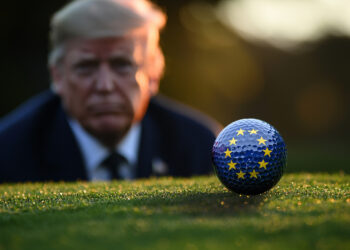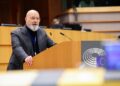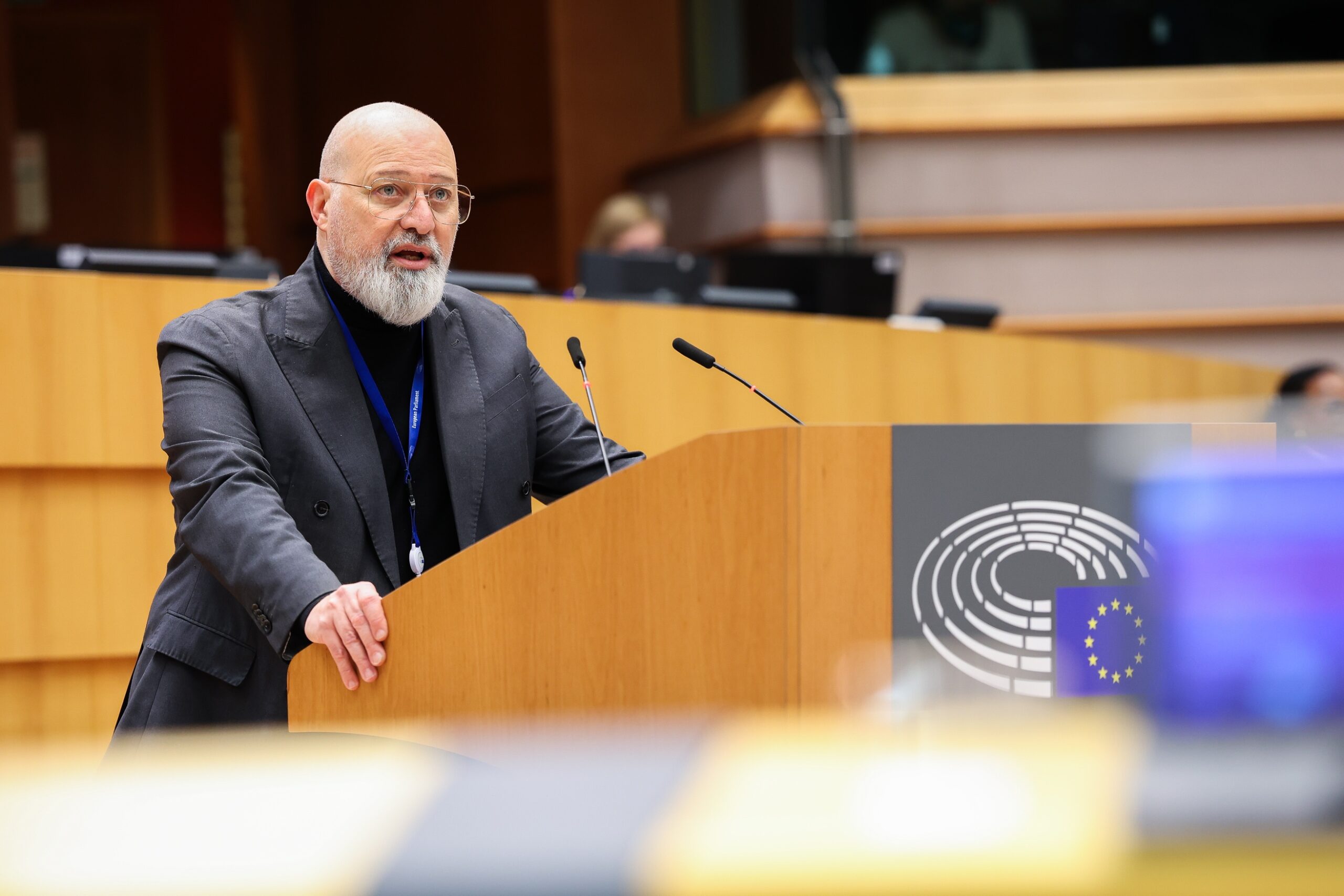
Rimini – The hope is that the new political makeup of the US House of Representatives and Senate, following the midterm elections, may prompt President Donald Trump to reconsider the trade war against Europe that began with his tariff policy. Stefano Bonaccini, MEP and President of the Democratic Party (PD), stressed this on the sidelines of Ecomondo in Rimini, the international trade fair dedicated to the green and circular economy sectors, noting that on the EU front, however, the battle is over a 2028–2034 multiannual budget that would completely reverse the proposed cuts to the Common Agricultural Policy.
Eunews: “What prospects do the Democratic wave and the US midterm elections bring to relations between the United States and Europe?”
Stefano Bonaccini: “From my point of view, one can only hope, more generally, for a new relationship between the United States and the European Union, because it had never been seen before a president working to undermine relations with Europe. I have said several times in recent months that two Republican presidents, like Bush or Reagan—and I mention them deliberately—must be turning in their graves seeing how, instead of strengthening what we call the Atlantic Pact, Trump has worked to dismantle it and divide Europe. Meanwhile, this also has incredible geopolitical implications. I don’t have much faith that Trump will change his nature or his approach, but having both the House and the Senate under such a strong Democratic majority will, I hope, compel him to adopt a more moderate stance. From the perspective, however, of the report on the issues I am following – those concerning tariffs – as I sit on the Committee on International Trade or the Committee on Agriculture and Agri-Food, the hope is that he will reconsider this senseless trade war that he started two years ago. Trade wars have never done any good to anyone, and I believe that this too, starting trade wars with everyone, has led some voters to reach their limit. However, I believe the real reason he lost the election so resoundingly, the likes of which the Republicans hadn’t seen for more than half a century, is the senseless and illegal war waged against Tehran, which has led to a further rise in fuel and energy prices in that country too, not just in Europe, combined with the fact that he had promised lower inflation and economic growth. Both of these things are going in the opposite direction”.
E: “You mentioned the fuel crisis, you mentioned the agri-food sector. What measures should be put in place to protect farmers?”
S.B.: “This is quite a problem. We asked Commissioner Hansen – who opened the session, even if some procedures need to be amended – such as the use of what we call RDP funds, that is, the Rural Development Plans, which are the European funds transferred from central government to the regions, can also help tackle high fuel prices. There had already been a recent opportunity to use them to tackle other problems caused by the war in the Strait of Hormuz, starting with fertilisers. We have now asked whether those resources can be used for the first time, as these are regional funds, to help with the high cost of fuel. Emilia-Romagna, for example, is already prepared to allocate 12 million euros from its rural development plan to farmers for the first time, precisely to help alleviate this issue. I hope that the overture made by the European Commissioner can move forward and lead to a solution, because in extraordinary times, extraordinary measures must be taken”.
https://youtu.be/uHdRrok-ZXo?si=fFDoE0mEkyXjoMf9
E: “Speaking of funding, the Commission has proposed cuts to the CAP in the next multiannual budget. What is your response?”
S. B.: “I was appointed months ago by the Agriculture Committee, and therefore by all political parties, as rapporteur for the draft budget that the Commission is presenting to the European Parliament. Let me say straight away that this is an unacceptable proposal for us, because agriculture is the sector hardest hit. There are 20 per cent cuts in the new Common Agricultural Policy. For Italy, that works out at 9 billion euros. And we cannot accept this. Therefore, in the proposal I have put forward, the first request is to reverse the cuts; otherwise, as Socialists, we have even gone so far as to say that we will not vote in favour of the budget, with all the consequences that this entails for the Commission. For the first time, I called for the introduction of inflation indexation, which we have forecast at 2.5 per cent, because in previous years, during the pandemic, inflation reached double figures and it has eaten into tens of billions of euros of the actual European budget. We called for the first time for the introduction of a new pillar for risk management, that is, the reinsurance of many agricultural businesses, particularly small and medium-sized ones. We have put forward a proposal for one billion eight hundred million euros, which would serve as a public lead to convince private investors, who have told us they might be interested, to find common ground. I hope – and I want to remain optimistic – that, at the very least, the cuts will be scrapped, because that would be truly outrageous and criminal towards the agricultural sector that the von der Leyen Commission had set out to relaunch. Let’s hope we can pull it off. I’m encouraged that the proposal I put forward to the committee received 80 per cent of the votes in favour across the political spectrum, from right to left, with the remaining 10 per cent abstaining. So we’ve shown once and for all that Europe can indeed remain united, beyond ideologies and political affiliations”.
* Video interview produced by GEA Agency
English version by the Translation Service of Withub