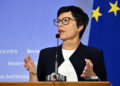
![La direttrice di Carnegie Europe, Rosa Balfour, con la rappresentante per il Commercio degli Stati Uniti, Katherine Tai [Bruxelles, 4 aprile 2024. Foto: Carnegie Europe, account X]](https://www.eunews.it/wp-content/uploads/2024/04/tai-carnegie.png)

Brussels – It may seem that shared history can be questioned, but it is not. Between the United States and the European Union, “there are tensions,” it is true, but “they are tensions that are natural because we are not equal.” First and foremost, US Trade Representative Katherine Tai wants to reassure those she considers partners: there is no change of course in the trans-Atlantic relationship; on the contrary, it is more important today than ever. The war in Ukraine, a China with which it is complicated to relate: these are two examples that Tai offers to remind us how firm the trans-Atlantic alliance is, after all.
“We responded quickly to Russia’s aggression of Ukraine with the sanctions that were needed,” she said. Relationships that showed “strong and quick action,” proving the ability to work together. Nevertheless, she stresses, in the debate with Carnegie Europe Director Rosa Balfour, that more needs to be done and not to dramatize. “We need to think less about results for the immediate and have a broader vision.” Translated: patience is needed. “Democracy is difficult, and solving problems too.” But “the way we are trying to understand each other demonstrates great maturity.”
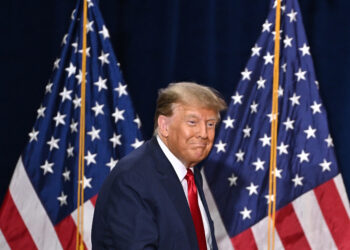
A concept Tai also insists on when the subject of the November presidential election, and a possible return to the White House by Donald Trump, is addressed, which concerns the Europeans, and not a little. “Democracy is difficult, and elections have consequences. That’s why democracies must work to help each other.”
A useful message from a trade perspective, where China is seen as the challenge that can and should unite the US and the EU. “US, EU, and China are the three largest and most significant markets in the world economy,” but non-marginal issues arise with the People’s Republic. First and foremost, economic. “In terms of demand, consumption, and flows”, stresses the US Trade Representative, “Chinese growth creates pressure on the US and EU economies, and this is something that requires action.” A call to circumscribe the Dragon’s advance, working to “find a way to coexist while remaining open and democratic” and impose that worldview unknown to the Asian competitor. “China has a very different political system and a different approach. This is a priority for the United States and the European Union to think about.”
An argument that cannot avoid reform of the World Trade Organization (WTO), called into question by the Trump administration and which the Biden one considers obsolete. “It’s a Bretton-Woods institution, and it’s showing its years in a world that has changed, with countries that have changed,” Tai acknowledges. The Bretton-Woods agreements date back to 1944 and were entered into by the then most industrialized countries with World War still in progress with a view to reconstruction. Today’s international economic system stems from there, but that is where it stands. “Reforms are necessary, and we are all aware of that. The question is what to make them look like.” That is where work needs to be done and where the United States is willing to work together.
The Council for Business and Technology represents a great working environment; “it’s an important demonstration of commitment,” Tai acknowledges. “If we look at where we were four years ago, in 2020, the council has contributed so much” to strengthening ties. But that’s not what matters so much as trust. “I don’t think the formatable formathe real issue: the relationships between technical teams, the attitude count.” A valid message should Democrats be reappointed in November’s presidential election. The United States does not intend to question relations with Europe: this is Tai’s promise.
English version by the Translation Service of Withub