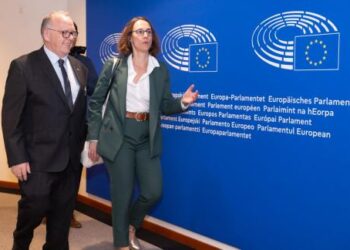
Brussels -If you buy a big car, you pay more than a small one. And that is fair. So why can’t the same concept be introduced in energy bills, revising fixed costs and taxes? Asking that question is Baiba Miltoviča, chair of the TEN (Transport, Energy, Infrastructure, and Information Society) section of the European Economic and Social Committee (EESC), who, in an interview with Eunews, reflects on how not to leave anyone behind in the energy transition.
Energy poverty has increased in Europe, and in 2023, according to Eurostat, 10.6 percent of Europeans, about 48 million people, were unable to keep their homes warm enough (up from 9.3 percent in 2022 and 6.9 percent in 2021). “For many, maintaining a stable and affordable energy supply in Europe is currently in conflict with the green transition. But it is not a question of pitting these two needs against each other: a just transition is possible,” Miltoviča said. “In our view, it is essential for National Energy and Climate Plans (NREAPs) to include a definition of energy poverty, in line with the EU legislation, transposed into national law; establish national observatories; and develop indicators to monitor the situation.” In addition, “Member States and EU institutions must rapidly provide public and private investment to harness renewable energy sources.” The ECSC also highlighted “that investments in energy efficiency must give priority to the energy poor, making the best use of the Social Climate Fund” because “access to energy is a fundamental right” and “that no one should be deprived of.”
First, “we believe EU policies should reduce energy poverty by ensuring fair and transparent prices. In all bills, there are electricity prices linked to consumption – and vulnerable people try to use less electricity, even to the detriment of their health, when they can’t heat their spaces enough. However, the many elements not linked to consumption are not fair. Half of the bill is taxes, tariffs, energy maintenance, utility costs, all the small parts that make the price high. All of this creates inequality,” and “it is a political decision to eliminate these taxes or to adjust them to make them linked to consumption.” Ultimately, it is a matter of equity: “If you spend less on your consumption, you pay little. If you spend more on your consumption, you can pay more. It’s like cars: if you buy a big car, you pay more; if you have a small or simple one, you pay little. So why don’t we introduce this concept in energy bills? We need to go back to equity.”
Second, “everyone should be entitled to free basic energy consumption,” and “member states where such provisions do not exist should make them operational urgently.” Third, “we called for Member States to implement the Energy Performance Directive in buildings, ensuring that green transition costs do not fall disproportionately on tenants,” and “to apply the principle of housing cost neutrality to offset rent increases with savings on energy bills.” In this regard, Miltoviča recalled how energy poverty and housing inefficiency are often two sides of the same coin and how devising policies that aim to renovate the buildings of people who do not have the means to do so addresses environmental and social issues.
Miltoviča also said that “experience shows that energy communities can pose a significant remedy to the energy situation” because they promote “democratic ownership of assets and their management in a needs-oriented rather than profit-oriented manner. Energy communities are legal entities that offer citizens and municipalities the opportunity to join together to produce and consume their energy.” Even though their role has gained “increasing recognition in EU legislation,” for this reason, the ECSC calls for “moving forward,” in particular in terms of “greater conceptual clarity to give guidance to consumers who wish to create an energy community, mainly in rural areas.”
Finally, the chair addressed the issue of reorganizing cities ways of moving around them, with an emphasis on mobility: with public transportation that “must be reliable in terms of schedules, and clean and comfortable to entice citizens to choose it” and “building cycling infrastructure to ensure road safety and incentivize bicycle use.” But the starting point is a dialogue between the players: “Listening to our partners at the conference, it becomes clear that involving local governments in the decision-making process is a prerequisite for fine-tuning our policies. In addition, dialogue between cities and other local stakeholders is key to sharing best practices. Transportation is an essential service. During last year’s conference, we discussed how affordability is the main concern for the most vulnerable citizens while switching to more sustainable forms of transportation remains a privilege. One of the crucial obstacles to developing effective measures is the lack of good data available on the issue,” she explained. However, “the accessibility of transportation options should be at the focus. For example, providing bus services for schoolchildren can enable their parents to switch to public transportation to get to work,” she noted.
In conclusion, “Guaranteeing the conditions to choose cleaner and more convenient means of transportation for citizens with a variety of profiles (gender, disability, migration background, rural environment, age, etc.) is critical to ensure that the transition does not have a social cost. For this reason, public authorities should first improve data collection on the situation of all groups of energy consumers. Second, we support using vouchers and subsidies for green transportation to help those who need it most, particularly for the inclusion of people living in isolated areas.”
English version by the Translation Service of Withub