
Brussels – Climate targets for 2040, no deal and everything to be redone. The ministers of the Member States meeting in the Environment Council could not agree on the amendment to the European climate law, nor on the attached letter of intent, thus failing to introduce binding targets for sustainability and combating global warming. The Danish presidency can only take note, deciding to refer the matter back to the heads of state and government. It will now be up to them to determine the way forward and clarify the mandate for the ministers of their respective governments and countries.
The regulation, known as the “European Climate Act”, passed in 2021, translates into law the goal set by the European Green Deal for the European economy and society to achieve climate neutrality by 2050. The law also sets the interim target of reducing net greenhouse gas emissions by at least 55 per cent by 2030, compared to 1990 levels.
In July this year, the European Commission presented a proposal for an amendment. to introduce a sustainability target for 2040, in the form of a 90 per cent reduction in net greenhouse gas emissions compared to 1990 levels.
The Danish Presidency has made the 2040 climate target one of its workhorses, a goal to be achieved during the Danish Presidency. “The EU needs a climate policy that makes our responsibility certain, that makes us sustainable by securing businesses, citizens, and jobs,” Lars Aagaard, Minister for Climate and Energy of Denmark, president-in-office of the Environment Council, disproved in his initial optimism by the facts. “We have had good progress in recent weeks, and I see a potential compromise” on the file, but this is not the case. Or rather, agreement is found for a referral to the leaders.
This is what Germany and Hungary are asking for, certifying widespread doubts and divisions. Because the request to pass the ball to the heads of state and government is joined by France (because “there are still points that need to be worked on”, stresses Minister Agnès Pannier-Runacher, who is asking for conditions that will be useful for the industry to work on), Romania (which is calling for an impact assessment), Poland (for which the strategic nature of the measure requires discussion by leaders), Czech Republic (which wants clear limits and targets set by the European Council), Slovenia (for still existing critical issues such as land use and road transport) Slovakia, Belgium, and Bulgaria (expressed reservations due to lack of guarantees on the feasibility of targets and respect of national characteristics).
Italy, through the Minister of the Environment for Energy Security, Gilberto Pichetto Fratin, welcomes the decision to put everything back into the hands of the leaders. “On such important issues, which encompass the entire economy of each country, it is fundamental that the Heads of State and Government express themselves.” This is why “I thank the Danish Presidency for the work done so far and especially for the decision to postpone the final decisions on the changes to the climate law to the European Council.” This is “a decision of great responsibility and also represents a strong political signal that recognises the complexity and strategic impact of this dossier, which cannot be addressed without a clear direction from the European Council.”

Minister for the Environment and Energy Security, Gilberto Pichetto Fratin [Brussels, September 18, 2025. Photo: European Council]
Climate law, therefore, is to be decided at a later date. Leaders will meet in Copenhagen on 1 October for the informal meeting, and then in Brussels on 23 and 24 October for the formal working session. This second meeting could be the occasion to address the issue, as according to the agenda, the leaders’ summit at the end of October will discuss competitiveness and the double green and digital transition (as well as Ukraine, the Middle East, security and defence, housing policies and immigration).
Europe’s ambition to present itself at the UN climate conference (COP30, scheduled to take place in Brazil from 10 to 21 November) with binding targets to 2040 and set itself up as an example of virtuousness risks being thwarted by a suddenly shortened and tightened timetable.
English version by the Translation Service of Withub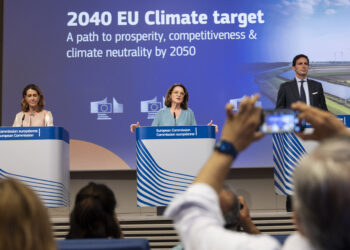



![Il ministro dei Trasporti, Matteo Salvini [Bruxelles, 5 dicembre 2024. Foto: Emanuele Bonini per Eunews]](https://www.eunews.it/wp-content/uploads/2024/12/salvini241205-120x86.jpeg)