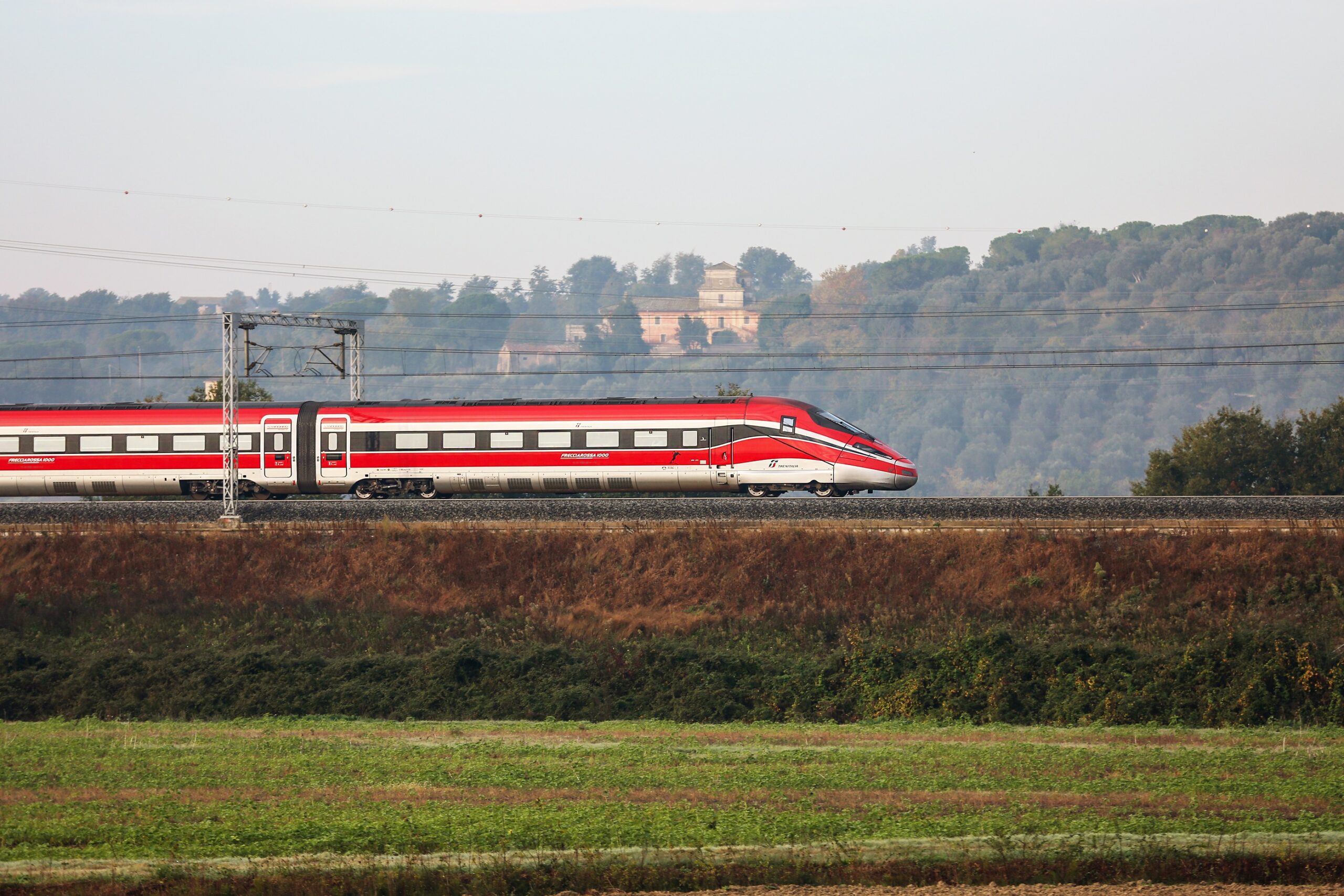

Brussels -Fewer regional trains and more high-speed trains (HST), upgrading the existing network to allow faster travel and more competitive integration. The European Commission aims to rethink rail mobility and relaunch it with a green, future-proof strategy. It does so through a communication — a non-legislative text — containing the ideas it shares with the Member States, from whom it asks for support, primarily financial, because the intentions are there, but the funding is lacking.
This is the most critical fact of a strategy that risks remaining an empty box. Building and modernizing the high-speed rail infrastructure requires “substantial long-term investment,” the EU executive itself acknowledges. The estimates indicate that completing the planned high-speed TEN-T network by 2040 will cost approximately EUR 345 billion, while a more ambitious network operating at very high speeds (well over 250 km/h) could cost up to EUR 546 billion by 2050. “Public funding alone will not be enough” to meet the huge investment needs, they warn in Brussels. EU funding will be needed to raise finance from other public and private sources; they will need loans and guarantees from financial institutions, such as the European Investment Bank (EIB) and national banks and promotional institutions.
In light of this, the Commission promises that it will “develop a funding strategy.” It ensures that it will “initiate a strategic dialogue with Member States’ financial institutions and other key stakeholders to close the investment gap,” aiming to achieve a “high-speed rail agreement” in 2026 with joint commitments to mobilize resources among all these actors. In short: a headline-grabbing announcement based on promises and good wishes.
https://www.eunews.it/en/2024/10/11/railway-companies-praise-von-der-leyens-high-speed-rail-plans/
A High-Speed EU: the Commission’s intentions
This is how Brussels conceives the EU traveling by rail by 2035: Rome-Munich in six hours instead of the current nine and a half (-3:30 hours), Berlin-Prague via Vienna in four and a half hours instead of today’s over eight hours, Madrid-Paris in six hours instead of nine and a half. To make all this possible, it is betting on a massive improvement of the infrastructure, in accordance with the suggestions contained in the Letta report and the need to strengthen the single market. First and foremost, the plan involves connecting the major nodes at speeds of 200 km/h or higher. The rest of the framework still has to be defined, but there is no shortage of ideas.
A financing strategy is needed and must be found; the Commission promises to return to this issue. By 2027, the aim is to eliminate all bottlenecks in networks between Member States. To attract private capital, the focus is on creating a “more attractive regulatory environment,” to be developed through simplification, state aid, or new legislation. Whatever the final option, the intention is to legislate in support of the rail revolution, which also involves promoting “a second-hand market for rolling stock,” the digital management of ticketing and railway traffic systems, and the strengthening of cross-border booking systems among Member States. Greater and better coordination among infrastructure operators will also be needed.

Executive vice-president Raffaele Fitto [Brussels, November 5, 2025]
It will take time, but the course is set. “High-speed rail is cohesion in action,” is the slogan used by Rafael Fitto, Executive Vice-President for Cohesion and Reforms, who is convinced that “improving travel times between capitals across Europe is a tangible and pragmatic result of our will to make Europe more united and more efficient.” A Europe on HST will “bring citizens closer together, make business easier throughout the EU, and contribute to what we call the ‘right to stay’.” Provided the EU knows how to find the resources that are still lacking.
The issue of tickets
High-speed trains are often associated with high fares. The European Commission believes this will no longer be the case, as an improvement in the service will lead to a downward adjustment of costs. In the meantime, a legislative proposal to amend the Regulation on Rail Passengers’ Rights is planned for early 2026, aimed at ensuring that passengers who purchase a ticket in a single transaction on a single platform are protected for the entire journey, regardless of the number of operators or countries involved, starting with guarantees, protections, and improvements to incentivise the use of HST and create a whole new demand.
English version by the Translation Service of Withub