Brussels – The objective is to increase investment in renewable and low-carbon fuels to make air and sea transport sustainable. The European Commission does not want to waste any more time and is launching a Sustainable Transport Investment Plan (STIP) that aims to take decisive action immediately. Negotiations on the multiannual budget proposal (MFF 2028-2034) have not even begun, and it promises to be very complicated. The plan is to mobilize the resources already available from the current common financial framework.
The European Commission intends to mobilise “at least EUR 2.9 billion” through EU instruments by 2027. Specifically, at least 2 billion will be allocated to sustainable alternative fuels under the InvestEU investment program; further 446 million will go to projects on synthetic aviation and maritime fuels under the Innovation Fund; and another EUR 133.5 million for research and innovation in the fuel sector through the EU Horizon Europe research program. Finally, EUR 300 million will be mobilised through the European Hydrogen Bank.
“STIP is not only decarbonisation, it is also energy security and industrial competitiveness,” emphasises the Commissioner for Transport, Apostolos Tzitzikostas. The problem, he explains, is that at present aviation and maritime transport “are sectors that are entirely dependent on fossil fuels” and investing in non-traditional solutions is not cost-effective. “Sustainable fuels currently cost 2 to 10 times more than conventional fuels, and investors are hesitant.”

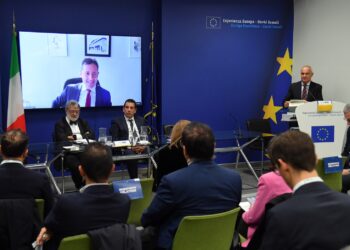
Transport Commissioner Apostolos Tzitzikostas [Brussels, November 5, 2025]
The EUR 2.9 billion strategy aims to shake all this up, “reduce the risks on the first investments” and induce private investors to overcome uncertainties, the transport commissioner emphasised again at a press conference. “We must act now,” with no more delay. The EU risks missing its sustainability targets set for 2040, as meeting the requirements of the RefuelEU Aviation and FuelEU Maritime strategies will require around 20 million tonnes of green fuels by 2035. However, “today we are not able to mobilise what we need to have them.” The von der Leyen Commission’s sustainable mobility agenda is an opportunity, especially for Italy, a leader in the production of synthetic fuels.
Tzitzikostas then wants to clear the field of doubts. The EU’s new political priorities, specifically support for the defence industry, will not affect this plan in any way. The Commission’s proposal on military mobility is expected in mid-November and “will not affect funding,” the Transport Commissioner said. There is no money to divert, and this is also meant as a message to private investors.
In addition to the EUR 2.9 billion spending plan for sustainable fuels up to 2027, the Commission, together with Member States, is preparing to launch an eSAF Early Movers Coalition pilot project for sustainable aviation fuels by the end of 2025, aiming to mobilize at least EUR 500 million for synthetic aviation fuel projects. The Commission will also work to strengthen the enabling conditions for market investments, aiming to close the investment gap. In the medium term, the Commission will work to establish a mechanism that connects fuel producers and buyers, providing revenue certainty and reducing investment risk.
English version by the Translation Service of Withub