
- Europe, like you've never read before -
Friday, 30 January 2026
No Result
View All Result
  • it ITA
  • en ENG
Eunews
  • Politics
  • World
  • Business
  • News
  • Defence
  • Net & Tech
  • Agrifood
  • Other sections
    • Culture
    • Diritti
    • Energy
    • Green Economy
    • Finance & Insurance
    • Industry & Markets
    • Media
    • Mobility & Logistics
    • Sports
  • Newsletter
  • European 2024
    Eunews
    • Politics
    • World
    • Business
    • News
    • Defence
    • Net & Tech
    • Agrifood
    • Other sections
      • Culture
      • Diritti
      • Energy
      • Green Economy
      • Finance & Insurance
      • Industry & Markets
      • Media
      • Mobility & Logistics
      • Sports
    No Result
    View All Result
    Eunews
    No Result
    View All Result

    Home » World politics » Von der Leyen puts forward three options to guarantee Ukraine 130 billion over next two years

    Von der Leyen puts forward three options to guarantee Ukraine 130 billion over next two years

    Bilateral subsidies, joint borrowing, or the use of frozen Russian assets. The latter is the alternative the Commission is banking on, the only one whose guarantees would not affect national budgets. But the Commission admits: "Potential knock-on effects, also for the financial markets"

    Simone De La Feld</a> <a class="social twitter" href="https://twitter.com/@SimoneDeLaFeld1" target="_blank">@SimoneDeLaFeld1</a> by Simone De La Feld @SimoneDeLaFeld1
    17 November 2025
    in World politics
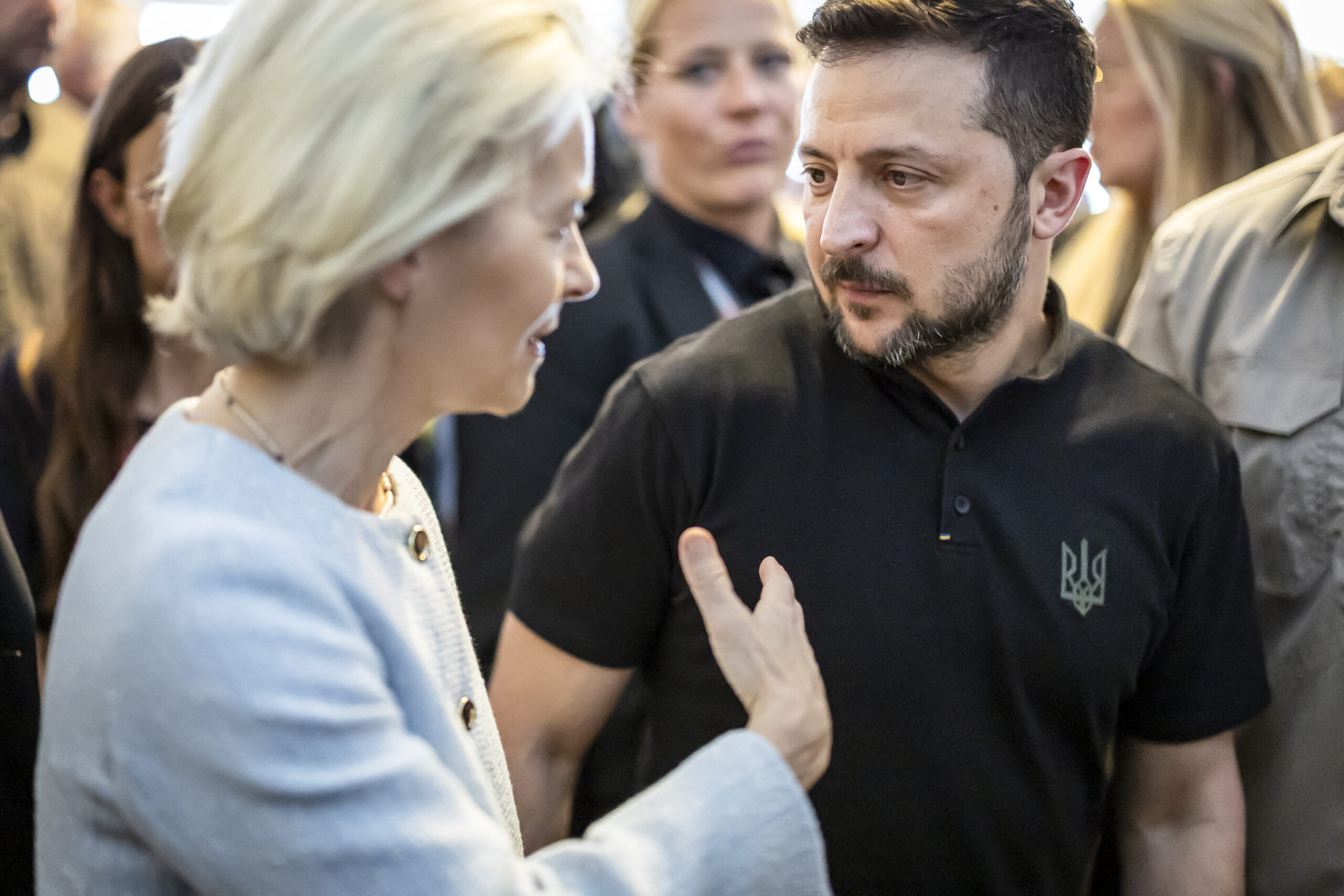
    President of the European Commission Ursula von der Leyen (L) speaks with Ukraine's President Volodymyr Zelensky during the Summit on peace in Ukraine, at the luxury Burgenstock resort, near Lucerne, on June 16, 2024. Dozens of countries meeting for a landmark international summit on peace in Ukraine agreed Sunday that Kyiv should enter dialogue with Russia on ending the war, while strongly supporting Ukraine's independence and territorial integrity. (Photo by MICHAEL BUHOLZER / POOL / AFP)

    President of the European Commission Ursula von der Leyen (L) speaks with Ukraine's President Volodymyr Zelensky during the Summit on peace in Ukraine, at the luxury Burgenstock resort, near Lucerne, on June 16, 2024. Dozens of countries meeting for a landmark international summit on peace in Ukraine agreed Sunday that Kyiv should enter dialogue with Russia on ending the war, while strongly supporting Ukraine's independence and territorial integrity. (Photo by MICHAEL BUHOLZER / POOL / AFP)

    Brussels – A month ago, the EU heads of state and government wavered in the face of Ukraine’s monstrous economic needs over the next two years and requested that the European Commission study a range of options to support it. Today (17 November), in a letter sent to the capitals, Ursula von der Leyen put forward three options. First, she met the Belgian Prime Minister, Bart De Wever, to try to convince him that the only way forward is to use the frozen assets (mostly in Belgium) of the Russian Central Bank. The only option that would not burden national budgets already compromised after three years of conflict.

    According to estimates of the International Monetary Fund—and assuming the end of the war by the end of 2026—Kyiv currently has to cover a gap of around €135.7 billion for the next two years. A gap that must be filled immediately, because Ukraine must be equipped to “fight tonight,” emphasised von der Leyen. In addition to being timely—the decision must be taken by the end of the year at the latest—the financial support should be “highly concessional”, given Ukraine’s “current debt sustainability situation,” flexible, and distributed fairly among member states and with international partners.

    The first option—the most straightforward—would involve the member states paying bilateral subsidies to the Union, which in turn would provide non-repayable support to Ukraine. An option—the Commission points out—that “does not entail new joint liabilities and does not require additional guarantees or compensation,” but that “has an immediate impact on the budgets of the Member States.” A minimum annual support target of €45 billion should be set, with the G7 partners contributing to finance the remaining needs. The respective impact for EU countries would be between 0.16 and 0.27 per cent of GDP per year.

    From the back, Ursula von der Leyen, together with EU heads of state and government at the European Council [photo: European Council]
    The alternative route is the tortuous one of resorting to joint debt. This second option would consist of the “granting by the Union of a loan with limited recourse, financed by the Union through borrowing on the financial markets,” as explained in the document sent to European chancelleries. A loan that Ukraine would repay only in the event of compensation from Russia, and which would be backed by “legally binding, unconditional, irrevocable and on-demand guarantees,” provided and distributed among the member states according to their Gross National Income (GNI). Capitals would have to pay back the interest and—”in the spirit of burden-sharing”—proportionately increase their contributions if any of the 27 decided to back out.

    Again, the interest to be paid by the Member States would “directly affect their deficit and debt.” Not to mention the guarantees themselves, which are also “likely” to burden national budgets. One way out would be for the loan to be guaranteed by the EU’s budgetary leeway, in which case “no such impact would be expected,” the Commission notes. To put €90 billion into the EU budget for the next two years, including related interest, it would be necessary to amend the Multiannual Financial Framework regulation, which currently “does not allow borrowing for a third country.”

    The barricades that several Member States would erect in the face of these two options make Brussels lean towards the third and last card, the ace up the sleeve, however risky it may be. It is a loan financed with Russian state assets frozen on European soil, amounting to over €200 billion. The option has been under consideration by the EU executive’s legal experts for months: the EU would enter into a compulsory debt contract with central securities depositories holding Russian assets frozen in “several member states” at zero interest, and then lend the cash to Ukraine in several tranches. Kyiv would repay the loan only once the war is over and Russia has paid reparations. Only then would Brussels in turn repay the financial institutions.

    Bart De Wever and Ursula von der Leyen at the Berlaymont building, headquarters of the European Commission, on 14 November 2025. (Photo by Nicolas TUCAT / AFP)(Photo by Nicolas TUCAT / AFP)

    It is a slippery slope; the EU would risk “repercussions” if the loan were “wrongly perceived by others as a confiscation.” Not only legally, but also economically: “One cannot exclude that there are potential knock-on effects, also for the financial markets,” von der Leyen again admitted, while reiterating that “the structure of this option guarantees full compliance with international law in all scenarios.”

    But above all, domestically, there is the strenuous opposition of Belgium, the country where Euroclear, the company that holds some 185 billion belonging to Moscow, is located and is already using the interest generated by these assets to support a separate €45 billion loan for Ukraine. The member states would ensure that the EU could repay Euroclear even without receiving any compensatory payments from Kyiv. “The exact scope of the risk coverage should be defined to ensure the necessary protection of exposed member states, as well as sufficient certainty for other member states providing voluntary guarantees,” the paper points out.

    In addition, “in view of the necessary solidarity among Member States, the guarantees may also have to cover the costs and financial consequences arising from arbitral awards or other judicial decisions or proceedings against a Member State arising from the freezing of Russian sovereign assets.” And the loan to Ukraine “should be designed in a manner that preserves the financial stability of financial institutions holding the fixed assets.”

    Von der Leyen, and with her almost all the member states—except those who are generally opposed to new financing for Ukraine—are hoping to chip away at Belgian resistance, because for many chancelleries the only viable option is to call on the resources of the Russian Central Bank. This is also because, unlike borrowing on the markets, the member states’ guarantees would in this case be considered “as contingent liabilities,” thus not affecting national debts.


    English version by the Translation Service of Withub
    Tags: asset congelatieuropean commissionmacro-financial assistancerussiaukraine

    Related Posts

    German Defence Minister Boris Pistorius (3rd R) and his counterparts from the Group of Five (GoF) Britain's Secretary of State for Defence John Healey (R), Poland's defence state secretary Pawel Zalewski (L), Italy's Minister of Defence Guido Crosetto (2nd L), European Union High Representative for Foreign Affairs and Security Policy Kaja Kallas (3rd L) and France's Minister of the Armed Forces and Veterans Affairs Catherine Vautrin (2nd R) address a press conference during a Group of Five (GoF) meeting at the German Defence Ministry in Berlin on November 14, 2025. (Photo by Odd ANDERSEN / AFP)
    Defence & Security

    The big five of European defence in Berlin. Kallas: “Attacks on Kyiv show that Putin does not want to negotiate”

    14 November 2025
    World politics

    Frozen Russian assets remain the preferred EU tool to support Kyiv amid corruption concerns

    13 November 2025
    Fondi congelati
    Business

    12 billion of Russian funds frozen in Europe belong to small investors who cannot get them back

    28 October 2025
    von der leyen consiglio nordico
    World politics

    Von der Leyen seeks backing on Russian assets at the Nordic Council, where Moscow is considered a real threat’

    28 October 2025
    Il presidente dell'Ucraina, Voldymyr Zelensky, con il presidente del Consiglio europeo, Antonio Costa [Bruxelles, 23 ottobre 2025. Foto: European Council]
    World politics

    Not just frozen Russian assets – leaders are asking for “support options” for Ukraine

    24 October 2025
    map visualization

    Compagnia delle Opere opens its first office in Brussels

    by Redazione eunewsit
    30 January 2026

    "A strategic step towards a deeper understanding of European policies and translating them into concrete opportunities for businesses and local...

    La Scala

    Precarious employment at La Scala: EU Court rules in favour of dancer without contract

    by Enrico Pascarella
    30 January 2026

    The use of temporary contracts for dancer Eliz Duygu was deemed abusive. The Court questions the limit on compensation provided...

    Abitazioni in bilico e carreggiate compromesse nell’area colpita dalla frana a Niscemi

    Cyclone Harry: Italy has three months to access EU Solidarity Fund. Brussels: “Ready to help”

    by Simone De La Feld @SimoneDeLaFeld1
    30 January 2026

    The procedure can take several months. For the floods in Emilia Romagna in 2023, the EU released €450 million after...

    [foto: Guillaume Baviere/WikimediaCommons]

    Cuba, the Commission fails to comment on Trump’s embargo: “No comment”

    by Emanuele Bonini emanuelebonini
    30 January 2026

    Although Kallas has expressed the need to end sanctions against the island, threats from the US president have led to...

    • Director’s Point of View
    • Letters to the Editor
    • Opinions
    • About us
    • Contacts
    • Privacy Policy
    • Cookie policy

    Eunews is a registered newspaper
    Press Register of the Court of Turin n° 27


    Copyright © 2025 - WITHUB S.p.a., Via Rubens 19 - 20148 Milan
    VAT number: 10067080969 - ROC registration number n.30628
    Fully paid-up share capital 50.000,00€


    No Result
    View All Result
    • it ITA
    • en ENG
    • Politics
    • Newsletter
    • World politics
    • Business
    • General News
    • Defence & Security
    • Net & Tech
    • Agrifood
    • Altre sezioni
      • European Agenda
      • Culture
      • Diritti
      • Energy
      • Green Economy
      • Gallery
      • Finance & Insurance
      • Industry & Markets
      • Letters to the Editor
      • Media
      • Mobility & Logistics
      • News
      • Opinions
      • Sports
    • Director's Point of View
    • L’Europa come non l’avete mai ascoltata
    • Draghi Report
    • Eventi
    • Eunews Newsletter

    No Result
    View All Result
    • it ITA
    • en ENG
    • Politics
    • Newsletter
    • World politics
    • Business
    • General News
    • Defence & Security
    • Net & Tech
    • Agrifood
    • Altre sezioni
      • European Agenda
      • Culture
      • Diritti
      • Energy
      • Green Economy
      • Gallery
      • Finance & Insurance
      • Industry & Markets
      • Letters to the Editor
      • Media
      • Mobility & Logistics
      • News
      • Opinions
      • Sports
    • Director's Point of View
    • L’Europa come non l’avete mai ascoltata
    • Draghi Report
    • Eventi
    • Eunews Newsletter

    Attention