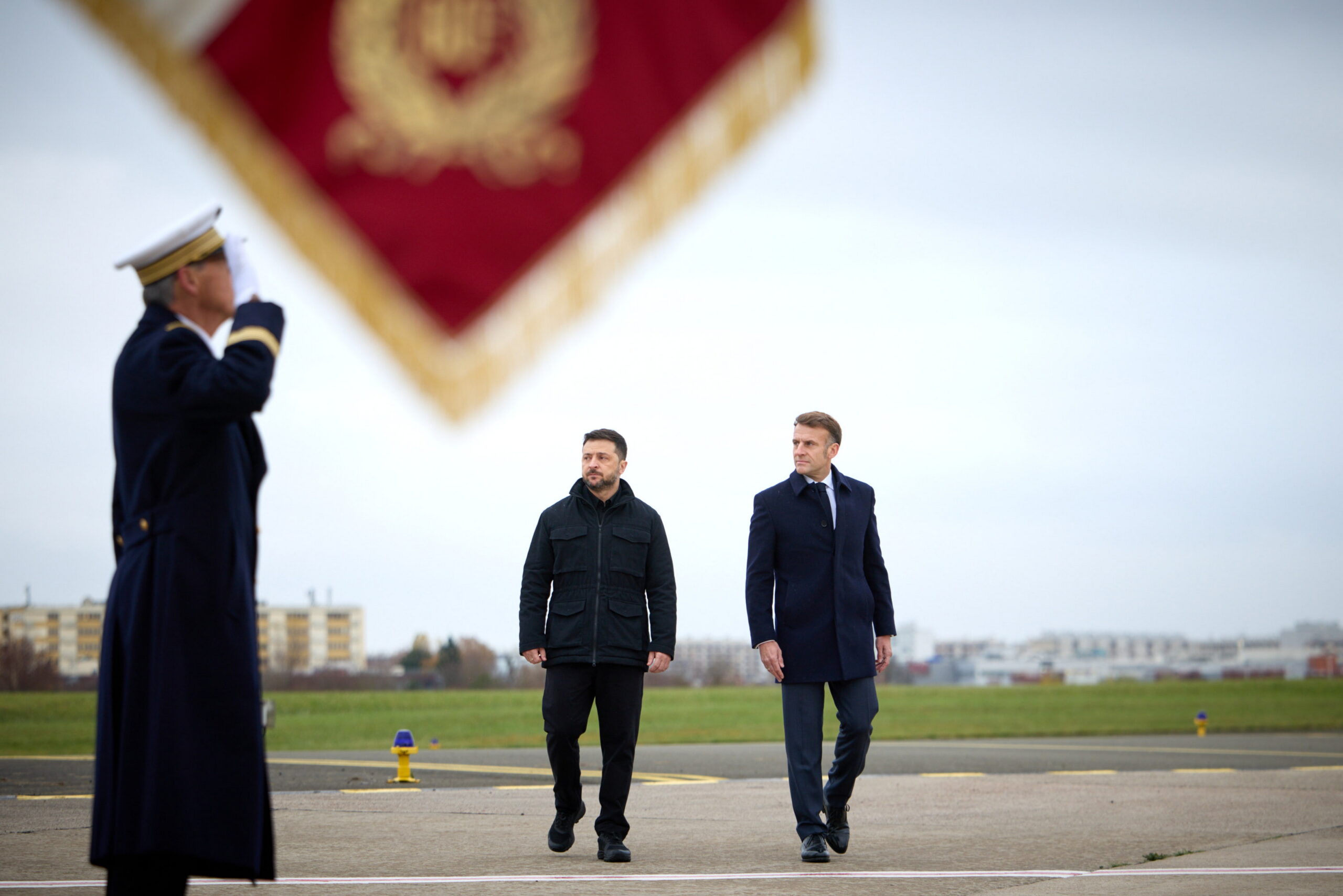
Brussels – The new European tour of Volodymyr Zelensky continues. Today (17 November), the Ukrainian president met with his French counterpart Emmanuel Macron to agree on a new defence cooperation between Kyiv and Paris, described as “historic” by both parties. The two leaders signed a memorandum of understanding to deliver 100 Rafale F4 fighter jets, the flagship French air force planes, to Ukraine by 2035.
In addition to the aircrafts, the agreements signed at the Villacoublay military airbase also provide for the supply of eight new-generation SAMP-T anti-aircraft systems still under development (a Franco-Italian production), drones, missiles, and radar equipment, as well as 55 locomotives. Unlike the fighter jets, the delivery of these products should start as early as by the end of this year.
In the afternoon, the two heads of state visited the headquarters of the “multinational force” to guarantee a potential truce in Ukraine, which was set up as part of the coalition of the willing under the Anglo-French umbrella. With this understanding, “we pass a new stage in the integration with the Ukrainian arms industry,” the host said during a joint press conference at the Elysée Palace, acknowledging the “difficult time” his host is facing at this stage of the war.
Grand jour.
Big day.
pic.twitter.com/YwfGV4d7Ii– Emmanuel Macron (@EmmanuelMacron)
November 17, 2025
“I hope we can achieve peace before 2027,” he added, stressing the need to “increase the pressure as we do through sanctions and the fight against Moscow’s ghost fleet.” Macron remarked that today’s agreements aim at the “regeneration of the Ukrainian army in the future,” so that it is “capable of deterring any new incursion” once hostilities end. “This is a historic agreement and we very much appreciate France’s support,” Zelensky remarked, speaking alongside him.
The difference with the Ukrainian leader’s previous visits is that, this time, the situation at home is particularly difficult. Militarily speaking, the Russian troops seem to be on the verge of taking Pokrovsk, a key junction for controlling the portion of the Donbass still in Kyiv’s hands. Moreover, the eventual capture of the city would allow Vladimir Putin to demonstrate to Donald Trump that the front line is far from stable, making it more difficult to argue for a ceasefire.
Domestically, Ukraine is shaken in these weeks by the biggest corruption scandal in years, which exploded following investigations by independent agencies that Zelensky himself had tried to remove from power last July.
At the time, the president’s move had sparked massive street protests and an unusual reprimand from Brussels. Now, disclosures of a potential $100 million illicit turnover have resulted in the firing of two top ministers in the government and the dismissal of a close associate of Zelensky.
After all, fighting corruption and protecting the rule of law are two key criteria for progressing towards EU membership. Zelensky acknowledged that the actions taken so far “are not sufficient,” promising to proceed with the necessary reforms. The tenant of the Elysée Palace said he was “confident” that his Ukrainian counterpart would continue these efforts, “in particular with regard to the rule of law, transparency, governance and the fight against corruption.”

Yesterday, on the first leg of his tour, Zelensky was in Athens. There, he struck a deal with Greek Prime Minister Kyriakos Mitsotakis to supply Ukraine with US liquefied natural gas (LNG), which arrives at Greek terminals via the Mediterranean. The agreement will be operational from next December until March 2026 and, according to the intentions of the contracting parties, will serve not only to shore up the supply to Kyiv (whose infrastructure is the target of daily Russian raids) but also to strengthen the energy security of the entire region, supplying also landlocked countries—and therefore more dependent on Moscow’s methane—such as Slovakia and Hungary.
Tomorrow, the Ukrainian president will be in Spain, where he will meet with Prime Minister Pedro Sánchez. Madrid has recently decided to participate in NATO’s PURL (Prioritised Ukraine Requirements List) programme, under which alliance members will purchase Star and Stripes weaponry to send to Kyiv.
Meanwhile, the EU-27 have recently approved the 19th sanctions package against the Kremlin. But they have not yet been able to square off on the 130 billion repair loan for Ukraine, which by the first quarter of 2026 will be one step away from default unless there is a liquidity injection from Western partners. The EU executive
is trying to convince the chancelleries to use frozen Russian assets to finance the disbursement, as the alternatives—a new joint debt issue or bilateral member-state contributions—are de facto impractical.
However, some countries are extremely reluctant to touch Moscow’s sovereign wealth funds, for fear of legal consequences, a concern also raised recently by the European Central Bank. Among the national governments, Belgium in particular, as the financial agency Euroclear, which holds the immobilised Russian assets, is based there. Premier Bart De Wever continues to call for strong risk-sharing measures should the Federation win an appeal in an international arbitration court. The December European Council should be the moment of truth.
English version by the Translation Service of Withub


![[Copyright: European Union]](https://www.eunews.it/wp-content/uploads/2026/10/euco-261015-120x86.png)