



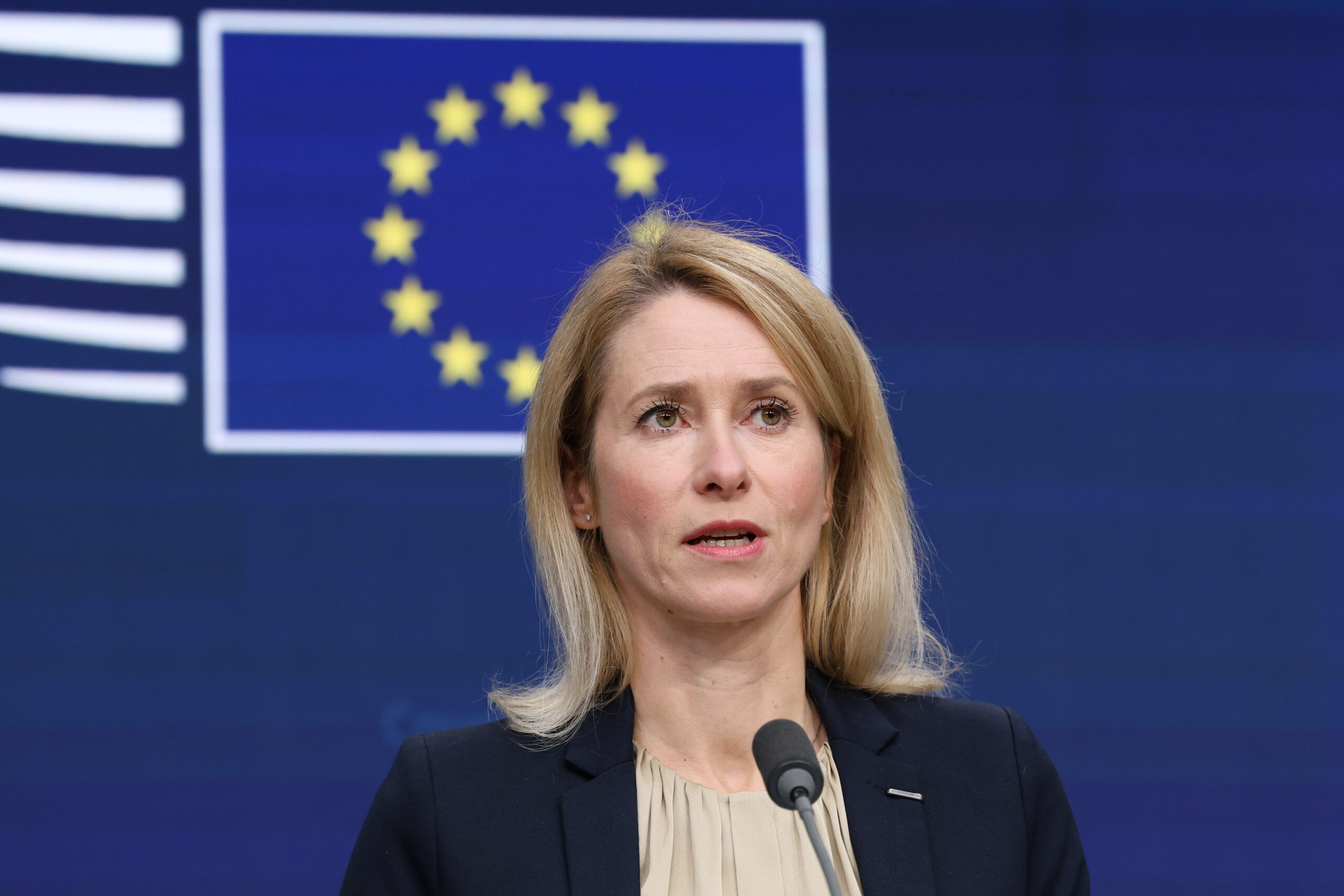
Brussels – The EU is not keen on being sidelined by the United States and Russia over negotiations to end the war in Ukraine. This is the message that the head of EU diplomacy, Kaja Kallas, had just finished addressing to his star and stripes ally, the day after the publication in the international media of a vague peace plan draft, which would be discussed bilaterally between Washington and Moscow. Only to be sensationally taken aback by Kyiv, which announced that it was in possession of the document and wanted to work on it with the White House.
“For any plan to succeed, it must be supported by Ukraine and Europe,” she told the press at the end of today’s Foreign Affairs Council (20 November). The High Representative emphasised that “our approach is focused” on new restrictive measures, in particular against the shadow fleet by which the Kremlin circumvents sanctions and exports its crude oil abroad.
According to yesterday’s reports, a 28-point peace plan was agreed in principle between two heavyweights of the US and Russian administrations: Steve Witkoff, the super-special envoy tasked by Donald Trump with solving all the world’s wars, from Ukraine to Iran via Gaza, and Kirill Dmitriev, an influential Kremlin advisor.
The details remain unclear, but some elements have emerged suggesting a relatively advantageous solution for Moscow. For example, there is mention of crucial territorial concessions by Kyiv. As a quid pro quo for stopping the aggression, the invader would get the entire area of the Donbass (the two oblasts of Doneck and Luhansk, rich in critical minerals and already almost completely in Russian hands), would retain control of the Crimea Peninsula and withdraw from the other two regions annexed by a sham referendum in September 2022, namely Kherson and Zaporizhzhia.

No freezing of the front on the current line of contact, therefore, while Ukraine would have to agree to diminish its army and renounce equipping itself with long-range weapons capable of striking across the border. Again, there would be talk of a reduction or discontinuation of US military assistance, just as any deployment of Western troops in Ukraine, as envisaged by the coalition of the willing, would be categorically ruled out. Kyiv should also recognise Russian as an official language and grant the Russian Orthodox Church formal status.
But as much as the former Estonian PM flaunted a serene firmness—if Moscow really wanted peace, he said, “it would have accepted the conditional ceasefire offered last March“—his words have gone awry within barely an hour. Shortly afterwards, in fact, Volodymyr Zelensky resoundingly disproved her, confirming that he had received the draft agreement from the US ambassador in Kyiv.
The Ukrainian president is said to have “highlighted the basic principles” on which Ukraine wants to focus the negotiations, declaring himself “ready now, as before, to work constructively with our American counterparts, as well as with our partners in Europe and the rest of the world, so that peace is achieved.” Kyiv and Washington are expected to discuss how to improve the proposal, and Zelensky could meet Trump as early as in the coming days. The Ukrainian leader had previously branded such demands from Vladimir Putin as inadmissible.
In Brussels, the High Representative had just described the atmosphere of today’s meeting as “calm” because everyone knows that “peace plans cannot work if Europeans and Ukrainians do not agree.” That is why, she had explained, the ministers were “focused on discussing what we are doing”: on sanctions which, she affirmed, had a “huge impact” on the Russian economy, but also on protecting critical infrastructure from “Russian-sponsored state terrorism,” referring to the recent sabotage on Polish railways.

The Union’s approach is based on two points: “weaken Russia and strengthen Ukraine,” Kallas repeated. It means not to let Kyiv lack the support it needs, both military and financial. The issue that has been on the table for months, in this regard, is the approximately €135 billion repair loan that Brussels would like to pay with the frozen Russian assets. A burning issue, on which the deal was off at the last summit in October, and on which the summit in December will again seek a balance. Yet, says Kallas, “we have not discussed financing” today, even though several chancelleries have stressed the “urgency to proceed” with the loan and overcome the reticence of some governments, Belgium in the lead.
The holder of the Farnesina, Antonio Tajani, is of the same opinion as Kallas. He reiterated that “Europe will have to be part of the negotiation,” not least because it will be necessary to discuss how to withdraw the sanctions imposed on the Federation. “When there is finally a chance to sit around a table, we will all work to achieve peace,” he added, recalling that “Ukraine represents a security barrier for Europe.” Indeed, he says, it will have to be Ukraine that decides on the territories now occupied by the Russians. On the issue of frozen Russian assets, Italy is in favour, but the deputy prime minister warns, “we need to identify the correct legal basis” because in such a context “mistakes cannot be made.”
His French counterpart, Jean-Noël Barrot, remarked that “peace cannot be a capitulation” for Kyiv, while the Polish Radosław Sikorski expressed the hope that “it is not the victim who is restricted in his ability to defend himself, but that the aggressive potential of the invader is limited.” Out of the chorus, as always, was the Hungarian voice: continuing to subsidise “a corrupt Ukrainian war mafia” would be unthinkable, said Péter Szijjártó, referring to the corruption scandal that exploded in Kyiv in recent days.
English version by the Translation Service of Withub




![Ilze Brands Kehris [foto: European Council]](https://www.eunews.it/wp-content/uploads/2026/10/ilze-120x86.png)
