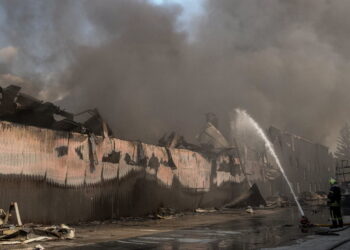
Bruxelles – As the Russian war in Ukraine enters its fourth winter, proposals for ending the conflict are multiplying in Geneva, where talks among Ukraine, the US and European states are focusing on the recently discussed plan negotiated by Washington with Russia. While the EU searches for frameworks that could help secure a just and lasting peace, US President Donald Trump has suggested that the conflict could be resolved by leaving much of the Donbas region under Russian control, even hinting at recognising Crimea as legally Russian.
These proposals have reignited debates over the country’s territorial integrity, also in Ukraine. Beyond the battlefield, another front has opened – one defined by institutions, treaties, and long- term commitments. Among the ideas gaining traction is that Ukraine’s membership of the European Union could itself serve as a key security guarantee in any future peace settlement.
But can a country join the EU while significant portions of its internationally recognised territory remain under foreign occupation? One often-overlooked precedent offers some guidance. Cyprus joined the Union in 2004 despite lacking control over the northern part of the island, providing both a model and a warning. Its accession shows that membership is possible even when a state’s territorial integrity is compromised, yet it also highlights the legal and political complexities that come with such a situation – complexities that Brussels and Kyiv will need to navigate carefully if EU accession is to play a meaningful role in securing Ukraine’s future.
Ukraine’s path to EU integration
For more than three years, Ukraine has officially been a candidate for EU membership. Yet the actual accession negotiations are still stalled, with the first cluster blocked by Budapest’s position. “Hungary does not support and will not support Ukraine’s EU membership, because it would bring war to Europe and send Hungarian money to Ukraine,” Hungarian Prime Minister Viktor Orbán said in some of his statements.
However, Russia’s war is unlikely to spread to the EU solely because of Ukraine’s accession. According to German intelligence, Moscow could be ready for a direct conflict with NATO members as early as 2029 – whether Ukraine joins the EU or not. Meanwhile, the European Commission emphasises that the war cannot block Ukraine’s EU accession.
Serhiy Solodky, director of the New Europe Center, confirms that Ukraine must do its “homework” to join the EU, but the territorial issue is not on the agenda. “The EU has set Ukraine a large package of reform work,” he recalls, stressing that “territorial integrity has never been mentioned as a precondition for membership.”
Yana Okhrimenko, senior economist at the Center for Economic Strategy, notes that the Ukrainian government does not tie EU accession to full de-occupation. “The political situation in the EU and the situation on the battlefield are too volatile for precise planning,” and, overall, responsible negotiators “are trying to stay ready for accession as soon as a window of opportunity opens,” she says.
And while negotiations with Russia are actively discussed in the media, most Ukrainians are not willing to make territorial concessions. According to an October 2025 survey by the Kyiv International Institute of Sociology, 54% of respondents are categorically against any territorial concessions, while 38% are ready to accept some territorial losses. As Okhrimenko emphasises, a dilemma between joining the EU and maintaining full territorial integrity “does not exist in public discourse at the moment.”
Can Cyprus be an example for Ukraine?
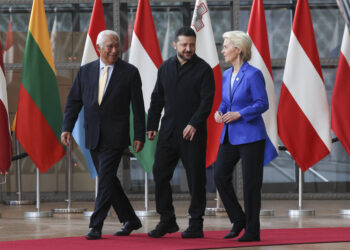
In the meantime – Hungary permitting – the European Union is preparing to begin accession negotiations with Kyiv. As a candidate country with an active war on its territory, Ukraine raises unprecedented questions about what accession under conflict looks like. EU membership is not simply a matter of economic integration or political alignment; it could also serve as a potential security guarantee in any future peace talks with Russia. Yet with Crimea and parts of Donbas under Russian occupation, Brussels faces the difficult challenge of reconciling enlargement with incomplete territorial control by a candidate state.
Cyprus offers both a precedent and a cautionary tale. Following the Turkish occupation of the northern part of the island in 1974, no diplomatic efforts at reunification have succeeded, even with EU accession. A referendum at the time failed due to opposition from the Greek Cypriot community, which ultimately joined the Union. The Turkish Republic of Northern Cyprus remains outside the EU, recognised only by Türkiye.
Denis Cenușa, associate expert at the Geopolitics and Security Studies Centre, points out that “since Cyprus joined the Union in 2004, the lack of territorial integrity has not posed any existential problem for the EU as a whole.” At the same time, he stresses that “it is very hard to call Cyprus a positive solution, but it was the only way for the EU to move forward.” Cyprus demonstrates that membership is possible despite territorial disputes, yet it remains an almost unique case.
For Ukraine, the situation is far more complex. The opposing party is Russia, a third state occupying its neighbour’s territory, not a candidate state with a frozen accession process like Türkiye. Moreover, the proximity of the threat turns Moscow into an existential concern for Eastern and Baltic EU members, making it a direct threat for the whole Union. The challenge for Kyiv and Brussels is clear: they must decide whether accession should wait for full territorial restoration or proceed alongside a roadmap for reintegration.
“When the EU granted candidate status to Ukraine, it made no distinction between regions controlled by Kyiv and those under Russian occupation,” Cenușa highlights. Meaning accession, whenever it occurs, will apply to
the country as a whole. If hostilities remain ongoing, “this would be unprecedented in the history of
enlargement,” and even the example of Cyprus cannot fully untangle the diplomatic knot.
The EU’s security guarantees for Ukraine
“The EU needs to supply arms and technologies in times of war and after it to make our army stronger, more technological, and more equipped. It’s also about money. Our economy is hardly damaged and we need a lot of time to recover, so the EU should pay for our army”, Mr. Bodgan Popov, Ukrainian political advisor, explains. “Another way to help would be through investment and joint venture in defense tech production”.
“There are discussions around the placement of some national armies military bases in Ukraine, but any military mission needs to have a coordinated mandate to join the battle if Russia attacks”. As Mr. Popov recalls, air and sea security is an important issue the EU needs to address soon. There are a lot of discussions around the SkyShield and the Drone walls initiatives, but they haven’t started yet. At the same time, the Black Sea security is essential to cover the Ukrainian export of grain.
According to Mr. Popov, nothing will change in terms of security guarantees if Ukraine becomes an EU Member State. “We already have security deals signed documents with more than 30 European countries, and we also have some regional alliances. But none of these alliances is forcing Member States to defend each other when one of them is under attack”. Article 222 of the Treaty on the Functioning of the EU commits the EU and its Member States to act jointly in a spirit of solidarity if a Member State is the victim of a terrorist attack or a natural or man-made disaster, but it can’t force States to defend each other in case of military aggression.
“So it’s more about military cooperation, defense tech development, reconnaissance, surveillance, and intelligence cooperation”.
This article was produced as part of the Thematic Networks of PULSE, a European initiative that supports transnational journalistic collaborations
Federico Baccini
Futura D’Aprile
Sofia Nazarenko




![Il ministro dei Trasporti, Matteo Salvini [Bruxelles, 5 dicembre 2024. Foto: Emanuele Bonini per Eunews]](https://www.eunews.it/wp-content/uploads/2024/12/salvini241205-120x86.jpeg)