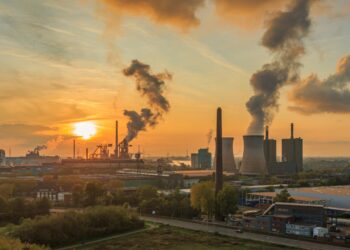
Brussels – The first (green) assessment of Chancellor Friedrich Merz is negative. The German think tank Agora Energiewende denounced the slower-than-expected pace of Germany’s green transition. In Europe’s largest economy, greenhouse gas emissions decreased just 1.5 percent compared to 2024. The decrease was less pronounced than in 2024, when they were reduced by 3 percent compared to the previous year, and less than in 2023, when they were down an 10 percent annually.
This underwhelming progress is attributed less to advances in renewable energies and more to Germany’s recent production downturn. The figures released today, 7 January, also cast doubt on the Federal Republic’s long-term goal of reducing its emissions by 65 percent compared to 1990 levels by 2030. As of today, the process is stuck at 49 percent, and it will be difficult to reach if the trend stays at fractions of a percent.
Merz’s backtracking
The news comes as no surprise. The Merz government has promoted a series of policies, both at home and in Europe, that could undermine the fight against climate change. The chancellor justifies these decisions as necessary to reduce the energy burden of German companies and households. Germany’s greenest faction points the finger primarily at Economics Minister, Katherina Reiche. The politician has a long career in the energy sector and, since the beginning of her term of office, has promoted the construction of new gas power plants.
Her decisions, admittedly, have not yet affected 2025 emissions, but things could be even worse in 2026. This year will see tenders for new gas‑fired power plants with a combined capacity of eight gigawatts (8 GW), well below the 20 GW Reiche wanted.
The good news
In a sub-optimal scenario, there are nevertheless positive signs. The Germans, who can partly serve as an example for the rest of Europe, bought more heat pumps than in the previous year (now outnumbering gas boilers) and more electric cars (which now account for one‑fifth of new registrations). Agora Energiewende’s director, Julia Bläsius, sees this increase as an opportunity to be seized: “The federal government should leverage this tailwind: by strengthening domestic demand – and with it also industry – Germany can catch up in climate-neutral technologies.”
On the topic of renewables, zero-impact energy production increased by 1 percent compared to 2024. The increase could have been higher, but the scarcity of wind penalised offshore power plants. On the other hand, the balance of solar energy was positive: for the first time, production surpassed that of coal, lignite, or gas power plants, becoming the second most important source of energy in the country after wind.
English version by the Translation Service of Withub

![[foto: wikimedia commons]](https://www.eunews.it/wp-content/uploads/2024/03/Renewable_Energy_on_the_Grid-350x250.jpg)


![Da sinistra: il presidente del Consiglio europeo, Antonio Costa; il presidente dell'Ucraina, Volodymir Zelensky: la presidente della Commissione europea, Ursula von der Leyen [Bruxelles, 18 giugno 2024. Foto: European Council]](https://www.eunews.it/wp-content/uploads/2026/06/euco_ua260618-120x86.jpg)
![[foto: Saverio De Giglio/imagoeconomica]](https://www.eunews.it/wp-content/uploads/2026/10/cpt-120x86.png)