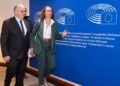
Brussels – Simplification and flexibility. These are the watchwords adopted by the European Commission in response to a world undergoing “continuous and profound change,” as reiterated by Raffaele Fitto, Executive Vice-President of the Commission responsible for Cohesion, in his message to Connact’s annual meeting in Brussels. A “valuable space for dialogue between institutions and the productive system,” which will “contribute to a stronger, more competitive European agenda that is closer to the territories,” Fitto stressed.
At the meeting, nearly 50 major Italian companies and associations, research centres, and third-sector organisations met with MEPs and representatives of European and national institutions in 13 thematic roundtables focusing on the priorities of the “Italian System” within the European agenda. Fitto’s institutional greetings, which closed the proceedings, were based on the awareness of a “profoundly changed and constantly changing context,” in which the EU is flying blind amid “armed conflicts on our doorstep, growing trade tensions, and increasingly intense global competition.”
Priorities have changed, and with them “the tools and methods of intervention.” Security and defence, but above all, the revival of the continent’s competitiveness. “It has been clear from the outset of this Commission that the status quo was not an option,” said Fitto. And so, Ursula von der Leyen’s second term revolves around two key words: “simplification to make the internal market more competitive,” and “flexibility to use resources more efficiently and effectively.”
Fitto claimed credit for the approval and implementation “in just one year” of the cohesion policy review, which has allowed Member States and Regions, since September, to redirect resources for the 2021–2027 cycle towards new strategic priorities. “Competitiveness, housing policy, defence, energy transition, water management,” listed the Executive Vice-President. A real “revolution for those who were resigned to having to spend resources on projects designed for the pre-war world in Ukraine.
The Commission has also broadened the scope of the Recovery and Resilience Facility, established after the COVID-19 pandemic and set to expire next summer. “We have worked to approve the revisions submitted by Member States with the aim of simplifying national plans,” insisted Fitto. The same approach now guides the proposal for the next multiannual financial framework, which will support the European Union’s action from 2028 to 2034. “It was no longer sustainable to maintain a rigid and immobile seven-year budget in a world that can change overnight, with global players capable of modifying strategies and interventions with very rapid decisions,” he stressed.
This is why the EU executive has proposed a “simpler, more flexible budget with fewer programmes,” which at the same time allows Member States to “choose the priorities on which to invest and to build their own national plans with a strong territorial dimension, because each territory has specific characteristics and its own productive vocation.” The “Italian System” has once again highlighted its priorities today, in the ideas, proposals, and concrete recommendations that emerged from the Connact thematic roundtables.
English version by the Translation Service of Withub