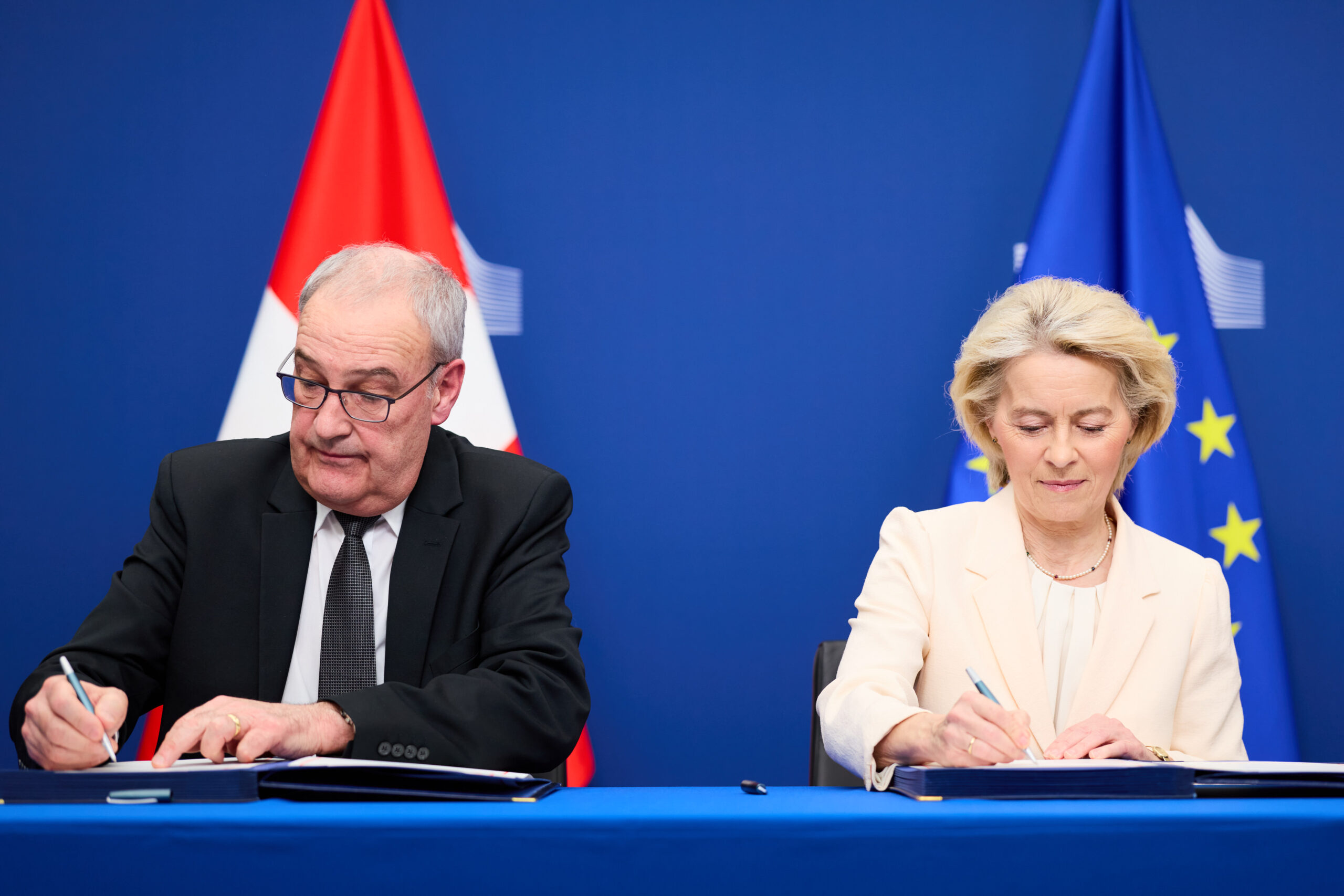

Brussels – “The European Union and Switzerland may be close geographically, but we are partners by choice.” With this statement, European Commission President Ursula von der Leyen announced a turning point in bilateral relations between the EU and the Swiss Confederation. Together with Swiss President Guy Parmelin, 18 agreements, protocols, and declarations were signed today (2 March) in Brussels to radically renew and modernise a partnership that has faced periods of profound uncertainty in recent years.
“The European Union is and will remain a reliable and predictable partner in an unstable global environment,” said the Commission President. The Swiss President echoed her sentiments: “Geopolitical upheavals, conflicts, tensions directly affecting the European continent, the closure of some countries to the outside world and the use of force by others, as well as changes in global trade relations, require a solid foundation.” Today’s signing is the culmination of an intense negotiation process, which resumed vigorously in March 2024 after an abrupt interruption in May 2021. At the time, the parties were unable to reach consensus on a single institutional agreement, risking the crystallisation of relations based on agreements made between 50 and 20 years ago, which are now inadequate to manage the modern challenges of the single market.
The negotiation phase that ended in December 2024 adopted a different approach: no longer a single framework agreement, but Switzerland’s association with a wide range of EU programmes. Back in November, Bern had already obtained the green light to participate in flagship initiatives such as Digital Europe, Erasmus Plus, and Horizon Europe, and last week, the favourable vote by the Council gave the go-ahead for the Commission to sign the agreement.
Von der Leyen emphasised that the top priority is the 1.5 million European citizens living in Switzerland and the approximately 450,000 Swiss citizens residing in the EU, as well as the hundreds of thousands of cross-border workers who cross the border every day. The new protocols finally provide greater clarity on crucial issues such as wages and residence permits, stabilising the daily lives of millions of individuals.

On the economic front, the agreement recognises that the economies of the two parties are intrinsically linked, with the EU remaining Switzerland’s main trading partner. Businesses, the other major priority of this agreement, will benefit from fair, transparent and predictable conditions, which are essential for promoting long-term investment.
Key sectors such as air and land transport will see deeper integration, but the real news concerns the electricity market. “We are bringing our electricity markets closer together, which will improve security of supply and contribute to greater price stability,” said von der Leyen. In addition, a common space for food safety has been established, with a single set of rules for producers on both sides, simplifying trade and ensuring high standards. Cooperation will also extend to cutting-edge sectors such as health research and space, which are key pillars for the future competitiveness of the entire European continent.
One of the most sensitive issues concerns “Buy European”, the principle of “preference for European purchases” that is gaining ground in Brussels, and how this principle will apply to countries in the European Economic Area and to the EU’s closest partners (such as the United Kingdom and Switzerland). The Industrial Accelerator Act (IAA), which the Commission will present in March, will impose minimum thresholds for content produced in Europe to access contracts and subsidies in strategic sectors (batteries, solar energy, defence). The fear in Bern is that Swiss industry could be damaged as a result. “There is no interest in excluding Switzerland,” von der Leyen reassured at a press conference, explaining that the IAA is intended to strengthen European competitiveness and that consideration of strategic partner countries is integral to the Commission’s vision.
However, EU officials have clarified that the agreements signed today are “profoundly different” from those governing the European Economic Area (EEA). It was a deliberate choice on the part of Swiss negotiators not to aim for such deep integration, in order to protect national specificities (such as the agricultural sector, where Bern requested and obtained an exemption from modernising the existing free trade agreement).
However, the process is not yet complete. President Parmelin pointed out that “today is not the end of the process,” as the implementing legislation will have to be reviewed by the Swiss Parliament. According to the Swiss president, it is very likely that the entire package will be put to a referendum, which officials expect to take place no later than 2028.
Regardless, EU officials maintain a firm stance: the agreement is considered a single, indivisible whole. Although Switzerland may decide internally to vote separately on individual issues (such as energy), Brussels has ratified it as a single, balanced package; a partial rejection in the referendum would open up uncertain scenarios as to how the European Council might react.
In the background looms the shadow of the “10 million” Swiss popular initiative, which aims to limit population growth and could jeopardise the free movement of persons. On this point, von der Leyen was categorical: free movement is a key and indispensable component of the package. The Commission is confident that Switzerland will continue to prove itself a reliable partner, capable of honouring its international obligations and continuing on this path of shared prosperity. “This initiative will have no direct effect on the EU-Switzerland package,” President Parmelin is keen to reiterate.
English version by the Translation Service of Withub