![[foto: European Council]](https://www.eunews.it/wp-content/uploads/2026/03/euco-260319.jpg)
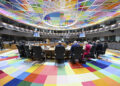
Brussels – The war in Iran is and remains a matter for the United States and Israel, from which the entire European Union is distancing itself. At a time when heads of state and government appear confused and divided over pressing issues such as Ukraine and measures to tackle the high energy prices caused by the conflict in the Middle East, the leaders nevertheless find unity on reiterating their opposition to participation in military operations. This is stated first and foremost by the Prime Minister of Belgium, Bart de Wever, who was among the first to arrive at the European Council headquarters for the meeting, and among the first to speak to the press: “Belgium has no intention whatsoever of becoming involved in this war,” he said bluntly.
A message for US President Donald Trump, who also faces the Dutch ‘nee.’ “The war in Iran was started by Israel and the United States; we must reduce tensions,” says Prime Minister Rob Jetten. Luxembourg’s Prime Minister, Luc Frieden, echoes the stance of the Benelux bloc, united in its refusal to get involved: “We did not start the war, we are not at war, and we do not want to be dragged into a war about which we have not even been consulted.”
Latvia is taking a slightly different, albeit cautious, approach. “We have not received any request; should a request come from NATO, we will consider it,” said Prime Minister Evika Silina, who, however, is far from wanting to intervene. Neither does French President Emmanuel Macron wish to intervene; indeed, he calls for diplomacy: “The fighting should cease for at least a few days to try to give negotiations another chance,” and thus bring the conflict to an end. The Spanish Prime Minister, Pedro Sánchez, is direct and unequivocal: “We are opposed to this war. The war in Iran is illegal.”
In short, the only possibility for European intervention in the Middle East is to manage the post-conflict situation, as German Chancellor Friedrich Merz makes clear: “We will be able to take concrete action only once the weapons have fallen silent,” he stated ahead of the European Council summit. In any case, for the Member States of the European Union to play a role, “an international mandate will also be required, which we do not currently have.”
Roberta Metsola, President of the European Parliament, also called to ease tensions. “We will continue to call for de-escalation. What has happened this morning and in the last few hours has a direct impact on the region and on Europe. Not only in terms of security, but also because of the rise in prices of the energy sources on which we depend. So we will continue to press this point and hope that a solution can be found,” she stressed.
EU leaders, therefore, have reached a consensus on saying ‘no’ to conflict in Iran, while acknowledging the repressive nature of the Ayatollahs’ regime. As a result, the common position of the 27 member states is set out by the EU’s High Representative for Foreign Affairs and Security Policy, Kaja Kallas: “Iran’s attacks on Qatar’s energy infrastructure are creating further chaos, and it is clear that we need a way out of this war, not an escalation.” Consequently, there will be no military support from the EU, as Israel and the United States would like—an option which, Kallas suggests, falls outside international law. She explains, “There is no legal basis” for such action, given that “the use of force is permitted in two cases: self-defence and a UN mandate, and neither of these applies.” Finally, she admits, “We do not know what the objective of the conflict is.”
English version by the Translation Service of Withub![[foto: European Council]](https://www.eunews.it/wp-content/uploads/2024/06/euco-strem-350x250.jpg)
!['Alta rappresentante per la politica estera e di sicurezza dell'UE, Kaja Kallas [Bruxelles, 16 marzo 2026]](https://www.eunews.it/wp-content/uploads/2026/03/kallas-260316-350x250.png)