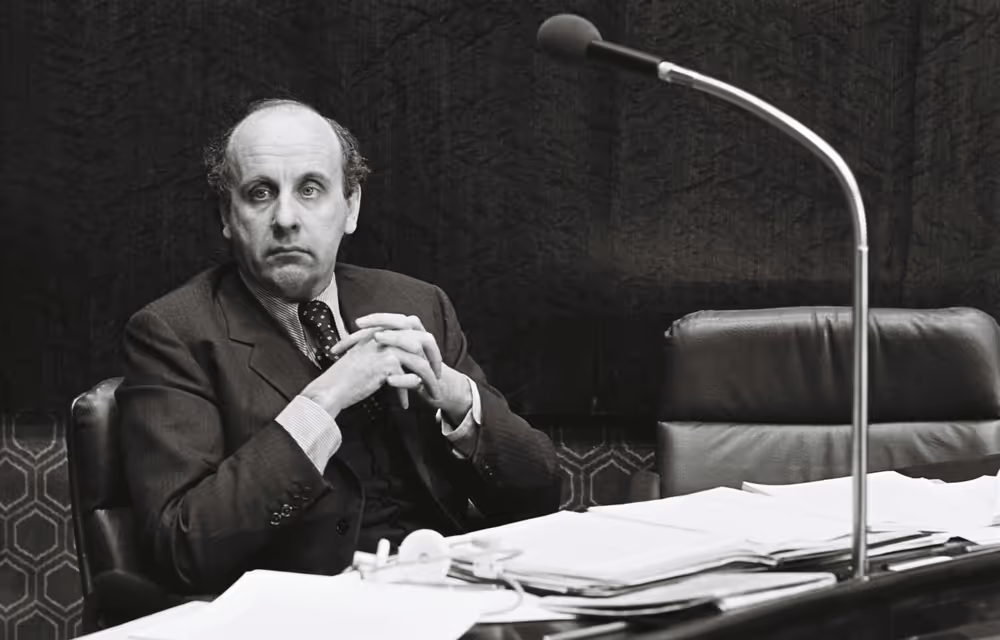

Last Friday, ten days later, as reported by the Belga news agency, the lawyer for Count Étienne Davignon, aged 93, quietly lodged an appeal against the indictment for alleged involvement in war crimes. By a curious twist of fate, on Friday, 17 March, the Brussels council chamber summoned him regarding his involvement in events described as war crimes. These events led to the killing, on 17 January 1961, of Patrice Lumumba, the Congo’s first Prime Minister, along with Maurice Mpolo, Minister of Youth and Sport, and Joseph Okito, Vice-President of the Senate—three leaders of a Congolese Republic that had been independent for only six months.
This follows a complaint filed 15 years ago, in 2011, by Lumumba’s children against ten Belgian citizens. Belga notes that the complaint targeted officials, police, and intelligence agents regarding war crimes linked to their father’s assassination. Étienne Davignon is the last survivor among the accused. He remarks: “Sixty-five years later. Suddenly, Belgium finds itself settling scores with its own past”. Belgium is also reckoning with one of the most prominent figures in its political, economic, and European history.
If one looks at the broader map of European power after the Second World War, “Stevie” or “Stevy” Davignon stands out as a dynastic grand commis. His family was already close to the court with political roles in 1830 at the founding of the Belgian state; his grandfather was Foreign Minister until the First World War, and his father was a diplomat in Budapest, where Étienne was born in 1932. He is one of the few figures who embodies this role with such precision and passion. A diplomat by training, a European commissioner by vocation, and a man of industry by necessity—more for the sake of Euro-Belgian capitalism than his own—Davignon has managed the relationship between Brussels institutions and the continent’s “exclusive circles” for over sixty years. He represents the genetic map of “how Europe sought to give itself a common industrial dimension in the face of the somewhat brutal challenges of globalisation”.
A rising star of European diplomacy
Davignon’s career began perfectly, as expected for an aristocratic scion. In 1959, he was a young diplomat in African Affairs at the Belgian Foreign Ministry. He was then posted to the Congo as a junior member of the task force working on its independence, as well as that of Burundi and Rwanda. This Congolese mission, which will now be the focus of the investigation, adds an unpredictable new facet to his biography. In 1961, it brought him directly into the inner circle of a giant like Paul-Henri Spaak, the powerful Belgian Foreign Minister known as “Mr Europe” and one of the founding fathers of the EU.
In this sociopolitical environment, steeped in aristocratic pragmatism, Stevie distinguished himself, steadily turning his CV into a glittering array of achievements. He acquired the ability to navigate the most complex geopolitical dossiers. Although his name does not appear in David Van Reybrouck’s monumental and meticulously researched book Congo, it was his role in managing the Congo crisis that gave the Viscount his definitive hallmark: a highly reliable official with great networking skills—a cultured, elegant, tenacious, and esteemed mediator.
He served as Chief of Staff to the Foreign Minister until 1969. However, the turning point came the following year when he became Political Director of the Foreign Ministry. He chaired the committee that drafted the Davignon Report, a pivotal document in Europe’s transformation. While the EEC was viewed as a technical-commercial agreement on coal and steel, Davignon offered a vision of Europe as a European Political Cooperation (EPC)—an informal forum to coordinate member states’ international positions outside formal community structures. The EPC was formalised in 1986 through the Single European Act, and it is the predecessor to today’s Common Foreign and Security Policy (CFSP) established by the Maastricht Treaty. Davignon understood that without a unified diplomatic voice, the single market might remain economically significant but politically irrelevant on the world stage—a view not unlike recent observations by Mario Draghi.
The plan that saved the European steel industry – for a while
Between the 1970s and 1980s, Davignon was perceived as Europe’s emergency problem-solver. In 1974, following the first oil crisis, he was appointed the first president of the newly formed International Energy Agency. Acting as a European counterpart to OPEC, he refined the art of negotiating with major producers and national governments, a style that became his personal brand. He served as a European Commissioner twice: first for the internal market, customs union, and industrial affairs (1977-81), and then as Vice-President of the Thorn Commission (1981-85) with the Energy portfolio. Twice he came close to the Commission presidency without ever securing it; the second time, in 1984, Jacques Delors was preferred.
His political-economic masterpiece was the industrial plan that bears his name, which allowed the European steel industry to survive for several decades. The “Davignon Plan” managed the impact of endemic overproduction and aggressive Asian competition within the EEC. With a blend of bureaucratic authority and smooth diplomacy, he convinced reluctant giants—such as Italy’s Italsider—to accept strict production quotas and painful cuts. It remains a paradigm of a community-wide industrial policy capable of imposing collective survival over national egoism. Though not universally loved, Stevie was respected for his courage and clarity.
First the clash with De Benedetti, and then the friendship with the Agnelli family
This track record served as a pass that led him into the private sector as a “bridge-builder” and a guarantor for major European “champions” still largely owned by industrial dynasties. Davignon also entered the upper echelons of the Italian industrial elite. In 1985, he left the Commission to join the heart of Belgian economic power: the Société Générale de Belgique (SGB). There, he clashed with one of the most divisive figures in Italian capitalism: Carlo De Benedetti. The Italian press was infatuated with “The Engineer”. Glossy magazines like Capital and major papers like Il Sole 24 Ore branded him a “global” entrepreneur and a raider capable of toppling old monopolies with electronics (Olivetti) and aggressive finance. A 1985 cover interview in Capital portrayed him as the ultimate winner, ready to devour Europe.
However, when De Benedetti launched a hostile takeover of SGB in 1988—which then controlled a third of the Belgian economy—he hit a wall: Davignon. De Benedetti had the audacity to arrive in the capital of master chocolatiers with a large box of fresh gianduiotti chocolates, handmade by Peyrano, Turin’s monarch of hazelnut flavours. It was a symbolic, perhaps slightly crude, clash. Ultimately, it was a clash of financial civilisations. De Benedetti represented the aggression of the “new wave,” finance that doesn’t ask permission. Davignon wielded the stubborn strength of relationships within the European establishment. Davignon famously remarked that while the Belgians might be slow, they knew how to count to 51 (per cent). De Benedetti was defeated. La Repubblica, then his “home” newspaper, which had previously headlined “De Benedetti buys a third of Belgium,” eventually acknowledged the defeat, framing it as a compromise that still yielded a profit.
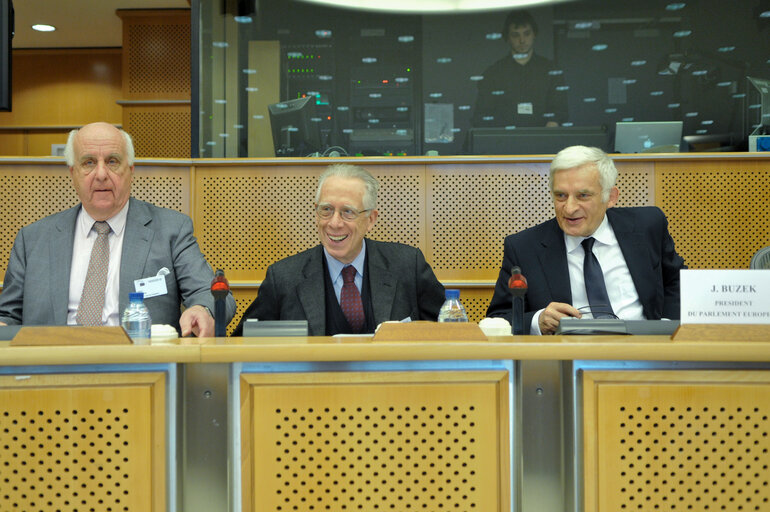
Giovanni Agnelli provided the final word: “Davignon may only be a Viscount, but he certainly knows how to count…”. And he recruited him for the long term. The Avvocato later shared, even privately, how impressed he was by how Davignon not only defended himself and Belgium but also orchestrated an economic and financial counter-manoeuvre involving the French “white knights” of Suez. De Benedetti’s “Waterloo” showed that in Europe, pure finance could not ignore political balances and consolidated trust-based relationships.
Consequently, for nearly twenty years, from 1988 into the 2000s, Davignon was an influential fixture on the Fiat SpA Board of Directors. His seat at the great table in the boardroom at Corso Marconi 10 (seventh floor) was not that of a mere technical advisor; he sat there with the authority of a plenipotenziary ambassador. 1992 was a turning point for European integration, marking the completion of the Single Market and the signing of the Maastricht Treaty. It was also the year of deregulation that saw a Japanese “invasion” of the automotive market. Agnelli sought to transform Fiat from a national giant into a “European champion,” and Davignon was the perfect guarantor. He could read between the lines of Brussels’ signals—and sometimes dictate their rewriting—before they became directives. The Viscount showed Turin how to navigate antitrust laws and state aid, providing strategic support that Fiat lobbyists then turned into effective tactics on the ground.
A relationship of deep professional esteem immediately formed between the grandson of the Princess of San Faustino (Agnelli) and the Belgian Viscount. Despite their aristocratic origins, they were sufficiently modernised to see themselves as part of the future, belonging to the new post-war aristocracy: a transatlantic elite that viewed industry as a tool for geopolitical stability.
Young John’s mentor
Davignon’s role was crucial during Fiat’s most critical period in the early 2000s, marked by the deaths of both Gianni and Umberto Agnelli in quick succession. A series of relentless illnesses dictated the future. The designated heir, Giovanni Alberto (“Giovannino”), Umberto’s son, had died in 1997 at 33. Edoardo, Giovanni’s son, died by suicide in 2000. In the ensuing power vacuum, with Fiat seen by markets as “the sick man of Europe,” Davignon acted as a mentor and provided international protection for the young John Elkann, who was appointed to lead the Group while only in his early twenties. Following Umberto Agnelli’s death in 2004, “Jacky” (John) gradually took the reins of the dynasty. Davignon acted as a guarantor of family continuity with European institutions and major foreign financial groups. His masterpiece was accrediting Elkann within global power circles. As Chairman of the Bilderberg Group (1998-2011), Davignon introduced John to the Steering Committee, providing the “diplomatic passport” necessary for his personal and corporate consolidation.
“Stevie” was also fundamental in 2005 for the success of the complex “Convertendo” loan. While banks threatened to seize control of Fiat from the Agnelli family, Davignon provided the credibility needed for the equity swap operation. Without his subtle but powerful backing, that manoeuvre—which allowed IFIL (now Exor) to retain control—would have been dismissed as a mere financial trick. Davignon ensured that while it was a family consolidation, it was also a solid industrial project backed by the partnership between Elkann and Sergio Marchionne.
Davignon’s soft power also extends to informal diplomacy; he dominated the Bilderberg Group for decades, transforming it from a discussion forum into a refined clearinghouse between regulated European capitalism and unrestricted American liberalism. He managed this with discretion, maintaining a solid, invisible consensus among elites. “In Italy, this meant the growth of a technical ruling class, from Mario Monti to the heads of major state-owned companies,” says a retired banker.
A different season
Today, Étienne Davignon’s career testifies to an era when politics and economy were interdependent and managed by a small, co-opted elite. His detractors see his actions as conservative protectionism for “exclusive circles,” while his admirers call him the true father of European economic integration. At 93, he is a living monument to the “complexity of power,” having demonstrated that true influence stems from loyalty to the State and Europe, the ability to unite diverging interests, and the wisdom to guide generational transitions.
He was the “midwife” at the birth of the AUME (Association for the Monetary Union of Europe) in 1987. This lobby of European multinationals promoted a single currency. Fiat, with both Agnelli brothers, was a key member alongside Philips, Solvay, and others. Giovanni Agnelli was a leading board member and a spokesperson for the project to international finance. Under Davignon’s leadership, AUME championed the ECU and convinced markets of the single currency’s feasibility long before the “Whatever it takes” era.
The Masterpiece
However, Davignon’s true masterpiece was the creation of the ERT (European Roundtable of Industrialists), based on an idea by Pehr Gyllenhammar (then CEO of Volvo). This exclusive club aimed to fight “euro-sclerosis” and push for the Single Market, playing a decisive role in the 1986 Single European Act. Again, Stevie gave the Agnelli brothers a leading role. Giovanni is considered a founding father, while Umberto was a protagonist in the preliminaries that led to its 1983 inaugural meeting. Davignon was the screenwriter and director. In 1982, while still a Commissioner, he personally recruited the original members.
Davignon later ushered John Elkann into the ERT; Jacky remains a member today, sitting on the Executive Committee. He represents Stellantis and Exor, focusing on competitiveness and innovation. Following in his grandfather’s footsteps and Davignon’s “user instructions,” Elkann uses the ERT for “industrial diplomacy”. Similarly, Elkann participates in Bilderberg as a permanent member of the Steering Committee. He serves as the head of the Italian delegation and uses the forum to coordinate his group’s interests with US and EU foreign and economic policy.
The count is now visibly annoyed
But how will the indictment end? The Count—elevated to this rank by King Baudouin in 1993—is “visibly annoyed”. His lawyer, Johan Verbist, has confirmed the appeal. In preliminary hearings (January 2026), the defence argued that the “reasonable time” for trial had passed, tacitly invoking the statute of limitations—which does not apply to war crimes.
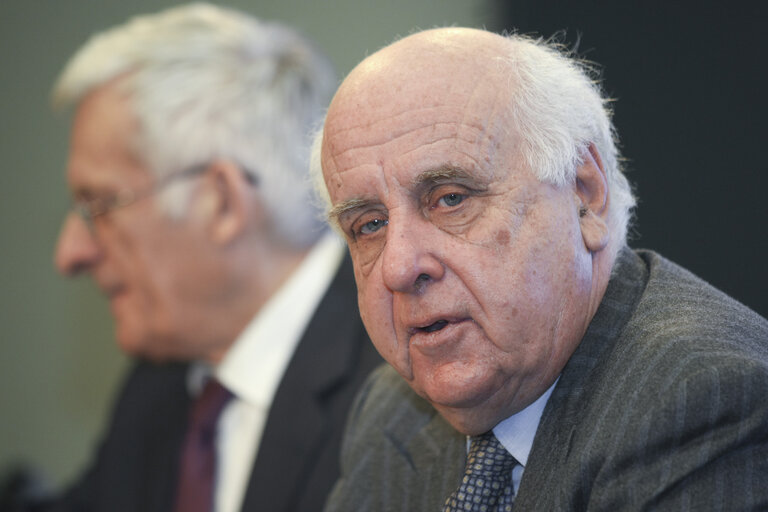
Davignon denies complicity in the murder of Lumumba and the other leaders. For Lumumba’s family, the decision is the start of a long-awaited reckoning. The trial is set for January 2027, when Davignon will be 94.
Many in Brussels suggest the matter might end without a verdict due to “natural causes,” which would turn a possible conviction into a “moral victory” for the family. Belgium admitted “moral responsibility” in 2001, but proving individual criminal responsibility remains difficult due to fragmented documents and the death of all other witnesses. In 2026, the ghost of Patrice Lumumba remains a divisive figure in Belgium’s reckoning with its colonial past.
English version by the Translation Service of Withub