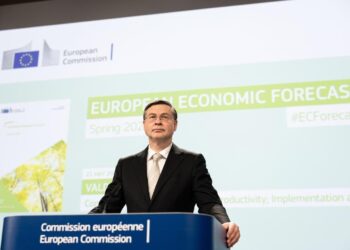
Brussels – It’s all the war’s fault. And the left’s. If things aren’t going well, it’s because of external factors – all negative – and internal factors that are both obstructive and counterproductive. The Commissioner for the Economy, Valdis Dombrovskis, has chosen an audience from the Czech Republic’s industrialists’ association to rally businesses in support of the European Commission in the fight against parties other than the centre-right. He is asked what he would expect from the business world regarding the EU’s competitiveness agenda, and it is in answering this question that a new rift emerges between the European People’s Party (EPP), which Dombrovskis represents, and the Socialists (S&D).
“I believe it is essential to be active, to make one’s voice heard, because when we discuss, for example, a simplification programme, there is momentum, a drive, but we must be aware that there is also resistance,” the Commissioner for the Economy replies. “If we talk about this with the left of the political spectrum, it’s not that simple.” Therefore, “it is important that the business community strongly supports the importance of the simplification programme.“
It was the opening for a jab at his left‑wing allies, in support of an agenda Dombrovskis proudly defends. He points out that, during 2025 alone, the Commission, of which he is a member, produced 10 regulatory simplification proposals worth “€15 billion in annual savings” for businesses. He points out that a further three omnibus simplification packages are planned for 2026, covering energy products, taxation, and reducing burdens on citizens. The first two packages are due to be presented on 24 June.
“Entrepreneurs across Europe, unite!” seems to be the Commissioner’s message, as he chooses to sideline all other citizens. It is the left that is holding back change and the drive for competitiveness, Dombrovskis argues.
The war in Iran and the closure of the Strait of Hormuz are also weighing on the situation. “We can count on external growth factors,” but Dombrovskis warns that, given the conflict and its repercussions, “we expect weaker demand for our exporters.” For this situation, the EU executive has blamed the governments of the United States and Israel, both led by conservative and far-right forces. All the more reason why Dombrovskis’s words sound curious, even as the Commission seems to have entered a new season of unorthodoxy, as shown by the election‑style rally it allowed the Hungarian prime minister to deliver from the Commission’s own podium.
Either way, with exports losing steam, the domestic economy needs a stronger push. “The closure of the Strait of Hormuz has an impact on competitiveness, which is why we are pressing this point.” In short, it is time to speed things up. But without neglecting the reforms that are needed. This last point relates to those who note that countries without a single currency seem to have better growth trends than those using the euro. “The euro can help with economic development, but it cannot replace sustainable public finances and a business-friendly environment,” Dombrovskis warns in conclusion.
English version by the Translation Service of Withub