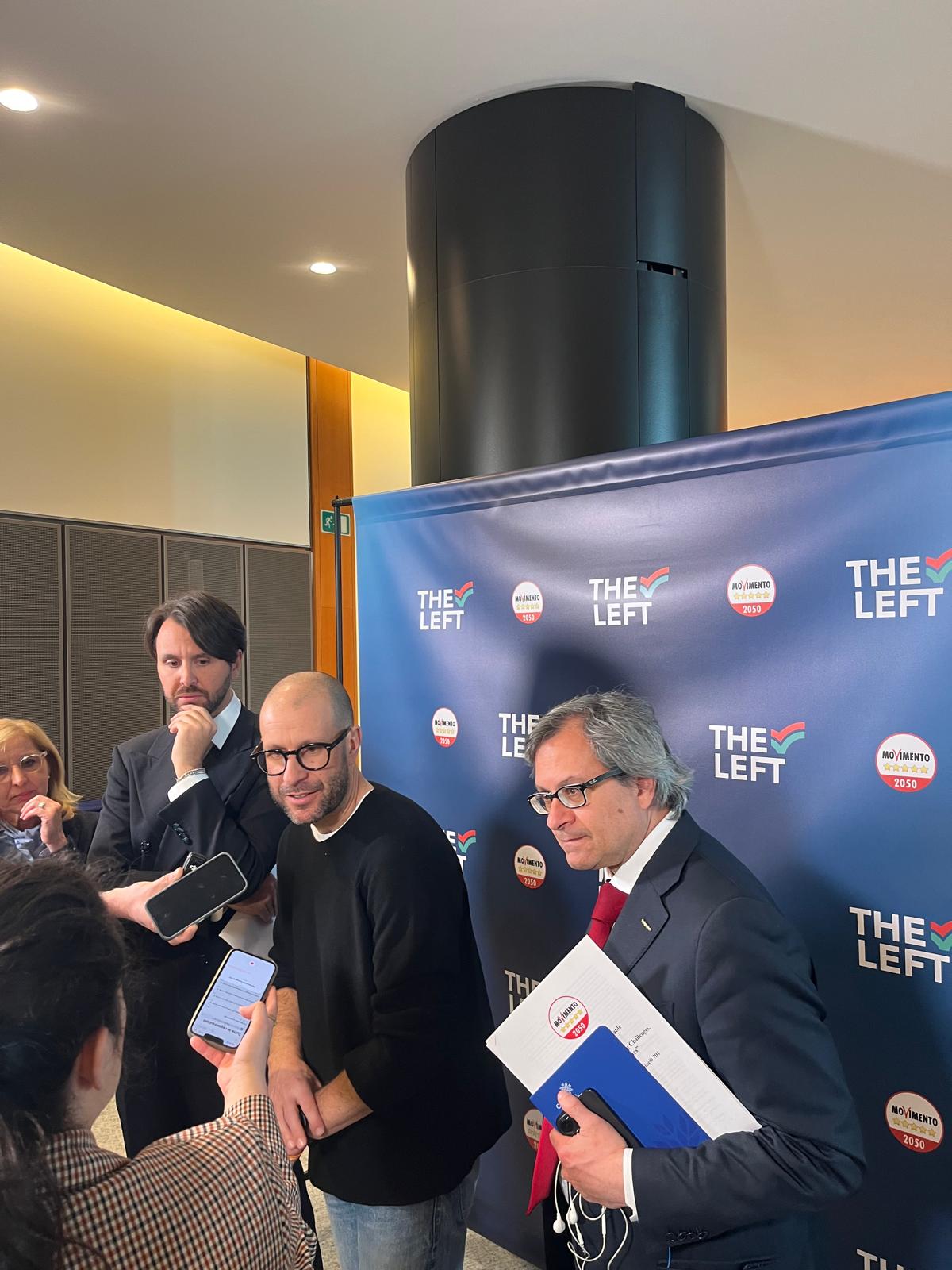
Brussels – “Artificial intelligence is a great opportunity, but it must be regulated and monitored to ensure it does not develop in a way that undermines freedom of information and pluralism.” With these words, Mario Furore (The Left), MEP for the Five Star Movement, opened the conference “AI and information: a possible alliance?“, organised today (22 April) at the European Parliament together with his party colleague, Gaetano Pedullà. With the aim of “initiating an in-depth reflection on the impact of AI on the media and information sector”, the discussion focused primarily on the increasingly widespread habit of obtaining information directly via AI platforms and on the economic risks this poses for the media sector.
This trend has gained significant momentum since 2024, the year in which Google began the gradual rollout of the new “AI Overviews” feature, which is now available on the computers of all European citizens. This is a mechanism whereby, when a user searches for an explanation on a specific topic, the search engine provides a summary of the key information, generated by artificial intelligence, placed directly at the top of the results page. The implications for newspapers and online news sites are clear: people tend to be satisfied with AI-generated summaries, and traffic to news pages is declining. According to figures provided by the two Five Star Movement MEPs, “several publishers are already seeing a reduction of up to 30 per cent in clicks to external sources from search engines.”
According to Pedullà—who worked as a journalist before being elected to the European Parliament—now is the time to tackle these issues, given that “the EU has embarked on a new phase of regulation regarding artificial intelligence,” with the start of the process to amend the AI Act by the European Commission in November last year. If effective action is not taken, added the M5S MEP, “the risk is of creating a Wild West that would place the awareness and knowledge of citizens in great difficulty, as well as the very resilience and existence of democracy.”
The risks of failing to regulate the relationship between the media and AI platforms were highlighted by the president of the National Federation of the Italian Press (FNSI), Alessandra Costante. Speaking at today’s event, the representative of the journalists’ union emphasised that “at this moment, all Italian media outlets are losing contacts because of Google Overview.” “The consequence of all this is an impoverishment of the information system and of our country’s democratic life itself,” added Costante, before noting that “precisely because of this impoverishment, Italian journalists are facing enormous difficulties in having their employment contracts renewed.”
The recent “incursion” of AI into the media world is having the greatest impact on so-called “fully digital” media outlets, i.e. news organisations operating exclusively online. This was reported by the editor-in-chief of Fanpage.it, Francesco Cancellato. “Our business model is based on clicks and user traffic: it is clear that systems such as Google Overview could throw it into crisis.” Cancellato sought to draw particular attention to the risks for independent publishing: “A publishing sector,” he explained, “that is not a secondary product of entrepreneurs who have other businesses and can afford to invest in a loss-making sector, but which instead aims to have informing the public as its core business.” “If this sector is lost,” warned Cancellato, “it will be very difficult to rebuild it.”
“The M5S MEPs on the European Parliament’s Committees on Justice and Culture will continue to work on the artificial intelligence dossier, with a view to making adjustments and influencing the Commission’s policy-making,” Furore assured at the end of the event.
English version by the Translation Service of Withub