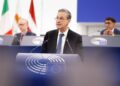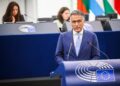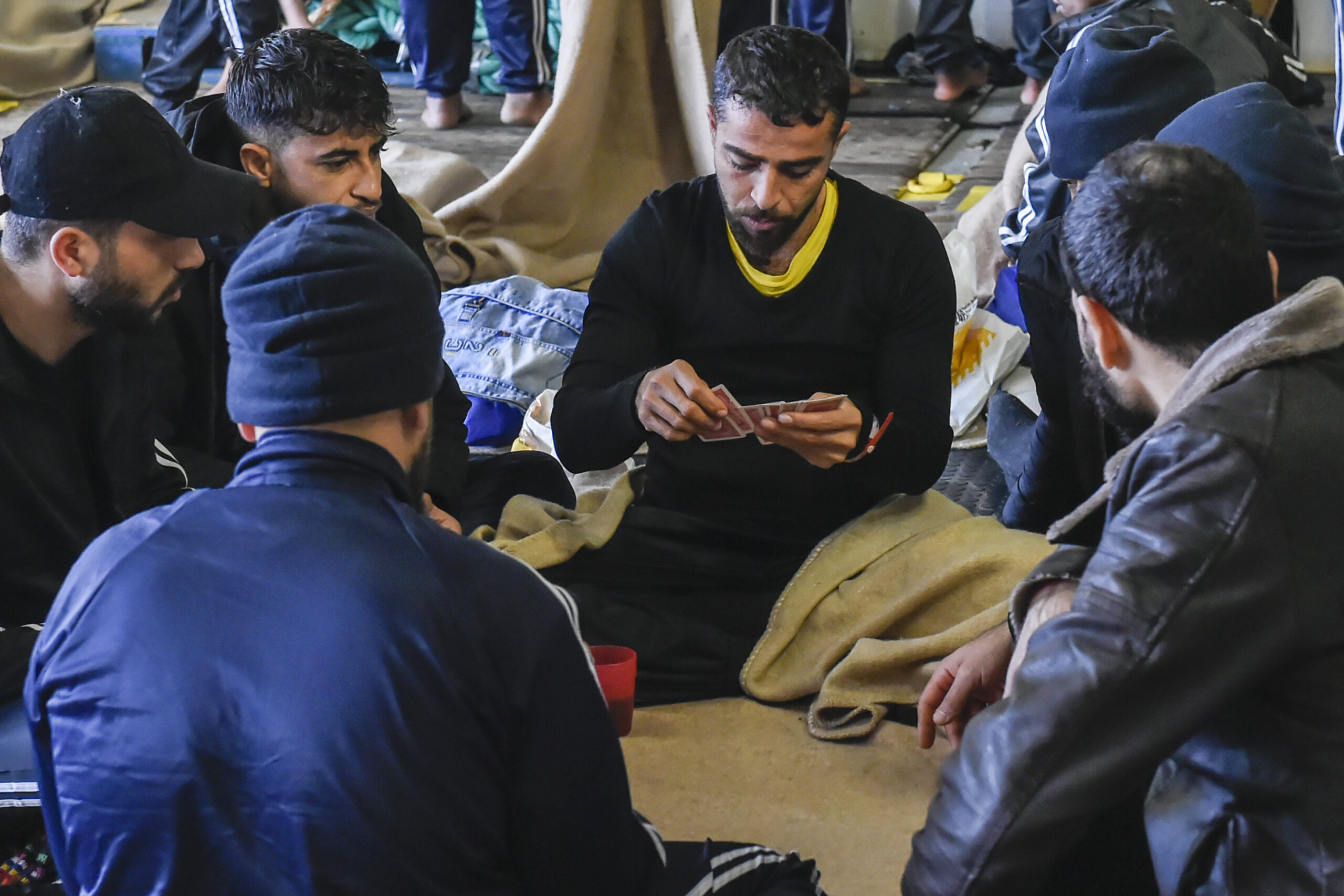
Brussels – “People are cut off from their families and deprived of their freedom only to be sold at auction like slaves, like animals, like commodities. I am here before you to cry out for you to stop everything that women are subjected to in prisons: they are raped, others die due to medical negligence, and there are children who are starving.” These are the words of Rose Chabatsuchi-Toua, a survivor of Libyan detention centres, who today (22 April) opened the presentation of the report “Women State Trafficking: Gendered Violence at the Tunisia-Libya Border“ at the European Parliament in Brussels. The event, organised by MEPs Ilaria Salis (Green-Left Alliance in the European Left Group), Cecilia Strada (PD MEP, S&D Group), and Leoluca Orlando (independent in the Greens/EFA Group), brought to the attention of the European institutions a new investigation into the systematic violation of the human rights of migrants along the Tunisia-Libya route.
The document is a follow-up to an initial investigation published in January 2025 and confirms the existence of a veritable “state-sponsored trafficking network”. At the heart of the investigation lies the logistics chain managed by Tunisian security forces, who intercept, arrest, and subsequently sell migrants and refugees to armed groups and Libyan authorities in exchange for money, fuel, or drugs. More specifically, through victims’ testimonies, the report explores the five stages of a logistics chain that has become integrated and refined, partly as a result of agreements between the EU and Tunisia: the arrest of migrants; their transport to the Tunisian-Libyan border; the role of detention camps run by the Tunisian military; the forced transfer and sale of migrants to the Libyan armed forces and militias; the detention of migrants in Libyan prisons until a ransom is paid and they are released.
The report is the result of work carried out by the international research group RR[X], which has chosen to operate anonymously to protect the safety of its researchers and local collaborators in repressive environments, with the support of ASGI (Association for Legal Studies on Immigration), the research agency on violence at borders, Border Forensics, and the research and analysis platform, On Borders. The investigation is based on 33 new interviews conducted between December 2024 and February 2026, in addition to the 30 already documented in the previous report. These accounts have made it possible to estimate that, between June 2023 and December 2025, approximately 7,400 people fell victim to this trafficking, a figure considered to be an underestimate as it refers only to operations documented directly. The report identifies key hubs such as the Tunisian barracks at El Meguissem, used as a hub for trafficking, and the Libyan prisons at Al Assah and Characharah, where victims are subjected to extortion and slavery. For women, the fate is often forced prostitution, used as the sole means of “paying off the debt” owed to the traffickers.
The appeal to the European institutions
“It must be emphasised,” the report states, “that this logistics chain for the supply of trafficked men and women, for the export and import of slaves, is also the product of the enormous amount of resources channelled by European policies of border externalisation into the state apparatus in Tunisia and Libya, triggering a new migration economy no longer centred on the combination of corruption and laissez-passer, but on the flexible and potentially reversible blocking of departures.” The report, therefore, raises the crucial issue of the political and financial responsibility of the European Union: it highlights how the Memorandum of Understanding of 2023 has encouraged practices of interception and arbitrary arrests that serve as the initial stage for the subsequent trafficking of human beings. Finally, the document strongly criticises the European Parliament’s recent decision to include Tunisia on the list of “safe countries of origin”, describing it as a “responsibility of the European Union and individual member states for exposing people on the move to death and slavery.”
MEPs speak out: “A failure of European principles”
According to Ilaria Salis, “what emerges is not a series of isolated incidents, but a system of human trafficking, an organised chain of capture, deportation and trafficking of human beings across the border between Tunisia and Libya, which affects women in particular, exposing them to systematic violence, rape, and exploitation.” For the MEP, the report marks a point of no return: “After its publication, no one will be able to say ‘I didn’t know’.” Salis then concluded with a stern warning: “Do not make this a question of migration, but a failure of the basic principles of humanity and justice.”
The sharp criticism regarding financial accountability came from Cecilia Strada, who called on Europe to fulfil its duty of transparency towards its taxpayers: “It is time for Europe to look its citizens—European citizens—in the eye and tell them: ‘Yes, we are using your taxes to support this kind of atrocity‘.” According to Strada, if the European Union agrees to become a mere trading zone for “packages” whilst ignoring fundamental rights, it simply ceases to be the EU.
Finally, Leoluca Orlando pointed the finger at complicit silence and the political origins of what is happening, identifying the externalisation of borders as “the basis for the commission of crimes.” It was a call for immediate action: “We must make it clear that it is now impossible to accept the silence of the Union and its Member States. I believe a response is necessary: we cannot go ahead with this agreement with Tunisia and Libya.” Orlando then concluded with a warning similar to Strada’s regarding the fate of the EU project: “I think we are destroying the European idea of rights.”
The report concludes with urgent recommendations sent to the European Commission, including the establishment of humanitarian corridors for the evacuation of witnesses still in danger, the immediate suspension of funding for the border guards involved and the launch of an independent international investigation to locate the mass graves reported by survivors along the border.
English version by the Translation Service of Withub