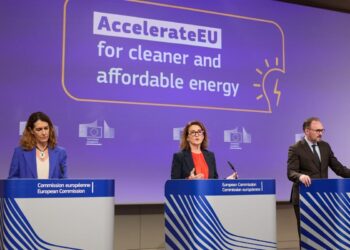
Brussels – To counter the energy instability fuelled by the conflict in the Middle East and tensions in the Strait of Hormuz, the European Commission presented the AccelerateEU plan today, 22 April, focusing on the continent’s energy sovereignty through massive electrification and energy-saving measures. The political reception, however, has proved deeply divided: whilst on the one hand there is approval for the push towards electric vehicles and energy independence, on the other hand, there are criticisms of an approach deemed too “ideological” and unrealistic, lacking secure public investment and attention to social justice.
The Italian opposition has levelled harsh criticism at the Ursula government. Dario Tamburrano (elected as a member of the Five Star Movement, within the European group La Sinistra) described the plan as “a mix of measures that were already planned but never implemented,” which should have prevented crises such as the current one. “Once again, the Commission is ignoring the fact that, to achieve the energy transition and increase strategic autonomy, substantial investment is needed. Everything else is just hot air,” thundered Tamburrano, before criticising the absence of taxes on energy companies’ windfall profits and the omission of recommendations for remote working.
On the other side, Paolo Borchia—head of the Lega delegation and member of the European Parliament’s Committee on Industry, Research and Energy—who rejected the plan, describing it as steeped in “a strongly ideological approach, based on the idea that the answer lies exclusively in ‘more integration’, ‘more electrification’ and a Green Deal elevated to the status of the sole industrial model.” His words ring clear: “The idea of a system based solely on renewables and electrification is not, and never will be, realistic.” The MEP from the Patriots Group is instead calling for the exploitation of Europe’s unexplored fossil fuel resources and an exemption from the Stability Pact to allow Member States to support households and businesses without being constrained by environmental regulations.
Renew Europe has welcomed the Commission’s adoption of the group’s priorities and calls for a joint effort ahead of tomorrow’s informal Council meeting. “We must accelerate the implementation of RePowerEU, increase our renewable and nuclear capacity, and strengthen joint gas procurement through AggregateEU to reduce imports and aim for strategic autonomy, making Europe more resilient to price shocks caused by geopolitical volatility.” The group also emphasised that “public funding alone will not be sufficient to achieve the transition to clean energy” and that the urgent priority is therefore to “unlock massive private investment,” which is “essential to bridge the necessary annual funding gap of €750 billion for European competitiveness,” calling for the implementation of the Draghi Report. Christophe Grudler, a French MEP and Renew Europe coordinator on the Committee on Industry, Research and Energy, praised the push towards electricity grids, but warned against paying lip service: “AccelerateEU, yes, but let’s really accelerate. It is urgent to keep energy affordable for consumers, but not at the cost of disguised gas subsidies that prolong our energy dependence.” His colleague and fellow countryman, Pascal Canfin, Renew Europe coordinator on the Committee on the Environment, Public Health and Food Safety, hopes that Europe will no longer “be content with simply changing gas and oil suppliers in the face of geopolitical crises.”
The Socialists and Democrats (S&D) are also calling for action, proposing an emergency legislative instrument to speed up planning permission for critical infrastructure: “A tool that acts as a bridge between the immediate response to the crisis and the long-term transformation of the European energy system, thereby enabling faster integration of renewable energy, greater electrification and improved grid capacity across the EU.” The group’s vice-president, Mohammed Chahim from the Netherlands, emphasised the urgency of “immediate and coordinated action” that is at the same time fair and socially just: “We are calling for strong measures to protect vulnerable households, including a Europe-wide social leasing scheme to ensure people have access to clean energy solutions without upfront costs,” Chahim continued, calling for a tax on windfall profits in the fossil fuel sector to fund social support.
The European Environmental Bureau (EEB)—the European federation of citizens’ environmental organisations—welcomes the move towards electrification, but describes the lessons as having been “learned only on paper”. The EEB highlights a paradox in the Commission’s new plan: whilst promoting electrification as a key solution to overcoming the crisis, the text does not set out a detailed roadmap for its implementation. In particular, it criticises the lack of direct public funding at the EU level and of binding measures, elements deemed essential to ensure that the technological transformation takes place at the speed and scale required by the climate challenge. The network also draws attention to windfall profits: “Although the plan acknowledges that Member States may tax energy companies’ windfall profits, it leaves full discretion at the national level and does not establish any framework at the EU level, despite calls from Member States and civil society.”
Finally, the NGO Transport & Environment (T&E) has also expressed deep disappointment at the EU’s failure to tax windfall oil profits, estimated at €37 billion since the start of the crisis. According to Andrea Boraschi, director of T&E Italy, the Commission has missed an opportunity to use those funds to promote citizens’ access to electric mobility. The organisation warns that yielding to pressure from manufacturers to weaken carbon dioxide reduction targets would result in 40 million fewer electric vehicles on the roads by 2035.
English version by the Translation Service of Withub