Brussels – During a rally for the 1987 election campaign, the then Prime Minister of Malta, the Labour politician Karmenu Misfud Bonnici, raised four fingers of his right hand in front of his supporters. He was the symbol of a fourth consecutive victory that his party considered a foregone conclusion following the successes of 1971, 1976 and 1981. A few days later, however, Bonnici’s disregard for superstition was punished: the conservatives of the Nationalist Party overtook the Labour Party by a margin of less than 5,000 votes, bringing an end to sixteen years of centre-left government.
Almost forty years later, the outgoing Prime Minister, Robert Abela, can, however, afford to make the same gesture, this time without fear of being contradicted. On Saturday (30 May), Maltese citizens went to the polls to elect the island’s 67-seat Parliament, and the Labour Party (PL) secured its fourth consecutive electoral victory, thus continuing a winning streak that began in 2013.
With a turnout of 87.4 per cent (up by almost two percentage points from four years ago), Abela’s party – which in Europe belongs to the Socialists & Democrats (S&D) – won 51.7 per cent of the vote and 36 seats, enough to secure it an absolute majority in Parliament once again. The rivals from the Nationalist Party (PN) – affiliated with the European People’s Party (EPP) – secured only 44.6 per cent, thus 31 seats. In a country where – unlike the rest of the European Union – the two-party system remains strong, the two main political forces have therefore divided all the available seats in Parliament between them, leaving the crumbs to the smaller parties.
At around 1 pm yesterday, Abela spoke to reporters from the public broadcaster TVM to celebrate the victory: “We have made history; this is a victory for the whole of Malta,” he declared, before assuring that “I will be the Prime Minister for all citizens.” Shortly afterwards, via a video shared on social media, the PN leader, Alex Borg, conceded defeat, stating: “The people have spoken and we must respect their will.” “I know many people will be disappointed,” he added, “but no one should regret having voted for change.”
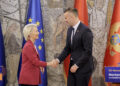
Leading figures from the European Union institutions congratulated Abela. The President of the European Commission, Ursula von der Leyen, noted on X that “Malta plays a central role in the Mediterranean.
A region ever more strategic for Europe’s future.” The President of the European Council, Antonio Costa, expressed his hope “to continue our excellent cooperation by working together for a more prosperous, secure, and united Europe.” Finally, there was also an official comment from the Maltese President of the European Parliament and leading figure of the nationalist opposition, Roberta Metsola. “Congratulations to Robert Abela, who was re-elected Prime Minister of Malta this morning at the Presidential Palace in Valletta”, she wrote on X.
According to reports in the island’s leading newspapers, Setting aside the usual post-election rhetoric, the result is as much a victory for Labour as it is a success for the nationalists. Whilst the former demonstrated a level of support that was by no means a foregone conclusion after 13 consecutive years in power, the latter achieved their best election result since 2013 and, above all, have halved the gap separating them from Labour: in 2022 the difference in votes was almost 40,000, whereas it has now fallen to just under 22,000.
‘It’s the economy, darling’: economic growth at the heart of Abela’s victory
Called months before the legislature was due to end next February, the vote was framed by Abela, who took office in 2020 after Joseph Muscat stepped down, as a test of his own mandate and his party’s strength, against the international backdrop of rising tensions in the Middle East. “In light of the global challenges that lie ahead, our country needs a renewed mandate to continue on the path of stability,” the Prime Minister had written on X.
After all, Malta is – along with Cyprus and Greece – one of the countries most geographically exposed to conflicts in Iran, Lebanon, and Palestine. More importantly, its economy depends largely on the revenue generated during the summer tourist season and, in light of the rise in jet fuel prices triggered by the closure of the Strait of Hormuz, Valletta fears a downturn in the sector in the coming months.
Despite these challenges, and in line with the main opinion polls, Abela’s gamble proved a success, and the outgoing head of government will be able to take the oath of office under the Maltese Constitution as early as today (1 June).
The island’s leading political analysts agree that the main reason for Labour’s victory is the excellent state of the Maltese economy. According to the island’s National Statistics Office data, GDP grew by 3.9 per cent in the first half of 2026 compared with a Eurozone average of +0.8 per cent. Furthermore, the European Commission’s recent Spring Economic Forecasts, published by the European Commission, confirm that Malta will continue to grow the most across the entire EU at least until 2027: +3.7 per cent for this year (compared to a European average of +1.1 per cent) and +3.6 per cent for 2027 (compared to an EU average of +1.4 per cent). Finally, other key economic indicators are also positive, with an unemployment rate of around 3 per cent, inflation held at 2.7 per cent, and a deficit expected to fall to 2.1 per cent by next year.
As Christopher Scicluna, a columnist for the Times of Malta, put it, “the quality of life remains good, and that matters.“
Or, at the very least, it seems to have carried far more weight than the key issues the nationalists focused on during the election campaign. Foremost among these is the corruption that permeates the main centres of power in Malta, as confirmed by a recent Council of Europe report published in 2025. The veil over this system was lifted some ten years ago by the journalist Daphne Caruana Galizia. The reporter documented the involvement of several prominent members of the PL – such as the then Minister for Energy Konrad Mizzi and the chief of staff to former Prime Minister Muscat, Keith Schembri – in the Panama Papers. It was precisely because of her investigative work that Galizia was murdered in October 2017 and, while ruling out any active role by the government in the murder, an ad hoc commission held the State liable for having created a “climate of impunity” that prevented the journalist from being adequately protected.
English version by the Translation Service of Withub