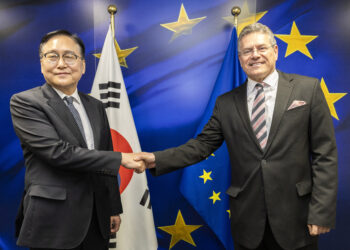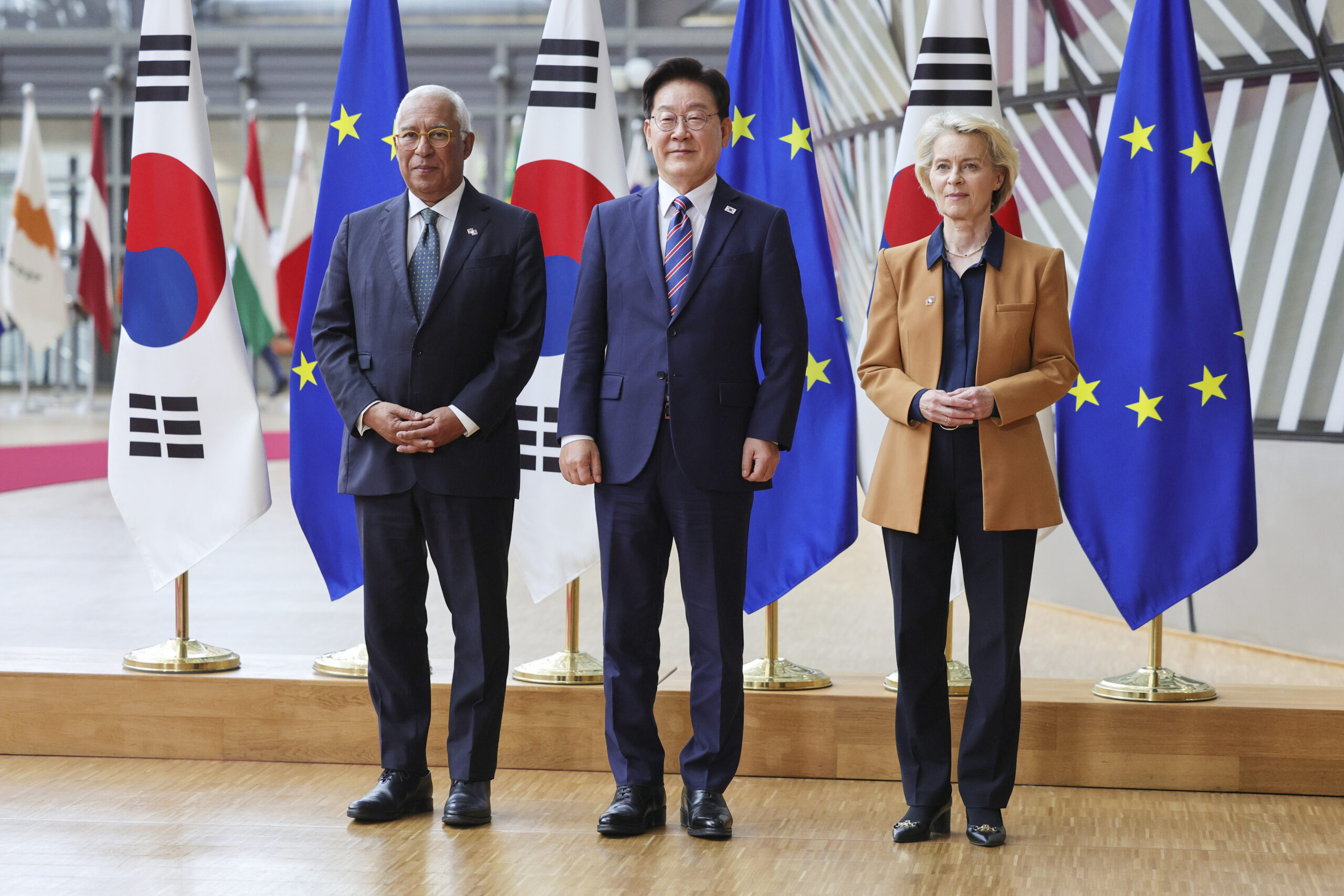
Brussels – Discussing the economy, security, technology, and energy with K-pop hits playing in the background. Three years after the last meeting at the highest political level, the European Union and South Korea have relaunched their strategic partnership with a summit aimed at strengthening an already very solid relationship and extending it into new areas of cooperation. At the 11th EU-South Korea Summit, held today (10 June) in Brussels, the President of the European Commission, Ursula von der Leyen, and the President of the European Council, Antonio Costa, met with the President of the Republic of South Korea, Lee Jae-myung.
The most tangible outcome of the meeting is the signing of the historic Digital Trade Agreement (DTA), but the summit also led to the launch of new mechanisms for economic cooperation, deeper dialogue on security and defence, and new initiatives in energy, research, and innovation.
“The partnership between the European Union and South Korea has never been more important,” said von der Leyen. “We are working together to strengthen economic security and drive innovation,” added the head of the Berlaymont, before emphasising that “our close cooperation delivers tangible benefits for our citizens and helps us build a more prosperous future for generations to come.”
A view shared by the President of the European Council, Antonio Costa, who stated that “today we have strengthened the strategic partnership between the EU and the Republic of Korea, deepening our cooperation beyond borders and further contributing to the prosperity and security of our citizens.”
The economy at the heart of the agenda: the new digital agreement and the dialogue on competitiveness
The economic agenda was at the heart of the summit. The significance of the trade relationship between Brussels and Seoul explains the focus on this issue. According to figures provided by the EU, in 2025 trade in goods between Europe and South Korea exceeded €124 billion, making the Asian country the EU’s eighth-largest trading partner, with imports amounting to €69.7 billion and exports standing at around €54.5 billion. In particular, South Korea is one of the main exporters of semiconductors to the EU.
During today’s summit, it was first decided to launch a new Partnership for Competitiveness, an instrument designed to coordinate cooperation on strategic issues: trade, investment, supply chains, advanced technologies, digital services, energy, and innovation.
This will be complemented by a High-Level Economic Dialogue, a new political forum tasked with deepening cooperation on economic security, industrial policy, and trade in an international context marked by growing geopolitical competition and the fragmentation of global value chains.
The most significant political outcome, however, is the signing of the Digital Trade Agreement, which was finalised last April during the visit to Asia by the European Commissioner for Trade, Maroš Šefčovič. This is the second autonomous bilateral agreement of this kind concluded by the European Union, following the one with Singapore, and forms part of the European strategy to establish common rules on the digital economy with partners considered reliable and inspired by the same values. In addition to Singapore and South Korea, Brussels is also drafting similar agreements with other Southeast Asian countries, such as Thailand, Indonesia, Malaysia, and India.
The agreement updates and supplements the EU-Korea Free Trade Agreement, which has been in force since 2011, adapting it to an economy in which an increasing share of trade occurs through digital platforms and services. According to data from the European Commission, in 2023 over a third of trade in services between the two economies was already conducted via digital channels, amounting to approximately €11 billion. More generally, Brussels points out that over 60 per cent of global GDP is now linked to digital transactions.
This is not merely a declaration of intent: the agreement introduces binding rules that recognise the legal validity of electronic contracts and digital signatures, facilitate online transactions and strengthen protections for consumers and businesses.
“It is an honour to have signed our Digital Trade Agreement, bringing the EU and South Korea even closer together,” said Šefčovič. According to the Slovak politician, “as digital trade continues to grow, this agreement ensures that our partnership keeps pace with the future, bringing real benefits for businesses and everyday life.”
The agreement must now follow the standard ratification process. First, it must be officially signed by Šefčovič and his South Korean counterpart. Subsequently – on the European side – the green light from the Parliament and formal approval by the Council of the EU will be required.
During the summit, discussions also took place regarding a possible Mutual Recognition Agreement (MRA) on product certifications and conformity assessments. The issue may seem technical, but it has significant economic implications. Today, many European companies exporting to South Korea, and vice versa, must subject their products to duplicate certification procedures. An agreement would instead allow for the mutual recognition of checks conducted by the authorities of both parties, reducing costs, time-to-market, and bureaucratic burdens.
Defence and security: Brussels is increasingly turning its attention to the Indo-Pacific
While trade has traditionally been the driving force behind EU-Korea relations, security is gradually taking on a more prominent role.
As stated in the joint communiqué issued at the end of the summit, “the leaders emphasised the interconnection between European and Indo-Pacific security and reaffirmed their shared commitment to multilateralism and a rules-based international order.”
Hence the reaffirmed support for Ukraine in the face of Russian aggression and, looking even further east, the “grave concern” expressed regarding North Korea’s nuclear and missile programmes. Both sides reaffirmed the goal of the “complete denuclearisation of the Korean peninsula.”
At an operational level, the summit decided to expand the EU-Republic of Korea Partnership on Security and Defence, the agreement signed in 2024 that provides the framework for bilateral cooperation in this sector. The aim is to step up coordination on cybersecurity, hybrid threats, countering foreign information manipulation and interference, terrorism, non-proliferation, maritime security, and space security.
This context also includes the intention to negotiate an Information Security Agreement, designed to facilitate the exchange of classified information between the two parties.
“We may be geographically distant, but the EU and South Korea face similar security threats,” said the High Representative for Foreign Affairs, Kaja Kallas. “When the rules-based international order is under attack, when the danger of nuclear proliferation is real, when we are threatened by aggressive neighbours, we know we can count on South Korea as a friend.”
Significant developments have also taken place in the area of energy cooperation. The two sides announced the launch of a High-Level Energy Dialogue, tasked with coordinating efforts on energy security, economic resilience and the transition to clean energy sources. The leaders also welcomed the first projects carried out as part of South Korea’s participation in Horizon Europe, the European programme for research and innovation, confirming their intention to strengthen scientific cooperation and support the internationalisation of deep-tech start-ups through European innovation-focused instruments.
English version by the Translation Service of Withub