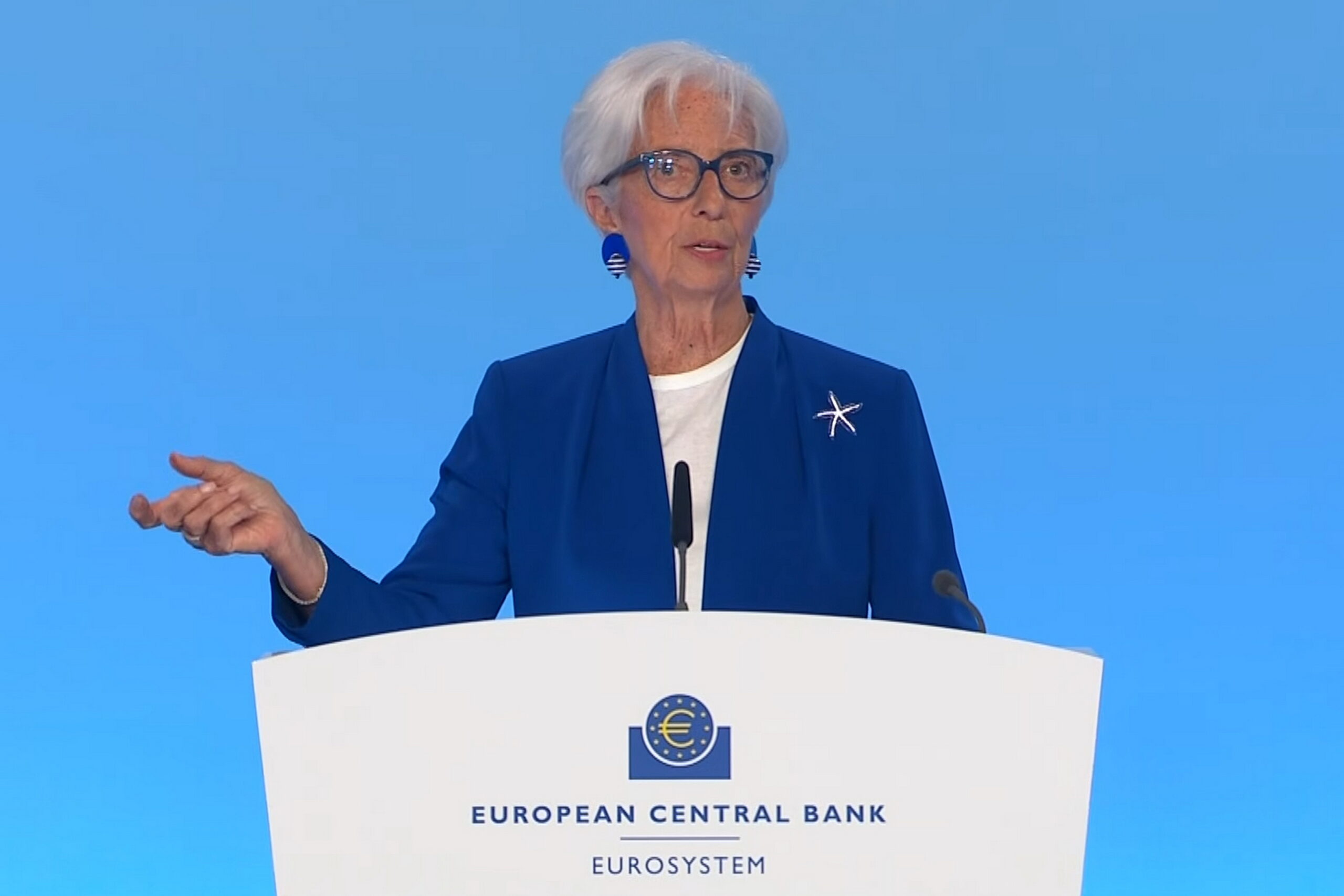

Brussels – The European Central Bank has raised interest rates by 0.25 per cent, from 2 per cent to 2.25 per cent. This is the first time since September 2023. Almost three years ago, rates were raised in response to inflation triggered by the war in Ukraine, and today (11 June) too, the monetary tightening comes in the wake of an energy crisis linked to a conflict, this time in Iran. “The war in the Middle East,” said ECB President Christine Lagarde at the press conference following the ECB Governing Council meeting, “is generating inflationary pressures and the decision to raise rates is robust across all possible scenarios regarding how the shock might unfold and affect the euro area’s medium-term outlook.”
According to the new estimates of the ECB’s economists, headline inflation is expected to average 3 per cent in 2026, 2.3 per cent in 2027 and 2 per cent in 2028. “Compared with March,” explained Lagarde, “ staff have revised the baseline projections for inflation in 2026 and 2027 upwards, due to the expected rise in energy prices, which is forecast to feed through to some extent into inflation for food, goods, and services.” The baseline projections also indicate average economic growth of 0.8 per cent in 2026, 1.2 per cent in 2027 and 1.5 per cent in 2028. “This is a downward revision for 2026 and 2027, reflecting a more pronounced impact of the war on commodity markets, real incomes, and confidence,” said the President of the European Central Bank.
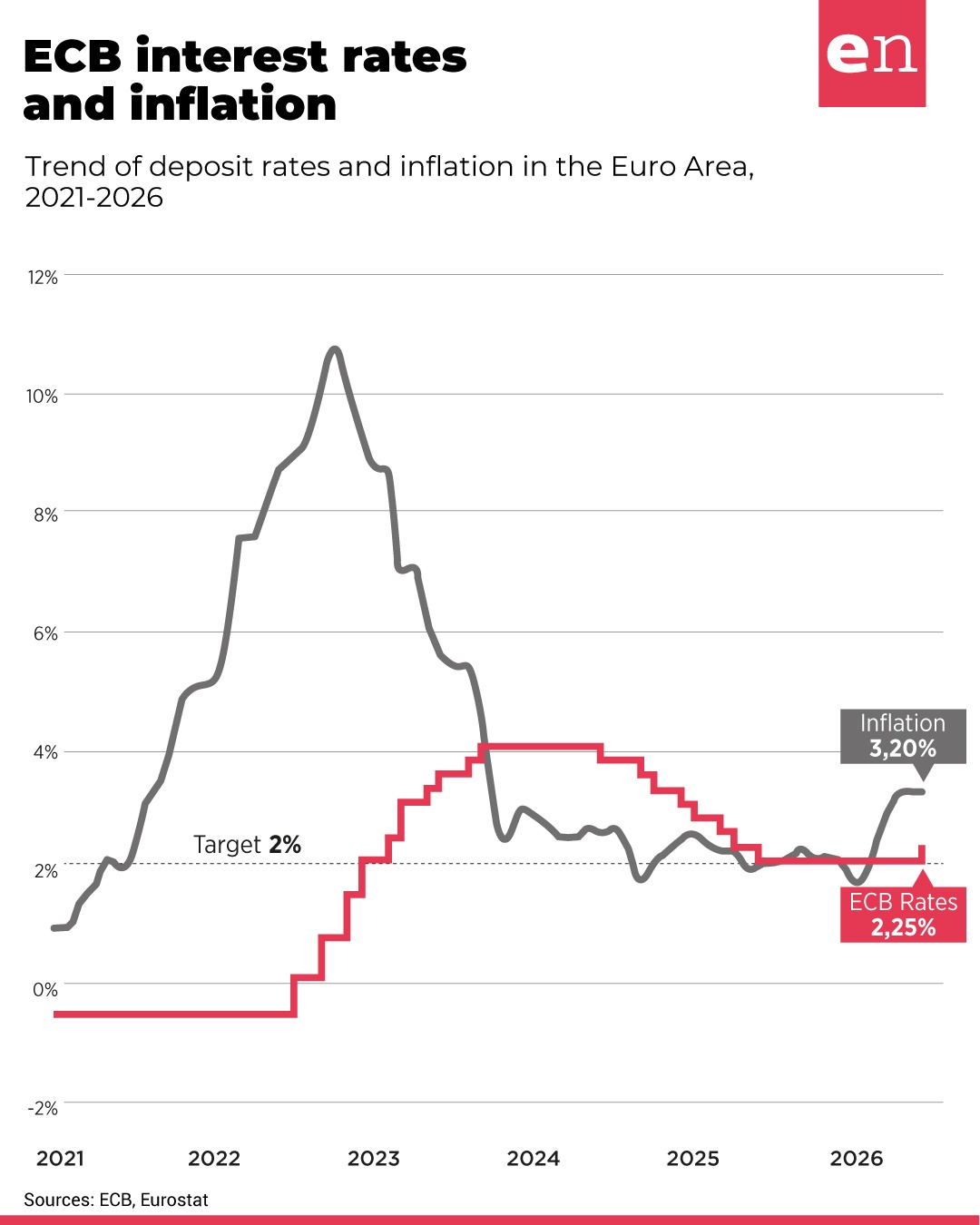
Lagarde pointed out that the outlook “remains uncertain, with upside risks to inflation and downside risks to economic growth” and that “the overall implications of the war for inflation and medium-term growth will depend on the intensity and duration of the shock to energy prices, as well as the extent of its indirect and second-round effects.” With today’s decision, “the Governing Council is best placed to manage the uncertainty caused by the war,” she emphasised. “It will monitor the situation closely and decide on a case-by-case basis, based on available data, on the direction of monetary policy. In particular, decisions on interest rates will be based on an assessment of the inflation outlook and the associated risks, in the light of new economic and financial data, core inflation dynamics, and the effectiveness of monetary policy transmission.”
Furthermore, Lagarde confirmed that the decision to raise rates by 25 basis points “was unanimous” and that “no other alternatives were discussed based on the new economic forecasts.” The decision, she added, “is not drastic” and “sends a signal: it is necessary given the economic situation we find ourselves in, the uncertainty we are facing, the inflation outlook, and the projections drawn up by the Eurosystem.”
How is the eurozone economy faring?
Christine Lagarde outlined the situation in the eurozone, where “the economy grew in the first quarter, buoyed by domestic demand and exports.” However, the war in the Middle East “is weighing on activity, and economic surveys point to a slowdown, particularly in services.” The manufacturing sector has held up so far, “partly because firms have built up stocks to cope with supply chain pressures, and partly thanks to increased defence spending,” the president explained.
The labour market also “remains resilient.” The unemployment rate, at 6.3 per cent in April, remains close to historic lows. New jobs were created in the first quarter, albeit at a slower pace than in the final quarter of 2025.” Demand for labour, meanwhile, “has cooled further.” The European Central Bank’s staff now expects “weaker domestic demand than projected in March,” she added, “as the war weighs on confidence and rising energy prices erode real incomes. At the same time, household finances are broadly sound and consumption is expected to remain the main driver of growth.” Although rising energy prices and falling confidence “will dampen private investment in the short term,” it should nevertheless “be supported by business investment in new digital technologies.” Furthermore, increased public spending on defence and infrastructure “is expected to continue to support public investment,” Lagarde specified. These factors should therefore partly mitigate the impact of the war.
The President took the opportunity during the press conference to make a number of recommendations, foremost among them the need to implement “reforms aimed at strengthening the euro area’s growth potential and at accelerating the energy transition to reduce dependence on fossil fuels.” Completing the Savings and Investment Union is “essential for financing innovation, supporting the green and digital transitions and improving productivity,” she said.
Inflation “rose to 3.2 per cent in May, from 3 per cent in April,” and “energy inflation reached 10.9 per cent, following 10.8 per cent in April, while food inflation fell from 2.4 per cent to 2 per cent.” Short-term inflation expectations “remain well above pre-war levels in the Middle East,” Lagarde said. At the same time, most measures of long-term inflation expectations stand at around 2 per cent, supporting the stabilisation of inflation around the target in the medium term.
As regards risk assessment, the risks to growth are “skewed to the downside, mainly due to the war in the Middle East”, which is taking place against an already unstable geopolitical backdrop. A prolonged disruption to energy supplies could further erode real incomes and dampen investment and consumption, while the closure of shipping routes could lead to shortages of essential raw materials. As for prices, according to Lagarde, the risks are “skewed to the upside”: if energy prices remain high for longer, inflation could rise further and spread to wages and other prices. Therefore, only a swift resolution of the war, or knock-on effects less severe than expected, could bring inflation back down to lower levels.
English version by the Translation Service of Withub