

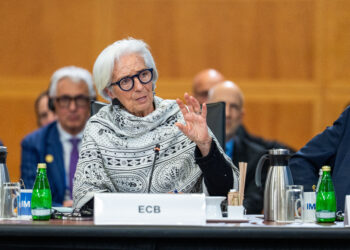
Brussels – “The treaties gave the ECB legal independence, but the crises gave it the authority it previously lacked to exercise that independence effectively.” For the President of the ECB, Christine Lagarde, this is “the key lesson” of history, which is intertwined with a present fraught with challenges. She chose the 28th meeting of Francophone Central Bank Governors to stress the importance of independence and credibility in navigating the roughest of waters, such as those we face today: “the framework in which we operate has become more demanding,” Lagarde warned.
Perhaps the most emblematic example is the clash between US President Donald Trump and Federal Reserve Chair Jerome Powell. An unprecedented clash for a country considered the beacon of democracy and its workings, with the federal government telling the Federal Reserve what to do. “When the Chair of the Federal Reserve publicly defended the institution’s independence, the ability to contain political pressures was thanks to the public support built up over the years through the Fed’s independent decision-making,” Lagarde said.
Of course, Powell stood his ground and stood up to Trump, winning the round. But “the matter is not settled,” and so, the ECB President continues, “we can clearly see the mechanism at play: where credibility exists, defending independence does not fall on the central bank’s shoulders alone.”
It is no coincidence that Lagarde focuses her speech on this issue. Of course, the reference to credibility could also be interpreted as a call for reform by national governments, given that, as she points out, “fiscal pressures stemming from defence needs, the climate transition, the digital transition and ageing are narrowing budgetary margins.” But actually, she argues, the real problem is that “Over the past decade, the de facto independence has deteriorated in almost half of central banks in countries that account for 75 per cent of global GDP.”
Hence, the call for everyone to follow the three key conditions that Lagarde considers crucial to safeguard the credibility and, consequently, the independence of central banks. Firstly, she explains, there must be “clarity of the mandate, as understood by the central bank itself.” This means that “price stability must remain the primary objective, and it must be defended even if there is a real, immediate cost.” The second condition is practical: “direct communication with citizens.” Finally, it is “preserving the room for manoeuvre of monetary policy.”
English version by the Translation Service of Withub


![Da sinistra: il presidente del Consiglio europeo, Antonio Costa; il presidente dell'Ucraina, Volodymir Zelensky: la presidente della Commissione europea, Ursula von der Leyen [Bruxelles, 18 giugno 2024. Foto: European Council]](https://www.eunews.it/wp-content/uploads/2026/06/euco_ua260618-120x86.jpg)
![[foto: Saverio De Giglio/imagoeconomica]](https://www.eunews.it/wp-content/uploads/2026/10/cpt-120x86.png)