
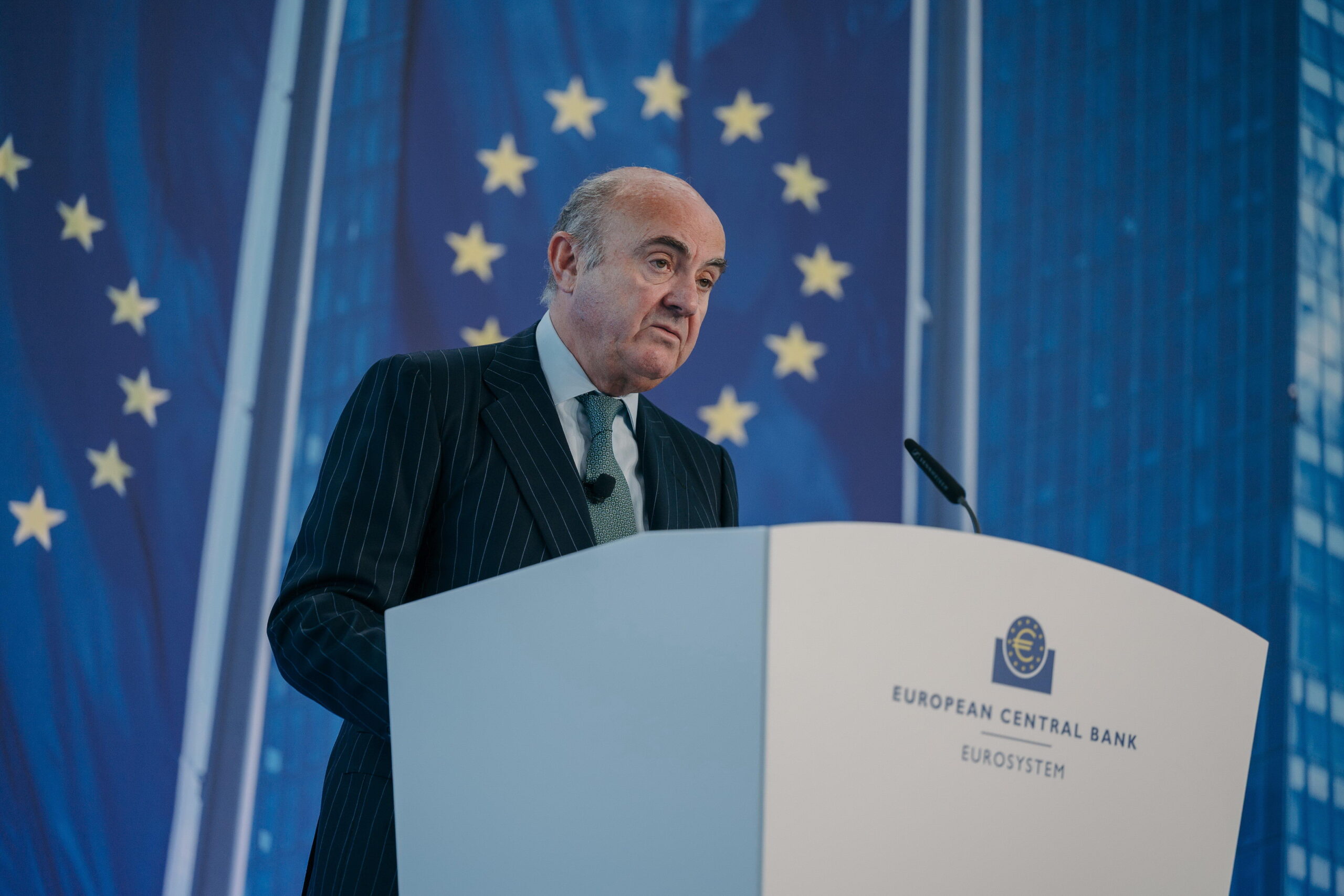
Brussels – Things are starting to look grim. With the war in Iran showing no sign of ending and the conflict’s repercussions on trade, the economy, and inflation, “a negative geo-economic shock is unfolding“, and, in this context, “financial stability vulnerabilities in the euro area remain high as the geoeconomic shock unfolds.” It is the Vice-President of the European Central Bank, Luis de Guindos, who takes stock of the situation while presenting the ECB Financial Stability Review (Financial Stability Review).
In Frankfurt, they know that everything will depend on the duration of the conflict and on how long the Strait of Hormuz remains closed. Two issues for which there is still no answer, and therefore, de Guindos continues, “there remain risks of further disruptions to trade and international cooperation, with cyber threats ever-present.” This is where the difficulties for the eurozone lie, with the combination of global weaknesses and European fragilities: “prolonged geopolitical tensions and persistent fiscal difficulties could test financial market confidence and expose sovereign vulnerabilities“, the ECB Vice-President warns, in an implicit call for governments to implement reforms, particularly where there are still high debt levels, like in Italy.
Speaking of countries with struggling national budgets, de Guindos warns against dangerous relationships in an uncertain, unstable environment prone to shocks: “The functioning of the sovereign bond market remains orderly, but a shifting investor base and external fiscal
imbalances could yet cause strains.” In other words, government bonds are exposed to turbulence, and this could fuel the spread, the yield differential with more reliable bonds such as the German Bund.
But there is also another significant unknown factor for the prospects of the EU and its eurozone, namely the increasingly risky links with the US economy. While acknowledging that there are no real, imminent dangers, de Guindos continues to highlight the critical issues arising from the interconnection with the US system, which is beginning to cause concern for the ECB. “Although direct exposures to US private credit funds are limited…if sentiment shifts were to affect high-yield bonds, leveraged loans and equity markets, spillover risks for euro area pension funds and insurers could be material.”
As for the Eurosystem, banking system resilience “has strengthened,” de Guindos said. However, “credit, liquidity, and funding vulnerabilities might unravel.” So far, euro area banks “navigated recent bouts of volatility well, supported by strong capital, liquidity and profits.” Overall, “direct exposure to the Middle East is limited.” Caution is advised, however: asset quality “could deteriorate if the war were to trigger a worsening of macro-financial conditions, while funding sourced from non-banks might prove flighty.”

![Boris Vujčić [foto: MEF, account X]](https://www.eunews.it/wp-content/uploads/2026/01/vucjic-350x250.jpeg)
![Il vicepresidente della BCE, Luis de Guindos [Bruxelles, 15 gennaio 2026]](https://www.eunews.it/wp-content/uploads/2026/01/de-guindos-260115-350x250.png)
![Luis de Guindos, vicepresidente della BCE [foto: Parlamento europeo]](https://www.eunews.it/wp-content/uploads/2020/05/de-guindos.jpg)

![Da sinistra: il presidente del Consiglio europeo, Antonio Costa; il presidente dell'Ucraina, Volodymir Zelensky: la presidente della Commissione europea, Ursula von der Leyen [Bruxelles, 18 giugno 2024. Foto: European Council]](https://www.eunews.it/wp-content/uploads/2026/06/euco_ua260618-120x86.jpg)
![[foto: Saverio De Giglio/imagoeconomica]](https://www.eunews.it/wp-content/uploads/2026/10/cpt-120x86.png)