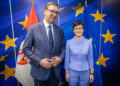
![VERTICE UE-CINA Luglio 2025 [Fonte: Imagoeconomica]](https://www.eunews.it/wp-content/uploads/2026/06/Imagoeconomica_2513581-scaled.jpg)
Strasbourg, by our correspondent – How can we balance the need to engage with a global power such as China with the defence of the EU-27’s economic sovereignty and the competitiveness of the single market? Europe’s relationship with Beijing was at the heart of the debate that opened today’s (17 June) proceedings in the European Parliament, which is holding its plenary session in Strasbourg from Monday 15 to Thursday 18 June.
The discussion, which is central to tomorrow’s and Friday’s European Council meeting in Brussels, was opened by Marilena Raouna, the Cypriot Minister for European Affairs, who reiterated the EU’s position and the Member States’ willingness to engage in dialogue: “As far as China is concerned, our approach remains one of engagement and dialogue,” adding that the aim is “to pursue a policy of de-risking, not decoupling.” The best solution for the current EU Council presidency is, therefore, to reduce Europe’s strategic dependencies without going so far as to sever ties with China entirely. Complete independence from Chinese resources is deemed “neither desirable nor realistic” by the Commissioner for Trade and Economic Security, Maroš Šefčovič, who, on behalf of the entire Commission, emphasised the need for a “decisive rebalancing” and transparency: “Our trade and investment relationship must be reciprocal, fairer and based on a level playing field.”
But while it is true that no one wishes to sever ties with the Asian giant entirely, the atmosphere of tension and concern in the face of the rise and dominance of the People’s Republic of China is equally evident. “At the moment, we have a trade deficit with China amounting to €1 billion a day. This is simply unacceptable,” declared in the chamber a concerned Manfred Weber, chair of the European People’s Party group, urging Europe not to be naive: “China is flooding European markets with its excess production capacity. This must stop,” and “we need a level playing field, in accordance with WTO rules.” Indeed, “we must tell the Chinese that subsidies are not part of fair trade,” he added, while also calling for clarity regarding European sovereignty over critical networks. Therefore, according to Weber, “the development of the 6G network in Europe should be exclusively a European network” to ensure technological sovereignty. The EPP president believes the EU should act in concert with the US. “Yesterday we voted on the agreement with the US on tariffs. We now have clarity and predictability for our activities. This is also an opportunity to make a fresh start, and the G7 summit in Evian offers us the chance to revive that kind of economic and NATO thinking. And together with the Americans, we should reflect on how to respond to the Chinese economic model,” he urged.
In the same vein of firmness, the MEP from Fratelli d’Italia, co-chair of the European Conservatives and Reformists (ECR) group, Nicola Procaccini, who criticised the bureaucratic approach, pointing out that competitiveness “is built on the ground” and that Europe must respond “resolutely to unfair competition and the complete lack of reciprocity that threatens to undermine our industrial base.”
The warning against the risk of Europe being crushed between the two blocs—Western and Eastern—came from within the ranks of Renew Europe, voiced by the group’s chair, the Frenchwoman Valérie Hayer. “We are in the midst of a Cold War: China and the United States are vying for global power, and Europe must not align itself with either of these powers,” she stated. “Firstly, we must no longer be complacent servants. We must cooperate with China and the United States. Yes, we must trade with them. Yes, we must defend our common interests, such as those relating to rare-earth metals. But we must never be under their control, neither today nor tomorrow,” she specified. This view was criticised by Iratxe García Pérez, chair of the Progressive Alliance of Socialists and Democrats (S&D) group, who accused it of “excessive” simplification of reality: “Any citizen might think that China is bad and the United States is good, but the world is much more complex”. According to the socialist leader, “we must understand that foreign relations, trade and economic exchanges are far more complex than this simplistic message suggests” and “we must take the issue of European sovereignty and the key role it plays in a challenging world seriously.”
Finally, Terry Reintke, co-chair of the Greens, reminded the House that the climate challenge is a cornerstone of geopolitical resistance: “If Europe wants to be a global player and stand up to autocracies around the world, including China, we must become world leaders in this green future.”
For the Commission, unity is the only way forward: in his closing remarks during the plenary debate, Šefčovič took on board the various calls from MEPs, reiterating a key concept for the summit of heads of state: “Unity is our most precious asset, and in this particular case it is even more important.” Tomorrow, the ball will be in the court of the European Council leaders, who will have to turn these and other views into a common strategy towards Beijing.
English version by the Translation Service of Withub
![[foto: European Council]](https://www.eunews.it/wp-content/uploads/2024/06/euco-strem-350x250.jpg)

![Da sinistra: il presidente del Consiglio europeo, Antonio Costa; il presidente dell'Ucraina, Volodymir Zelensky: la presidente della Commissione europea, Ursula von der Leyen [Bruxelles, 18 giugno 2024. Foto: European Council]](https://www.eunews.it/wp-content/uploads/2026/06/euco_ua260618-120x86.jpg)
![[foto: Saverio De Giglio/imagoeconomica]](https://www.eunews.it/wp-content/uploads/2026/10/cpt-120x86.png)