Strasbourg, by our correspondent – The trade dispute between Brussels and Washington—launched at the end of March 2025 by US President Donald Trump—appears to be nearing a conclusion. The European Parliament, meeting in plenary session, with 440 votes in favour, 151 against, and 50 abstentions, has given the green light to the measure implementing the commitments made a year ago in Scotland regarding the import-export regime between the two sides of the Atlantic. Under the agreement, Washington has committed to capping tariffs on EU products at 15 per cent, while granting most-favoured-nation treatment to strategic sectors such as aeronautics and pharmaceuticals. In response, Europe has agreed to abolish tariffs on all US industrial products and to grant preferential access to large quotas of agricultural and fishery products: 500,000 tonnes of nuts, 25,000 tonnes of pork and 340,000 tonnes of Alaska pollock (cod) will be imported duty-free.
At the same time, the Chamber approved, with 444 votes in favour, 152 against, and 54 abstentions, the second bill relating to trade relations with the other side of the Atlantic: the one providing for the removal of customs duties on imports of US lobsters, extending the exemption to processed products as well. The measure applies retroactively from 1 August 2025 and will remain in force until 31 December 2028. In return, the United States will reduce tariffs on EU products such as crystal glassware and ready meals by 50 per cent. The agreement aims to ensure economic stability while maintaining strict suspension clauses relating to security and human rights.
Trade tensions, which had reached a period of relative respite following last July’s agreement,, were subsequently characterised by repeated US threats to raise tariffs set at 25 per cent, unilaterally imposed deadlines such as that of 4 July and by additional 10 per cent tariffs because, in Washington’s view, the EU, along with 59 other economies, had “failed to effectively enforce the ban on imports of goods produced using forced labour.” The EU has consistently responded to these threats by declaring itself a reliable partner and referring to the agreement reached in Scotland.
Following today’s vote, the PD (S&D) MEP, Brando Benifei, co-ordinator on the Committee on International Trade, highlighted how the Parliament had managed to significantly improve the European Commission’s proposal. Benifei pointed out that, in order for the European Parliament to give the green light to the legislative texts implementing the Turnberry trade agreements with the United States, “tough and intense negotiations with the Council and the European Commission were necessary, in the face of unacceptable initial proposals, lacking any means of defending our interests, in a context of mere submission to American demands, which we were determined to reject and which therefore required lengthy discussions.” Furthermore, she highlighted the role played by the Socialists and Democrats: “It took all the determination of our political group and a large part of the European Parliament to include suspension and conditionality clauses that will allow the Commission to suspend the agreements in the face of possible violations and threats from the US. We also wanted a specific deadline to be able to renegotiate the agreements before the end of 2029 in a different political context,” he added.
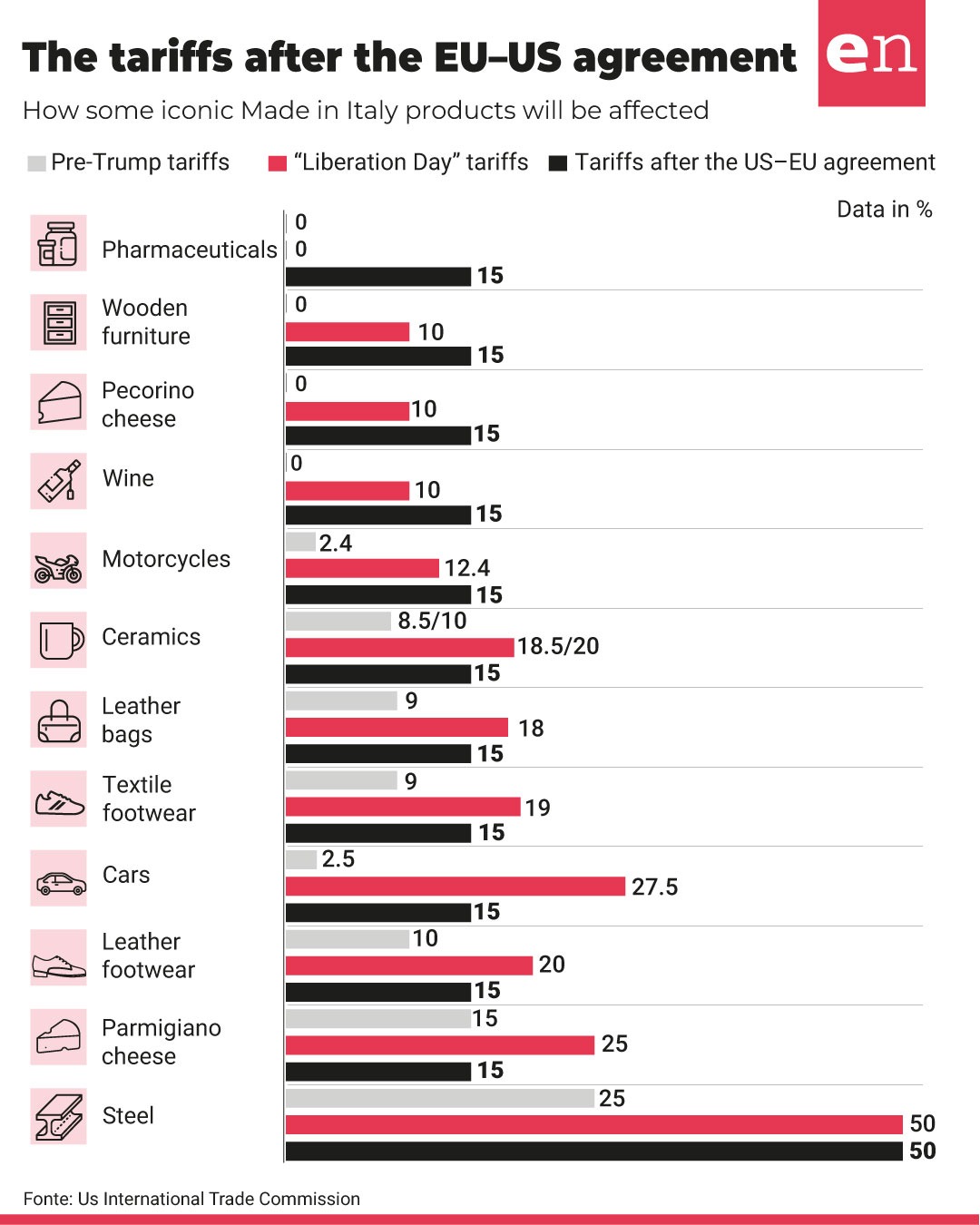
Pasquale Tridico, head of the Five Star Movement delegation to the European Parliament, was even harsher. “By voting in favour of the EU-US trade agreement, Fratelli d’Italia and Forza Italia have betrayed our ‘Made in Italy’” because “this agreement actually worsens market access to the US for European exports, and in particular for Italian exports, for which the US is one of the most important markets.” According to the Five Star Movement representative, “for our country, the estimated losses are put at between 7 and 22 billion euros, according to some business organisations.” Meanwhile, “to those who say that unilateral tariffs of 15 per cent on our businesses are a good compromise, we would point out that the pre-Trump average was 2.5 per cent,” and “the sectors hardest hit are those with high added value: mechanical engineering, pharmaceuticals, the automotive sector, but also the agri-food sector”. For Tridico, therefore, “despite a few tentative safeguard clauses, the agreement signed in Scotland remains a millstone around the neck of the European economy and, in our view, should be rejected and renegotiated.”
According to the Fratelli d’Italia MEP (ECR), Daniele Polato, coordinator of the ECR Group in the Committee on International Trade (INTA), the agreement “provides for a reduction in import duties, greater stability in transatlantic trade relations and, consequently, greater certainty for economic operators.” According to the MEP, “preserving Euro-Atlantic unity and strengthening coordination between Europe and the United States is now essential for our economy. It is not an easy challenge, but a necessary one,” and “supporting these agreements, as the Fratelli d’Italia-ECR Group has done, is an act of responsibility.”
The “5 S” strategy to secure the deal
The agreement set out in the first adopted text, valid until 31 December 2029, includes safeguard clauses that allow Brussels to suspend concessions should a rise in imports cause serious harm to European industry. To safeguard European economic sovereignty, the so-called ‘5 S’ strategy has been introduced, comprising a set of clauses designed to ensure reciprocity and oversight. The package includes the Steel clause, which excludes steel and aluminium from the elimination of tariffs pending a specific agreement on derived products (currently subject to a 50 per cent tariff by the US), followed by the Sunset clause, which limits the regulation’s validity to 31 March 2028 to allow for a reassessment of its impacts. Added to these is the Standstill clause, a mechanism allowing the EU to respond to new US tariffs contrary to the spirit of the joint declaration; the Safeguard clause, which allows for the suspension of preferential treatment if imports increase by more than 10 per cent in a year, and finally the Strengthened Suspension clause, which grants the Commission the power to act through delegated acts in the event of economic coercion or a breach of commitments by the United States.
The debate in the Chamber
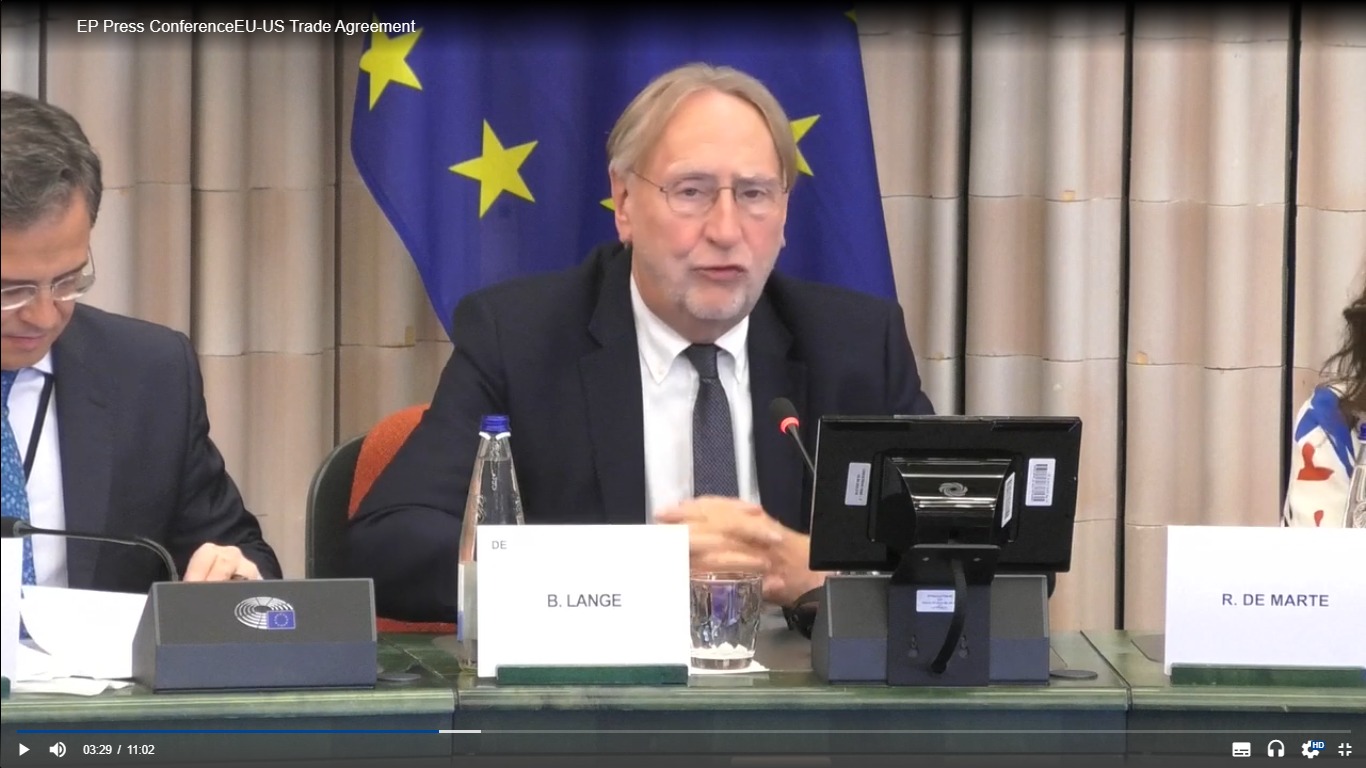
The German Socialist MEP, Bernd Lange, chair of the Committee on International Trade, has pointed out that this agreement was “concluded under pressure” and remains fundamentally “unbalanced”. He therefore vigorously defended the need for a robust legislative framework: “A handshake or a joint declaration is not enough to steer a ship; we need clear guidelines, we need clear legislation.” Lange proudly emphasised the democratic nature of the European legislative process, stating that it is “completely different from a system in which a single man alone can decide whatever he wants.”
Speaking on behalf of the EPP, Zeljana Zovko recalled the alliance’s historic values: “For decades, Europe and the United States have stood united as true brothers in arms, bound by shared values, common sacrifice, and an unwavering commitment to freedom and democracy. But today our partnership is being tested not only by geopolitical challenges, but also by economic uncertainty.” Zovko then called for a vote in favour, describing it as a “strategic decision that will protect jobs, strengthen our industries, and reinforce the transatlantic partnership that has ensured prosperity for generations.” Meanwhile, the EPP Group chairman Manfred Weber emphasised that, although not perfect, the agreement is crucial because “predictability for our industry is key for us.”
The harshest criticism came from the Greens and the Left. Anna Cavazzini (Greens) challenged the very origins of the agreement. “One thing is clear: Trump’s tariffs are illegal. In fact, this agreement should not exist. Last year, as the European Union, we should have been stronger and more self-assured,” she thundered. Cavazzini also expressed firm opposition to energy dependence: “The European Union must not depend on the United States for fossil fuels.”
Even harsher was the criticism from Martin Schirdewan (The Left), who argued that “Donald Trump is blackmailing the European Union and has unleashed a trade war against it.” Therefore, “Ursula von der Leyen should never have accepted this terrible deal.” Schirdewan concluded by reiterating his group’s position: “I am proud that my group has taken a stand against this autocrat and this unfair trade policy, which puts European jobs at risk and leads to permanent dependence on the United States.”
English version by the Translation Service of Withub
![Riunione del consiglio Affari esteri [Lussemburgo, 15 giugno 2026. Foto: European Council]](https://www.eunews.it/wp-content/uploads/2026/06/fac-council-250615-350x250.jpg)
![Parlamento europeo di Strasburgo, lavori in corso [Foto: Imagoeconomica]](https://www.eunews.it/wp-content/uploads/2026/06/Imagoeconomica_1277744-350x250.jpg)


![Da sinistra: il presidente del Consiglio europeo, Antonio Costa; il presidente dell'Ucraina, Volodymir Zelensky: la presidente della Commissione europea, Ursula von der Leyen [Bruxelles, 18 giugno 2024. Foto: European Council]](https://www.eunews.it/wp-content/uploads/2026/06/euco_ua260618-120x86.jpg)
![[foto: Saverio De Giglio/imagoeconomica]](https://www.eunews.it/wp-content/uploads/2026/10/cpt-120x86.png)