![[Foto: EC - Audiovisual Service]](https://www.eunews.it/wp-content/uploads/2026/06/P-070063_00-24_01-ORIGINAL-350675-scaled.jpg)
Brussels – “Moldova’s place is in the European Union.” This was emphasised by Ursula von der Leyen, President of the European Commission, during the second summit between the EU and Chișinău. Europe “stands with Moldova: for reforms, for opportunities, and for a shared future of peace, freedom, democracy, and prosperity,” she said.
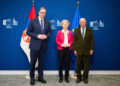
The tenant of the Berlaymont Building, the head of the European Council, António Costa, and the Moldovan President, Maia Sandu, met today (22 June) in Brussels for this second official meeting. The meeting comes “just a week after Moldova has reached a historic milestone on its path towards the EU,” Costa noted, “with the opening of the first cluster of accession negotiations.” Maia Sandu appealed to the Member States, calling for “a process based on merit” in what she described as “a race against time” that “Moldova intends to win.” Furthermore, the President emphasised her country’s determination to press ahead swiftly towards the EU. “We are ready to open the remaining clusters”—that is, the chapters of the accession negotiations—“and it is important that this be done as soon as possible, given that this is a process based on merit and the Commission has recommended proceeding in this way,” she noted.
The President of the European Commission described the summit as a concrete step forward on a path already marked by significant achievements. On the economic front, the €1.9 billion Growth Plan adopted in March 2025—the largest financial support package ever allocated to Moldova—“is already producing tangible results.” To date, the country has drawn down around €504 million in three instalments and “has completed 93 per cent of the reforms planned so far,” said von der Leyen. And “if Moldova implements all the planned reforms by the end of this year, a further €523 million could be released. This will result in better roads and bridges, more efficient healthcare facilities, improved access to finance for businesses and greater opportunities for citizens. A genuine win-win situation for both Moldova and the European Union,” she explained. During the summit, a new €232.7 million investment was also announced for the rehabilitation of the Porumbrei–Comrat road, funded through the same plan.
Sandu also focused on the results and described the EU as “already a domestic market.” More than half of Moldova’s trade is with Europe, and European investment has grown by almost 30 per cent in four years. Three new agreements were signed during the summit, including a letter of intent linking Moldova’s automotive sector to European industrial value chains. The energy transition was presented as the most symbolic turning point: “Four years ago, Moldova was entirely dependent on Russia as its sole supplier. Today we are free from that dependence, a move that no government had dared to make for three decades,” Sandu emphasised.
According to the Commission’s data, integration into the European Single Market is progressing on several fronts. Since October 2025, Moldova has been part of the Single Euro Payments Area (SEPA), while since January 2026, Moldovan citizens have benefited from free roaming in the EU. In January, the country also joined Creative Europe. The Commission has also announced its intention to extend the DiscoverEU rail pass to young Moldovans starting in 2027 and supports the country’s full participation in the next Erasmus+ programme.
The issue of security was a central focus of the summit. The leaders acknowledged that the country is on the front line when it comes to Russian hybrid attacks. “Moldova’s security is Europe’s security,” said von der Leyen. In response, the EU announced a new €11 million package to strengthen resilience against hybrid threats and €17 million for border infrastructure. Moldova is the second-largest beneficiary of the European Peace Facility, with €197 million committed to date, and a new package is being prepared for 2026. The leaders reaffirmed the role of the EU Partnership Mission and support through the European Democracy Shield instruments.
In this context, the joint EU–Moldova statement issued at the end of the summit set out in black and white a specific point directed at Moscow. “We reaffirm our firm support for the independence, sovereignty, and territorial integrity of Moldova within its internationally recognised borders. We urge the Russian Federation to honour the commitments it made at the OSCE summit held in Istanbul in 1999, namely to withdraw all its troops and ammunition from the Transnistria region of Moldova,” the text reads. “The EU commends Moldova’s efforts to maintain peace and stability on both banks of the Nistru River and the measures taken by the Moldovan government to promote the gradual convergence of the two banks. The EU reaffirms its commitment to actively supporting the process of the country’s comprehensive, peaceful, and lasting reintegration.”
Finally, Costa highlighted that Moldova is not only a beneficiary of European support but has also become a model for it. “Moldova’s experience in countering hybrid threats has benefited other countries,” he said. “The EU Partnership Mission on the ground is doing an excellent job of strengthening institutions against foreign interference and has served as a model for the new EU mission in Armenia.”
English version by the Translation Service of Withub![Da sinistra: il presidente del Consiglio europeo, Antonio Costa; il presidente dell'Ucraina, Volodymir Zelensky: la presidente della Commissione europea, Ursula von der Leyen [Bruxelles, 18 giugno 2024. Foto: European Council]](https://www.eunews.it/wp-content/uploads/2026/06/euco_ua260618-350x250.jpg)