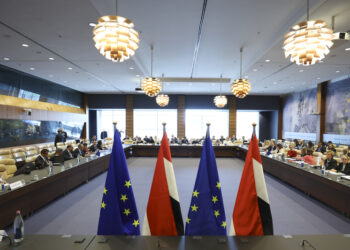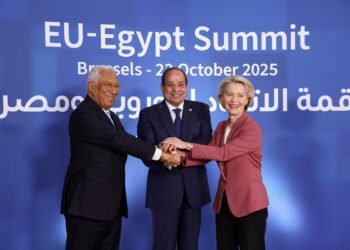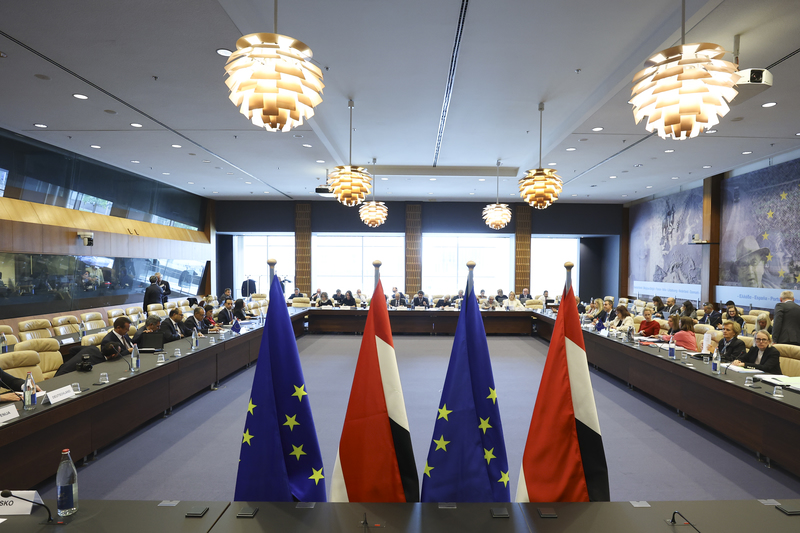

Brussels – A new European macro-financial aid package to support the Egyptian economy, but also a further step in the European Union’s controversial strategy of rapprochement with Cairo. The European Commission has today (24 July) disbursed €1.5 billion in macro-financial assistance (MFA) to Egypt, the second tranche of the programme totalling €4 billion launched to support the North African country. The European Commission announced this in a press release. Brussels’ stated aim is to help the Egyptian government cope with financial pressures, strengthen macroeconomic stability and support the reform programme agreed with the International Monetary Fund (IMF).
The new support takes the form of subsidised loans and is part of the wider EU-Egypt strategic and comprehensive partnership, signed in March 2024 and worth a total of €5 billion in European financial assistance. The first tranche of one billion was paid out in January 2026, while the final part of the programme is expected to complete the package in the coming months.
According to the European Commission, Egypt has met all the necessary conditions for receiving the funds: from the implementation of economic reforms to maintaining the programme with the IMF, right through to certain “concrete and credible steps” towards strengthening democratic mechanisms, the multi-party parliamentary system, the rule of law, and respect for human rights.
It is precisely this last point, however, that remains the most controversial. While Brussels highlights the progress made by Egypt, international organisations and activists continue to denounce a political landscape characterised by repression of dissent, restrictions on civil liberties, and a dominant role for the security forces in public life. Since 2014, the year President Abdel Fattah al-Sisi came to power following the military coup that led to the ousting of President Mohamed Morsi, the country has repeatedly been accused of progressively eroding democratic freedoms. The Egyptian authorities reject these accusations and maintain that the measures taken are necessary to ensure stability and national security. Against this backdrop, the European Union’s decision to strengthen economic ties with Egypt has been criticised by various voices within civil society according to which the EU runs the risk of sidelining the issue of human rights on the grounds that it prioritises strategic interests and undermines its credibility as a promoter of democracy and the rule of law.
But for Brussels, Egypt is a key partner in terms of energy security, the management of migration flows, regional stability, and the balance of power in the Middle East, particularly following the outbreak of war in Gaza and the crises in the rest of the region. And the partnership agreement signed in 2024 marked a shift in bilateral relations: Brussels has chosen to regard Cairo as a strategic ally, despite persistent criticism of the domestic situation.
Finally, on the economic front, the European Commission highlights the achievements of the Egyptian government: these include the strengthening of public finance management, improvements to the foreign exchange market, the reform of state-owned enterprises, the digitalisation of public services, and some progress in the green transition, particularly in the water and energy sectors.
Despite all this, in one of the EU’s founding member states, Italy, more than ten years after the abduction, torture, and murder in Cairo of the Friulian researcher Giulio Regeni, the quest for truth and justice continues. A trial which, as Deputy Public Prosecutor Sergio Colaiocco stated in his closing speech on 23 June, “has not, from the very outset, been a trial like any other” because “it has been a trial against those who did not want to speak, against those who refused to cooperate, against those who trusted that time would erase the evidence. It has been a trial against lies. Against contrived accounts, against attempts to mislead the investigation.” For the four Egyptian intelligence agents on trial, the magistrate has sought a life sentence and three sentences of 17 and a half years. The verdict is scheduled for 28 September. But Regeni’s abduction, torture, and murder never really made much of an impact at the Berlaymont Building. Only the European Parliament managed to adopt, in 2016 and in 2020, two resolutions condemning the murder of the Italian researcher and Cairo’s human rights violations, and urging the Egyptian authorities to cooperate with the Italian judicial authorities.
English version by the Translation Service of Withub