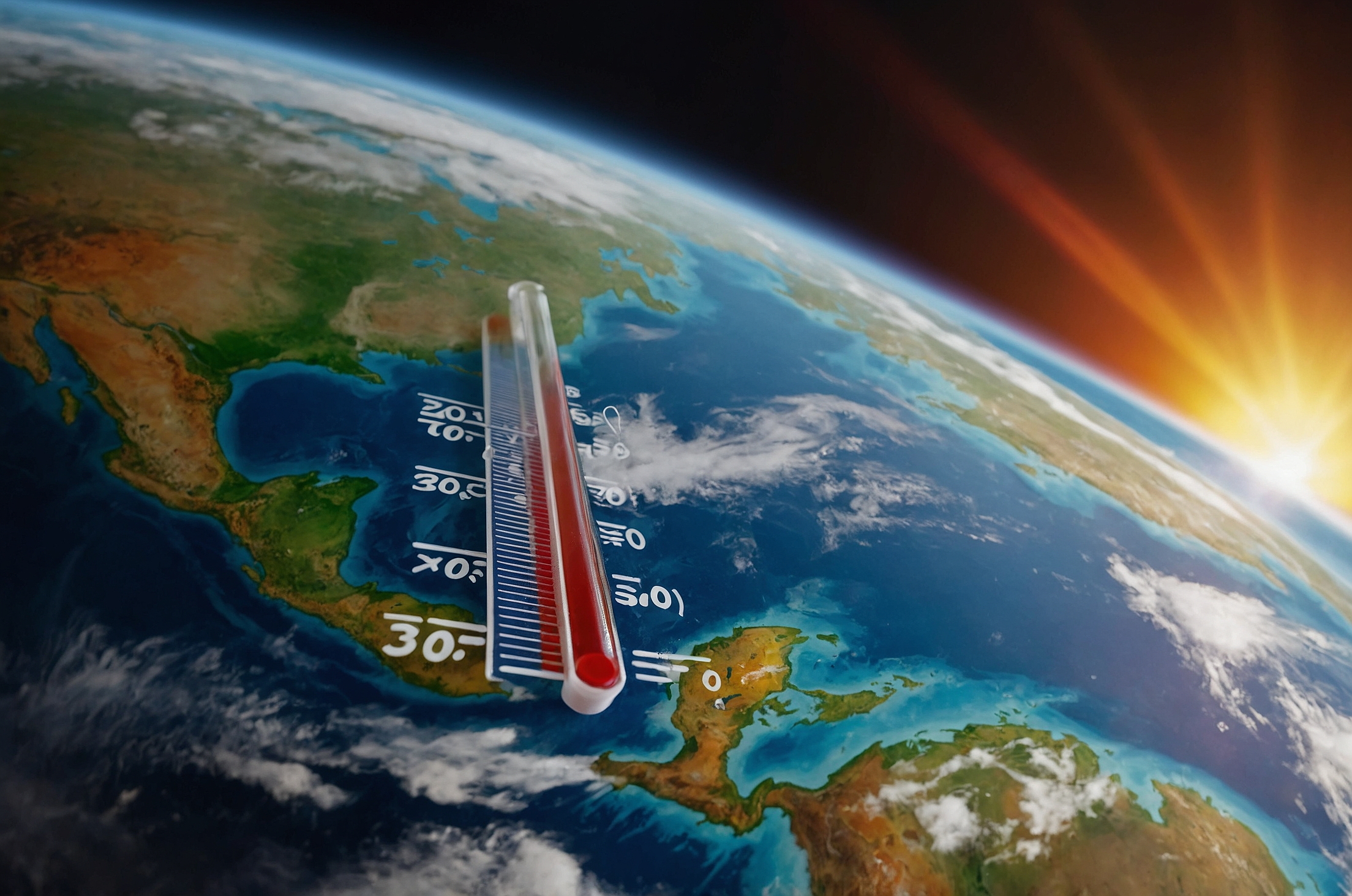

Brussels – The fight against climate change: it’s not working. Ten years after the Paris Agreement was signed at the international level to try to limit the rise in global temperatures, “greenhouse gas emissions are still rising, albeit at a slower rate than in previous decades. This is the finding of experts at the European Central Bank in a special bulletin dedicated to the topic. The 149 signatory countries, including those of the European Union, are therefore failing to meet the climate challenge. The data, outlook, and trends speak for themselves: “Mitigation efforts are not sufficient to keep the 1.5°C target within the set limits.”
ECB experts warn that carbon uptake by the soil “is declining” and that the remaining carbon budget to limit the temperature rise to 1.5°C “is almost exhausted,” implying “an increasing likelihood of exceeding geophysical tipping points.” This situation effectively shifts the paradigm of the political agenda, whether it is a 12-star one or not: “As tipping points draw nearer and the urgency increases, the question is no longer whether to act, but how to act decisively, adaptively, and collectively to tip the balance in favour of a sustainable future.”
https://www.eunews.it/en/2025/01/10/2024-the-hottest-year-ever-exceeded-the-limit-of-the-paris-climate-agreements/
Adopted on 12 December 2015 and entering into force on 4 November 2016, the Paris Agreement sets its overall objective as keeping the rise in global average temperature well below 2°C above pre-industrial levels and limiting the temperature increase to 1.5°C above those same pre-industrial levels. Ten years on, the ECB report continues, “the climate crisis is accelerating.” Assuming there is no further strengthening of climate mitigation measures in the coming years, global warming of around 3.2 °C is projected by the end of the century, with a margin of uncertainty ranging from around 2.2 °C to 3.5 °C. Not only that: “an intensification of extreme weather events, biodiversity loss and ecosystem collapse, which will rank among the top three global risks for the coming decade,” is forecast. On the horizon, therefore, lies a worsening of already familiar crises, including the wave of climate refugees.
In short, it is time to take action—and to do so in earnest, in accordance with written and heralded commitments. “Ten years on from the Paris Agreement, global greenhouse gas emissions have not yet begun to decline significantly,” and both the level of ambition and the level of implementation “remain considerable,” the ECB document acknowledges. But take note: all is not yet lost. “The picture is not one of failure, but of partial progress,” and of rapidly expanding response capacities that “can still be harnessed on a large scale.” In practice, this means “effective climate risk management” based on “two temporal dimensions: reaction time and intervention time.” In this sense, policy should not move towards “a rejection of existing instruments,” namely carbon pricing, regulation, public investment, innovation policies, transparency, funding for adaptation or international coordination. It is a matter of bringing about “a change in the logic that organises them.”
In a nutshell, ten years on from the Paris Agreement, we must stop thinking in terms of the old logic whereby climate policy aims for marginal reductions in emissions in the face of known risks, to be optimised through discrete measures and gradual adjustments. On the contrary, as the ECB’s experts point out, “the new paradigm is based on profound uncertainty, extreme risks, tipping points, political and geophysical inertia, and the possibility of catastrophic outcomes.” The new reality, therefore, requires “a systemic, precautionary, and adaptive framework that is compatible with incentives, capable of reducing the likelihood of irreversible climate damage, even when the probabilities are poorly understood.”
English version by the Translation Service of Withub