
Brussels – To step down or not to step down as President of the European Central Bank before the natural end of her term of office, scheduled for 31 October 2027. Christine Lagarde has expressed ambivalence, first stating that she wishes to fulfil her current role to the end, then leaving open the possibility of returning to French politics and thus stepping down early. These remarks have inevitably sparked speculation about potential successors.
Lagarde and her political commitment
“I am not standing for any office, but I am very keen to ensure that Europe is safeguarded and that it remains the framework within which Member States, including France, can develop,” said Lagarde in an interview given to Euronews in early July. At first glance, these words appear to rule out her participation in the French presidential election on 18 April 2027 (first round). There is still a long way to go (nine months since the President made these remarks), and a great deal can still happen.
One thing is certain: the outgoing and incumbent president, Emmanuel Macron, will not be able to stand for re-election. Unlike Mario Draghi, a technical figure, Lagarde has a political calling and background: formerly a member of the UMP (affiliated with the EPP), she served as Minister for Foreign Trade, Minister for Agriculture and then Minister for the Economy. She knows the EU well, having navigated its waters in these roles and as a member of pro-European parties. With France’s traditional parties struggling, her name could attract support within the pro-European and Atlanticist centre-right. She seems to be biding her time. She is not standing for election, but if someone were to put her forward as a candidate, the path to a political career could open up for her.
ECB: a political bargaining process in a Europe with many seats to fill
Lagarde’s comments and the speculation surrounding them have merely brought forward a process – of appointing her successor – which was already on all the leaders’ agendas but had been deliberately left unresolved. This is partly because, at the EU level, there are other issues considered to be of more immediate priority, starting with the approval of the next multiannual financial framework (MFF 2028–2034). The political objective is to reach an agreement in October, and this issue alone – perhaps even more complex than in the past due to a new framework in the budget – is reason enough to hold off on discussing the renewal of the ECB presidency.
Then there is the issue of a Trump presidency still in full force. The US mid-term elections are due to take place on 3 November, and the EU is waiting to see whether Donald Trump will retain control of Congress. A victory by the Democrats would ultimately limit the US President’s scope for action regarding new Euro-Atlantic relations. This is yet another reason for the delay in discussing such a complex issue.
The post-Lagarde era: the first names and the challenges of the negotiations
The first unofficial names are already circulating, but these should be treated with caution, given that a formal selection process has not yet begun. It is believed that three current and former central bank governors are already in the running to succeed Lagarde: Klaas Knot (former governor of the Dutch central bank), Pablo Hernández de Cos (Spain), and Joachim Nagel (German, former Bundesbank president).
In politics, the impossible often materialises, but one must remember the rule of political and national balance when assigning top posts in EU institutions. Germany already has Ursula von der Leyen at the helm of the European Commission, and it seems difficult to imagine Nagel also taking the helm of the ECB. Looking ahead, however, with the 2029 European elections, Berlin will certainly lose the presidency of the EU executive, and attempting to force the issue would mean securing top roles for the future (the ECB president has a non-renewable eight-year term).
On the other hand, Spain cannot aspire to the role either, given that Nadia Calviño is already President of the European Investment Bank (until 31 December 2029, with the possibility of renewal). Moreover, at present, Spain is the only EU country with a socialist government in the true sense of the word (the socialist parties in Denmark and Malta are considerably more conservative on many issues).
Then there is the matter of France: with Lagarde’s departure – whether early or not – Paris will lose a top post. At the moment, however, French politics is focused on the presidential elections in April, and the balance of power in Europe has taken a back seat. Macron has, however, managed to secure the appointment of his compatriot François-Louis Michaud at the helm of the European Banking Authority (EBA), ensuring that France retains a leading role at least until March 2031. This does not spell the end of other ambitions for top positions. Still, it allows France to buy time and wait until January, when the EU will be called upon to decide whether to confirm Roberta Metsola (EPP) as President of the European Parliament.
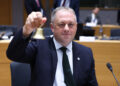
This is likely to be the first real test for the new twelve-star organisation, as the re-election of the President of the Parliament coincides with that of the European Council: Antonio Costa has a two-and-a-half-year term expiring in mid-2027, and the “musical chairs” of EU appointments sees the Parliament, the Council, and the ECB closely intertwined in these dynamics, which are entirely political (the Socialists would like to see Costa’s term in the Council extended, while the EPP would like to retain control of the Parliament and perhaps even take over the Council), yet at the same time geographically driven. It should also be noted that the current Vice-President of the ECB, the Croatian Boris Vujčić, was nominated by the Croatian Prime Minister (EPP) and supported by the Eurogroup with an EPP majority.
The European Union today, however, finds itself at the starting line more divided and contentious than ever before, as demonstrated by the debate on the same common budget and, even more so, by migration issues. Forging alliances, reaching agreements, and striking compromises appear more complicated than ever. The tensions building up between the governments of the Member States risk spilling over into this appointment process, which is anything but straightforward.
English version by the Translation Service of Withub
![Boris Vujčić [foto: MEF, account X]](https://www.eunews.it/wp-content/uploads/2026/01/vucjic-350x250.jpeg)