




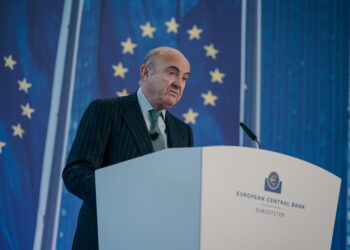
Brussels – The eurozone is grappling with geopolitical uncertainties stemming from the war in Ukraine, the war in the Middle East, and, even more so, the war in Iran, with knock-on effects on energy prices. Christine Lagarde is trying to instil optimism. The President of the European Central Bank is aware that the situation is far from ideal, given that the Governing Council has already raised interest rates in response to the latest surge in inflation and that further upward adjustments are likely in September. However, this does not mean the situation is spiralling out of control. On the contrary, the eurozone is proving its resilience.
“Last year the euro area economy grew by 1.5 per cent, driven entirely by domestic demand,” Lagarde said at the International Business Council, the advisory body comprising around 120 of the world’s leading chief executives, representing various sectors and regions, established within the World Economic Forum. In addition to the expansion in 2025, “in 2026 it has continued to grow despite the energy shock, with domestic demand contributing positively to the quarter-on-quarter growth of 0.4 per cent in the second quarter of 2026.”
It is not the time to lower the guard, but it should also be noted that the eurozone remains a solid and well‑established reality. Lagarde does not deny Europe’s limitations, as demonstrated by the fact that “some 12 per cent of EU scale-ups have relocated outside the EU, most notably to the United States.” There is therefore work to be done, but, as the ECB President insists, the fundamentals are in place, and there are reasons to be optimistic: “At home, we retain world-class manufacturing capabilities, including global leadership in areas such as lithography and precision optics. We have a highly skilled workforce too.”
Furthermore, Lagarde insists, “we have a world-class research and knowledge base.” Numbers in hand, the ones she reels off, “the EU accounts for around 6 per cent of the world’s population but as many as 15 per cent of its researchers. It also produces almost one-fifth of the world’s most-cited scientific publications.” Looking to the immediate future, “Europe is well placed to make the most of new technologies,” Lagarde insists.
From an innovation perspective, “there are already encouraging signs that European businesses are investing in artificial intelligence,” a sign that they are not standing idly by and that they are keen to keep up with the times. Lagarde notes with some satisfaction that “survey evidence suggests that firms in the euro area expect to allocate an average of around 9 per cent of their total investment to AI this year.”
In short, the EU and its eurozone are here to stay, more vibrant than ever, and the crisis – or slowdown – that many fear, even within the ECB itself, is merely a theoretical scenario that the twelve-star reality leaves as just that. Lagarde is convinced of this: “We already have many of the ingredients for stronger long-term growth.” Now it is a matter of blending these ingredients properly: “The challenge lies in turning that knowledge into commercial success and ensuring that new technologies diffuse across the economy.”
English version by the Translation Service of Withub




![Ilze Brands Kehris [foto: European Council]](https://www.eunews.it/wp-content/uploads/2026/10/ilze-120x86.png)
