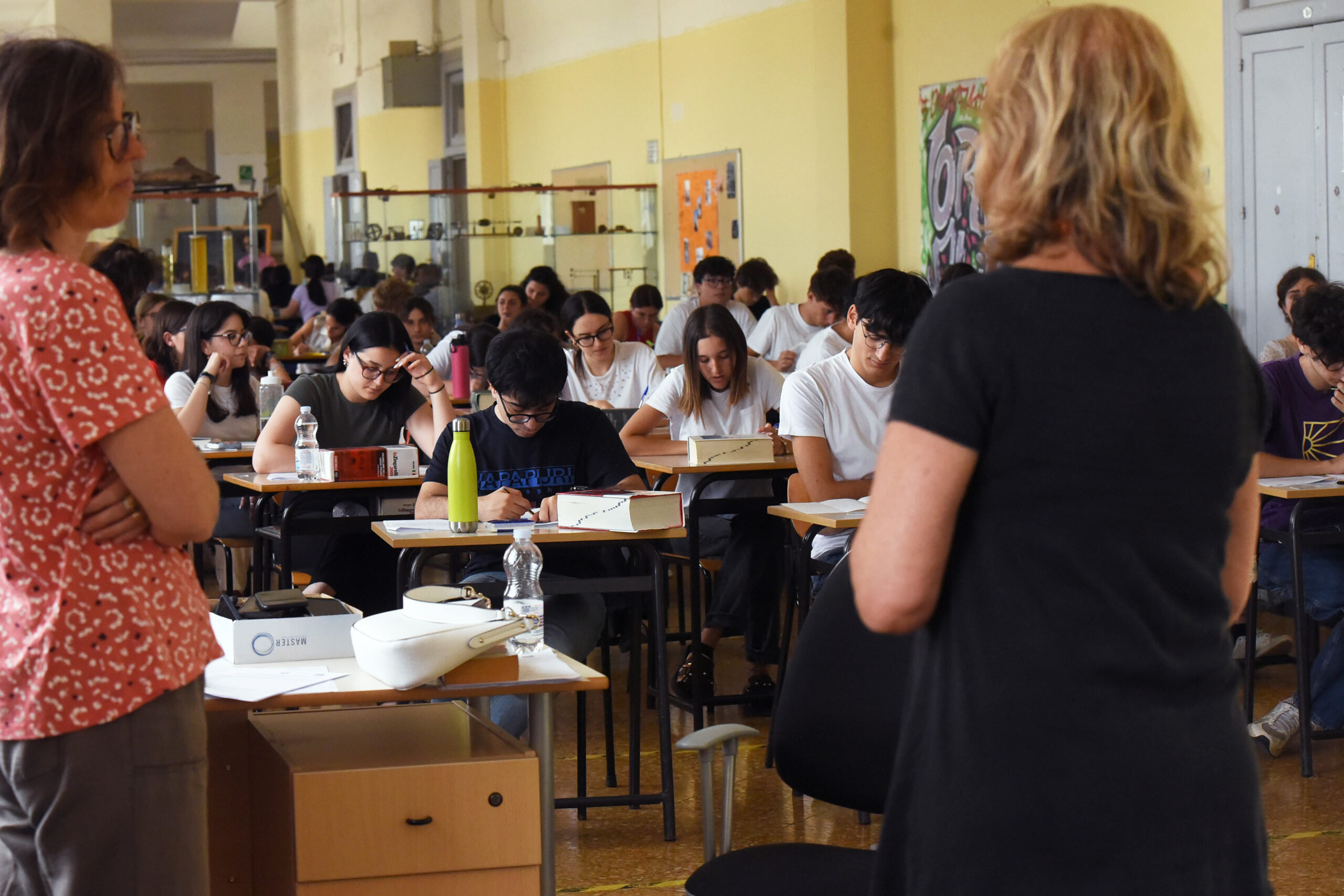
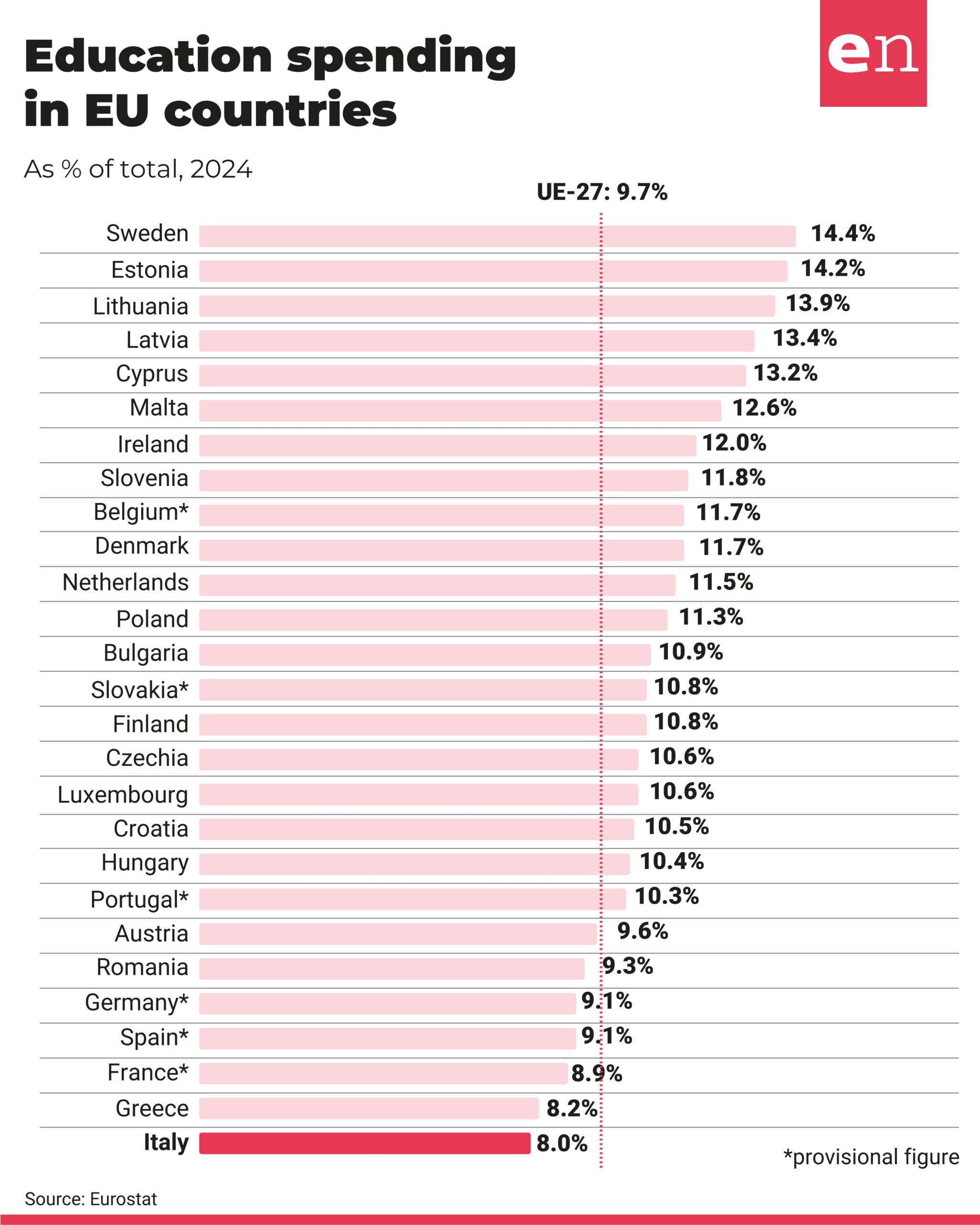
Brussels – A healthy school is one where salaries are good, and the quality of working life is satisfactory. This is the blueprint for successful education, according to the European Commission’s report on investment in teaching. However, in Italy, such investment leaves much to be desired. The first figure that stands out is public education spending: Italy (figures updated to 2024) ranks last in terms of support for education. The European Commission uses two indicators: the percentage of total public expenditure and the percentage as a proportion of Gross Domestic Product (GDP). “At the country level, the former varied from 14.3 per cent in Sweden
to 8.0 per cent in Italy,” the document notes.
The situation changes, albeit only slightly, when the second expenditure parameter – that relating to GDP – is taken into account: in Italy, the figure stands at 4 per cent, with lower figures recorded only in Greece (3.9 per cent) and Ireland (2.7 per cent). Italy therefore ranks low in terms of investment in education, confirming a trend that is becoming increasingly structural, given that the 2023 figures showed five other EU countries ranking below Italy in terms of education expenditure as a proportion of GDP, whereas now there are only two. This is a sign of a clear political will not to prioritise this area.
Moreover, the study notes a general lack of commitment to education. Between 2019 and 2024, public spending on defence increased by 0.5 per cent and public spending to support the economy by 0.7 per cent, whilst state support for education (-0.3 per cent) and social policies (-1.2 per cent) fell over the same period.
For the Italian system, however, the situation is even more serious regarding pay. While it takes 12 years to reach the highest salary level in Denmark and the Netherlands, in Italy it takes at least 35 years to reach the top of the pay grade, the study warns. To be fair, the country is not alone; Greece, Ireland, Slovakia, and Spain also require “at least” 35 years to reach the highest pay level, but being a teacher in Italy is certainly unattractive.
Looking at the figures, “The findings show that over 3 in 4 teachers (76.5 per cent), if given the choice to choose a new profession, would choose to continue to teach.” In Italy, the figure drops to 50 per cent: one in two people is tempted to change careers due to an underfunded school system at risk of remaining so. In an Italy that does not invest in education, the Recovery Fund alone – the financial instrument of the National Recovery and Resilience Plans (NRRP) – provides 28.2 billion euros, making the country the main beneficiary of fresh European funding for schools, education, and training. As was the case for Southern Italy, where Italy used EU funds as a substitute for national resources rather than as a supplement, there is a risk that the same thing could happen to the education system.
For Italy, the Commission’s report serves as a reminder and a fresh call for genuine reform of the sector. Roxana Minzatu, Executive Vice-President for Social Rights and Skills, does not beat around the bush: “This report makes clear that attracting and retaining teachers is not only about salaries. It is also about working conditions, well-being, professional recognition and opportunities to grow throughout a career.” Not exactly Italy’s picture.
English version by the Translation Service of Withub
![[foto: Flautomagico25/Wikimedia Commons]](https://www.eunews.it/wp-content/uploads/2026/02/Laurea_di_Clelia-350x250.jpg)