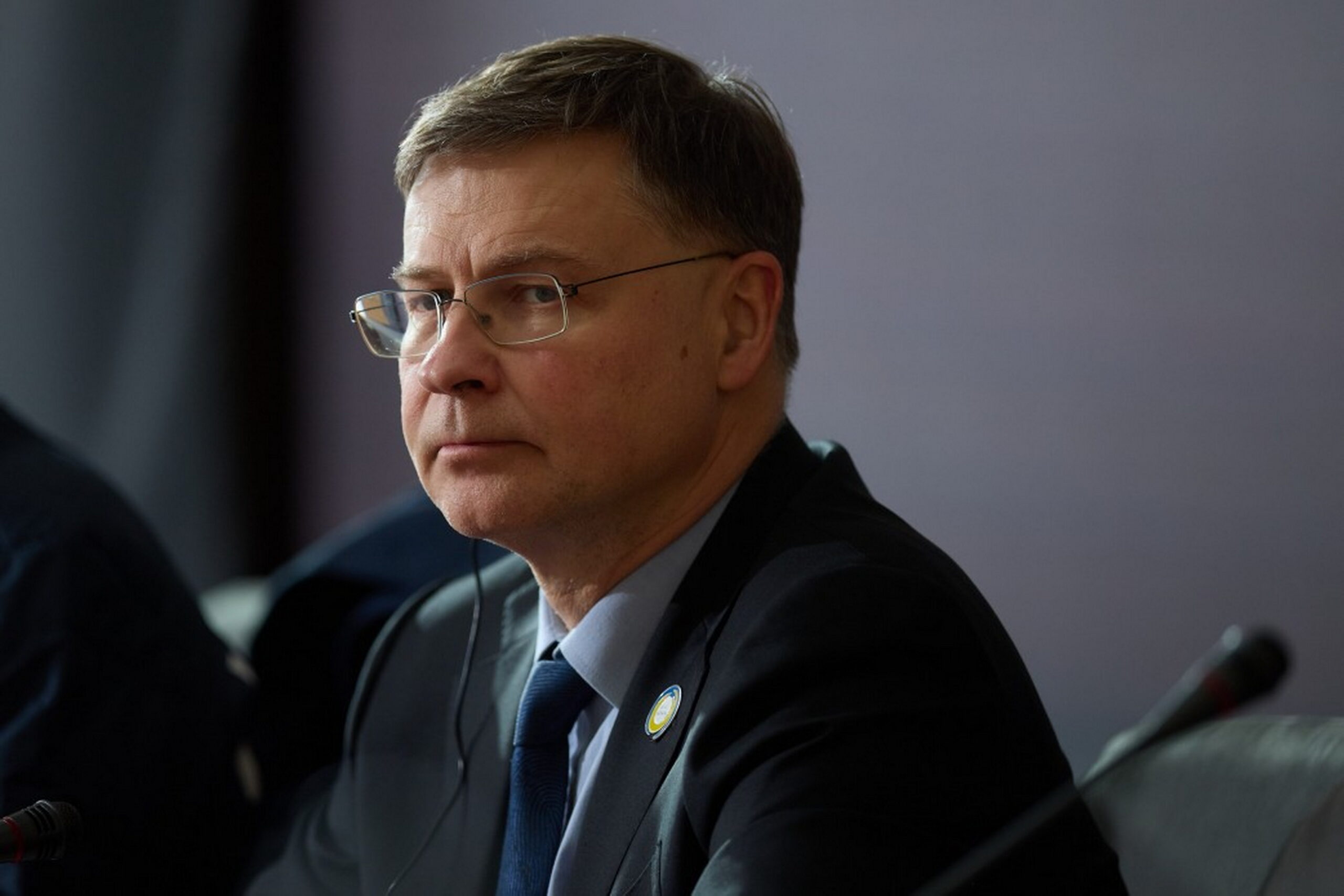
Brussels – Russia’s return to the G20 Finance Ministers’ meeting in Asheville, North Carolina, is heightening already high tensions between Washington and the European Union. Russian Finance Minister Anton Siluanov, invited by the United States, took part in the two-day meeting of finance ministers and central bank governors from the world’s leading economies. Moscow’s presence immediately provoked a reaction from the EU. Among the first to take a stand was the European Commissioner for Economic Affairs, Valdis Dombrovskis: “We do not believe at all that this is the time to normalise Russia’s presence,” in light of the intensified attacks on civilian targets in Ukraine.
The EU Commission’s position was confirmed by the Commission’s spokesperson, Paula Pinho, during the press briefing. Dombrovskis, the European Union’s representative at the G20 Finance Ministers’ Meeting, “has had no contact with the Russian minister, nor does he intend to have any,” Pinho clarified.
Trump defends the invitation; Bessent meets Siluanov
US President Donald Trump directly justified Washington’s decision. “We like to get on well with everyone. One of the reasons for my success is that I get on well with everyone,” he said, defending the open stance towards Moscow.
Meanwhile, US Treasury Secretary Scott Bessent met Siluanov in a bilateral meeting on the sidelines of the first day of the proceedings. The United States is said to have extended the invitation to the Russian minister without prior involvement from its European counterparts, further fuelling tensions between Washington and Brussels.
The European position was also endorsed by the German Finance Minister, Lars Klingbeil, who described the signal sent by the reception given to the Russian representative as “worrying.” He emphasised that, while the war in Ukraine continues, it is not possible to behave as if relations with Moscow had returned to normal.
Russia left out of the family photo
The standoff continued right up to the traditional G20 “family photo”. Several European representatives had threatened not to take part in the photo if Siluanov appeared alongside the other ministers. In the end, the Russian representative did not appear in the photograph.
And so a photograph becomes a political statement: Europe is keeping its distance from Moscow, reiterating that support for Ukraine remains one of the key red lines in relations with Russia. This stance echoes the principle of “as long as it takes”, which has been repeatedly emphasised by the President of the European Commission, Ursula von der Leyen.
Growth, debt and deregulation at the heart of the G20
Under the US chairmanship, the Asheville meeting is focusing on global economic growth, trade imbalances, sovereign debt, banking regulation and energy security. Bessent is particularly keen to put economic growth and the reduction of regulatory barriers back at the centre of the agenda. According to the US Treasury Secretary, greater growth is the way to tackle the enormous accumulation of public debt. Washington also supports greater deregulation of the financial sector.
The United States is also seeking international support for its campaign of economic pressure against Iran. Bessent has announced possible new sanctions and is seeking to persuade allies to tighten the financial noose around Tehran, while the military escalation in the Middle East continues to weigh on energy prices and market stability. On Iran, Washington and Brussels are, at least in part, on the same page. The EU has said it supports further economic pressure on Iran and wants to work with the United States and other G7 partners to promote de-escalation and regional stability.
China and trade imbalances
However, the Russian issue above all highlights how difficult it is for the two sides of the Atlantic to maintain a common position on the entire G20 agenda. For Europeans, the war in Ukraine remains a political dividing line; for the Trump administration, the forum must, above all, return to being a tool for negotiation on growth, trade, energy, and economic security.
China is also on the agenda in Asheville. Bessent has called on G20 partners to tackle what Washington considers an unsustainable trade imbalance, pointing to China’s huge trade surplus, which the United States estimates at around $1,200 billion. Dombrovskis expressed his reservations precisely on the issue of global imbalances. “Personally, I have had, and continue to have, reservations about discussing issues such as global imbalances with a representative of an aggressor state that carries out brutal attacks against civilians on a daily basis. It is a matter of respect for the victims,” said the European Commissioner.
English version by the Translation Service of Withub
![Il premier israeliano, Benjamin Netanyahu (sinistra) e il presidente russo, Vladimir Putin [foto: imagoeconomica]](https://www.eunews.it/wp-content/uploads/2026/08/putin-netanyahu-350x250.png)


![[foto: European Council]](https://www.eunews.it/wp-content/uploads/2026/03/euco-260319-120x86.jpg)