



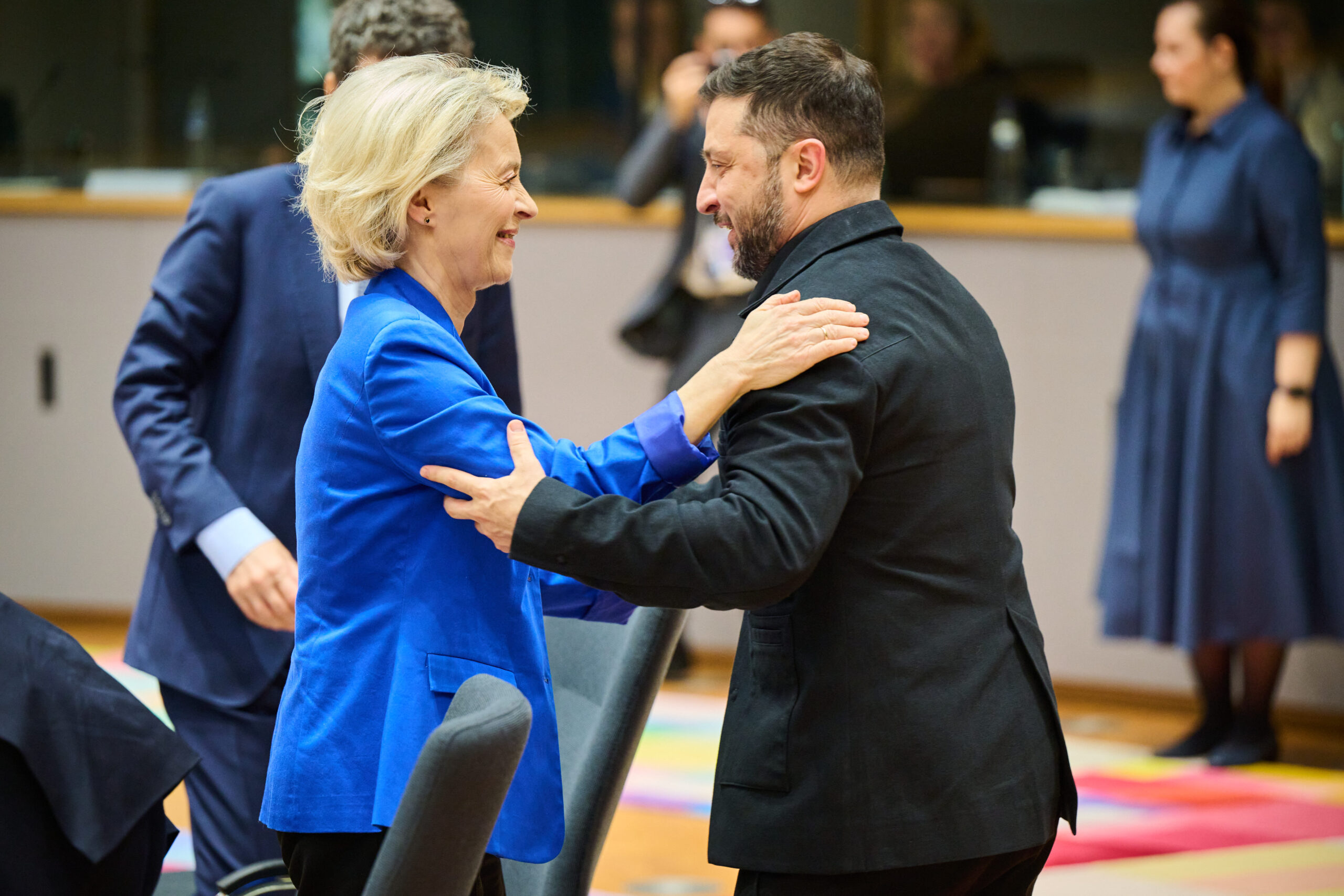
Brussels – Following last night’s Russian attacks on Kyiv and in the Odessa and Chernihiv regions, the European Union has once again reaffirmed its support for Ukraine, in line with the stance Brussels has set out more than once, namely “as long as it takes”, for as long as necessary. However, against the backdrop of the war, internal issues affecting the government are mounting.
New corruption investigations involve figures close to the presidency, while the debate over whether to hold elections during the conflict is resurfacing. For now, however, these internal developments do not appear to have altered Brussels’ stance. Indeed, following last night’s Russian attacks, von der Leyen has emphasised once again the need to “strengthen Ukraine’s defence capabilities,” particularly its defences against ballistic missiles.
The EU: “Support Ukraine’s anti-ballistic capabilities”
The Russian attack struck Kyiv and other parts of the country with missiles and drones. According to Ukrainian President Volodymyr Zelensky, the raids “have caused casualties and injuries and damaged residential buildings, a children’s hospital, and a school in the capital,” as well as infrastructure in the Odessa and Chernihiv regions. According to Reuters, the death toll has risen to 16, with more than 40 people injured in Kyiv and the surrounding areas. Zelensky used the attack to renew his call on allies to supply additional interceptors for the Patriot systems. For the Ukrainian president, sufficient anti-ballistic capabilities remain essential to protect cities and save lives.
Von der Leyen responded by reposting Zelensky’s message on X. “Russia is losing the war it started. And it is retaliating by targeting civilians and civilian infrastructure,” wrote the Commission President, explaining that Brussels is working “with Member States and our partners to support Ukraine’s anti-ballistic capabilities.” The aim, she added, is to provide Kyiv with the means to prevent loss of life, which she describes as “the most urgent priority.”
European support for Ukraine’s defence therefore remains a central pillar of the EU’s policy on the war. As recently as the end of July, the European Commission announced the allocation of a further €3.47 billion for drones, missiles, air defence, and fighter aircraft as part of the EU’s €90-billion loan to Ukraine.
New corruption investigations
New investigations involving members of the Ukrainian institutions are under way against this backdrop. On 19 August, the National Anti-Corruption Bureau of Ukraine (NABU) and the Specialised Anti-Corruption Prosecutor’s Office (SAPO) announced una nuova operazione, denominata “Forrest Gump”.
The investigation concerns an alleged criminal organisation,
according to investigators, involving a sitting MP, a former MP and senior
officials from the President’s Office.
Among those involved in the searches is Iryna Mudra, deputy head of the Presidential Office, who is also responsible for legal affairs and judicial reform. Investigators searched her home and, on the same day, Zelensky signed the decree to remove her from office.
Anti-corruption authorities also carried out searches at the home of MP Vadym Stolar, who was previously elected on the ticket of the pro-Russian Opposition Platform, For Life, a party banned following the large-scale Russian invasion.
The investigations are still ongoing, and the allegations will have to be substantiated in the relevant courts. The operation is, however, part of a wider series of anti-corruption investigations which, in recent months, have targeted high-ranking figures in Ukrainian politics, increasing the pressure on the Zelensky administration.
The crux of the elections
Alongside the new investigations, the debate over the elections has reignited in Kyiv.
The
former Defence Minister, Mykhailo Fedorov, raised the issue publicly and has
called for a return to the polls even while the war is ongoing. The issue is a direct attack on President Zelensky, who sacked Fedorov about a month ago, causing major upheaval in Ukrainian politics which has not yet fully subsided. Zelensky’s presidential term formally expired in May 2024, but the elections scheduled for March of that year did not take place due to martial law.
For Brussels, however, it is not for the EU to decide when Ukrainians should return to the polls. The Commission’s position is that “it is up to Ukraine to decide when to hold them, in full compliance with its own legal framework.” As the Foreign Affairs spokesperson Anitta Hipper explained, the EU stands ready to support Kyiv throughout the electoral process, in line with democratic standards and expectations.
The issue is not merely legal; it is also linked to security and the practical conditions under which the vote might take place. With the war still raging, territories occupied by Russia, millions of citizens outside the country, and attacks continuing to strike cities, organising an election campaign and a national vote presents significant difficulties.
Support for Kyiv and reforms: two separate issues
The events of recent weeks therefore raise two distinct issues. On the one hand, there is the EU’s support for Ukraine in the war against Russia; on the other, the domestic reform process and the functioning of the institutions.
T
he fight against corruption, the independence of institutions and respect for the rule of law are, in fact, key elements in Ukraine’s path to accession to the European Union. In June, von der Leyen had highlighted Kyiv’s progress on reforms, and European support is linked to continuing this journey towards the Union. EU accession therefore remains linked to Ukraine’s ability to press ahead with the required reforms.
For Brussels, these two aspects do not currently translate into a policy change on support for Kyiv. The European Commission continues to regard Ukraine’s ability to defend itself against Russian attacks as “a priority”, while the Ukrainian authorities are called upon to continue their work on reforms.
English version by the Translation Service of Withub![Il premier israeliano, Benjamin Netanyahu (sinistra) e il presidente russo, Vladimir Putin [foto: imagoeconomica]](https://www.eunews.it/wp-content/uploads/2026/08/putin-netanyahu-350x250.png)




![Ilze Brands Kehris [foto: European Council]](https://www.eunews.it/wp-content/uploads/2026/10/ilze-120x86.png)
