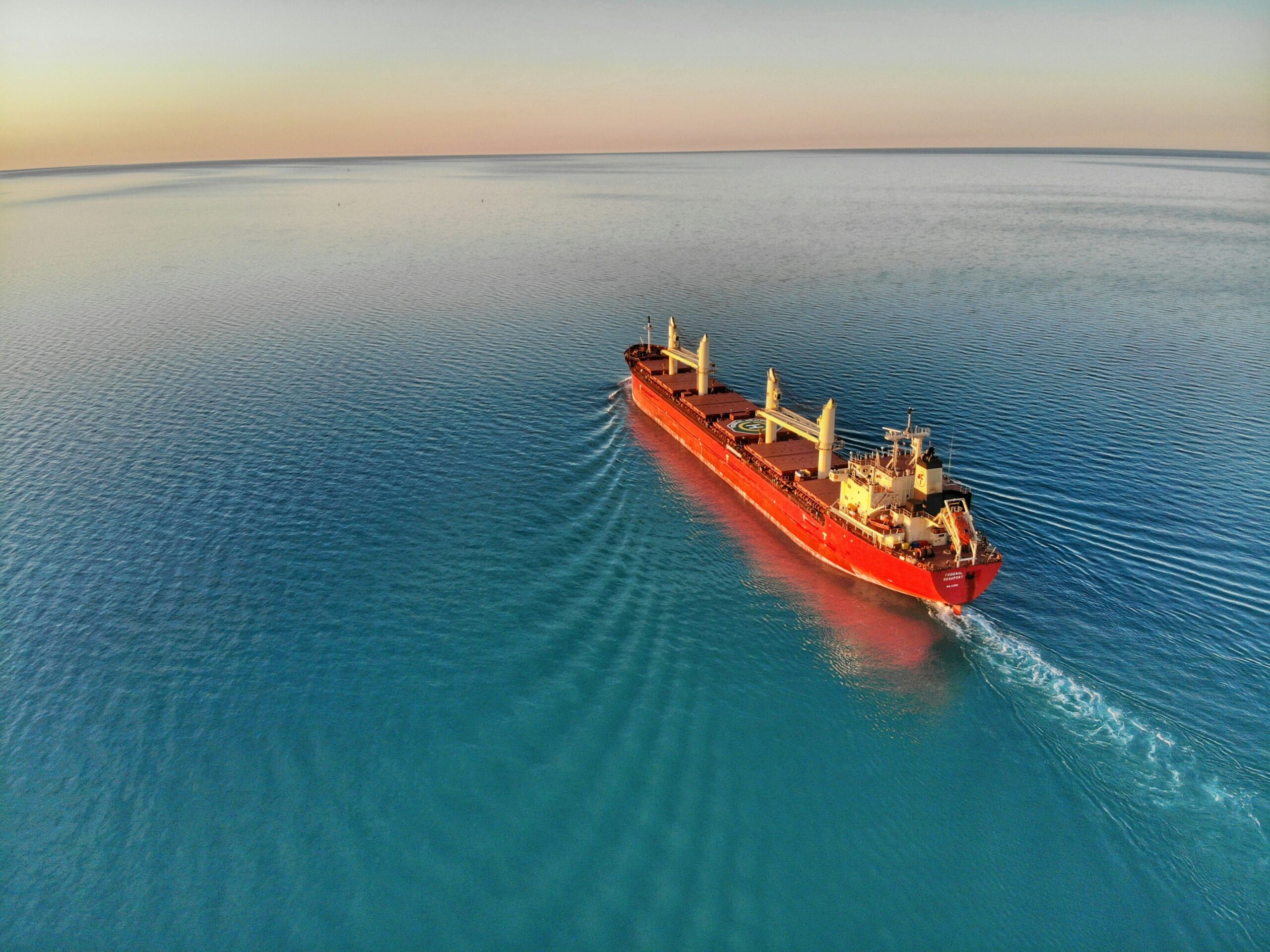
Brussels – This time, it’s CO₂ that travels: it will board a ship in the Netherlands, cross the North Sea and end up stored over 2,600 metres underground, beneath Norway’s seabed. As of today (7 September), this will be the new route for the CO₂ captured at Yara’s plant in Sluiskil, in the Netherlands, as part of the CCS (carbon capture and storage) project.
Yara’s facility begins operations today. Technically, CO₂ will be captured and liquefied at Sluiskil, and permanently stored beneath the North Sea in Norway. The Dutch plant, which produces ammonia and fertilisers, will be able to capture up to 800,000 tonnes of CO₂ per year, with a projected total of around 12 million tonnes over the next 15 years. Once liquefied, the CO₂ will be transported by ship to Øygarden, on the west coast of Norway, where it will enter the Northern Lights infrastructure – developed by Equinor, Shell, and TotalEnergies – and will be injected approximately 2,600 metres below the seabed.
The project is the result of the EU-Norway Green Alliance signed in 2023. The agreement aims to strengthen cooperation on the green transition and, for the EU, Sluiskil is one of the most tangible examples of this. “European cooperation, combining private investment and public support and bringing together industry, the EU, its Member States, and Norway,” said the European Commission in a press release. Furthermore, the European Union is helping to make the project between the Netherlands and Norway possible by funding Northern Lights through the Connecting Europe Facility. For Brussels, it is therefore an example of how private investment and European funds can support strategic infrastructure for industrial decarbonisation.
Today’s inauguration of the Dutch facility – which is the largest commercial carbon capture and storage (CCS) project in Europe – was attended by the European Commissioner for Climate Action, Wopke Hoekstra, the Norwegian Prime Minister, Jonas Gahr Støre, the Dutch Prime Minister, Rob Jetten, and the Chairman and CEO of Yara International, Svein Tore Holsether.
It is precisely from Norway that Europe can draw inspiration for the energy transition, given that the country generates almost all of its electricity from renewable sources, primarily hydropower, and has developed infrastructure for CO₂ capture and storage that is now also used by European industry. From this perspective, for Brussels, the project demonstrates how emissions can be reduced without weakening Europe’s industrial base. “This is exactly the kind of project Europe needs to combine climate ambition with a strong and resilient industrial base,” Hoekstra explained. CCS is primarily intended for sectors where reducing emissions is more complex, such as the fertiliser and ammonia sectors, and forms part of the Clean Industrial Deal strategy and the revision of the European Emissions Trading Scheme (ETS).
“Europe must go all‑in on energy that is ultra‑low‑cost, clean, reliable and produced within Europe. Naturally, renewable sources will play a fundamental role in this,” he added. “I am a great advocate of solar energy and wind power; I am also thinking of geothermal energy, and I am also thinking of nuclear power.”
According to Hoekstra, however, the transition must be pragmatic and open to all technologies capable of delivering results. “This is perhaps also the crux of this whole transition: let’s be pragmatic, let’s be truly open-minded. What matters is what actually works in terms of climate, competitiveness, and independence, and that is precisely what we are seeing today: building a solid industrial base. Reducing emissions and being at the forefront of clean technologies,” he said.
“But we will need more,” he pointed out. “We cannot wait for all this to be fully realised, and this is where CCS comes into its own. And that is also why we are here today, but also because Europe has recently announced that we intend to integrate CCS into the ETS system”.
English version by the Translation Service of Withub


![Il ministro dei Trasporti, Matteo Salvini [Bruxelles, 5 dicembre 2024. Foto: Emanuele Bonini per Eunews]](https://www.eunews.it/wp-content/uploads/2024/12/salvini241205-120x86.jpeg)