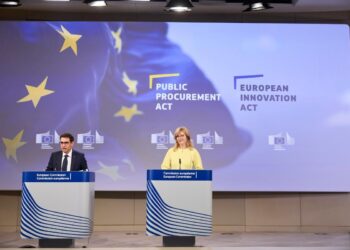

Brussels – Public procurement: the reform proposal is welcomed by workers and businesses alike. The entire decision-making process must run its course, followed by the implementation phase, but at least in the form presented in Brussels by the European Commission, it seems to have won universal support, starting with the European Trade Union Confederation (ETUC), which was the first to comment. The new proposal for EU rules on public procurement “represents a crucial opportunity to ensure that public money promotes quality jobs and collective bargaining”, argues the confederal secretary, Ester Lynch, who believes that now “the Parliament and the Council must strengthen the Commission’s proposal and turn it into a success for workers.”
For the trade unions, the European Commission’s initiative “acknowledges that the European approach based on awarding public contracts to the lowest bidder has proved disastrous for the quality of goods and services, as well as for the millions of workers who try to provide them with extremely limited resources.” Building on this, she continues, “the provisions on subcontracting must be strengthened to combat abuses, including by limiting the length of subcontracting chains.” Furthermore, in the forthcoming inter-institutional negotiations, “MEPs must strengthen the reference to collective bargaining in order to introduce mandatory social conditions.”
The business community has expressed some satisfaction: “The drive towards digitalisation, improved data collection, and transparency represents a positive step that we support,” states Markus Beyrer, director of BusinessEurope, the association of European industry federations. However, he adds, “public procurement is not a panacea for all the strategic challenges facing Europe.” This means that “we must focus on strengthening competition and finally unlocking a properly functioning cross-border procurement market.” Like the trade unions, businesses are also keeping a close eye on the approval process for the new rules: “We look forward to working with the EU institutions to ensure that the final rules set out a competitive, accessible, and efficient European procurement landscape.”
The agricultural sector has also welcomed the proposed reforms to public procurement: “For farmers and agricultural co-operatives, this reform could offer a practical way to strengthen Europe’s strategic autonomy and ensure that European taxpayers’ money supports the continent’s productive capacity, following years of procurement practices focused primarily on the lowest price,” was Copa-Cogeca’s statement, the umbrella organisation representing agricultural producer organisations across the EU. Of course, “some elements of the proposal presented today still require further clarification,” and so the primary sector, too, is awaiting the process that is now beginning.
Ecco, the Italian climate think tank, has also welcomed the move. “The European Commission’s new legislation on public procurement represents a positive step forward, as it moves beyond the “lowest price” approach by introducing quality-based criteria,” said Marta Lovisolo, Senior Advocacy Advisor at ECCO. “However, the parameters used to assess the “quality” of a contract can vary considerably, ranging from environmental, climate, and social benefits to considerations relating to safety, resilience, and European origin (made-in-Europe),” she added, emphasising that “climate performance remains just one of many options.” Therefore, “for public procurement to provide concrete support for the decarbonisation and competitiveness of European industry, clear, common, and progressively more ambitious low-carbon criteria are needed,” Lovisolo emphasised.
English version by the Translation Service of Withub