
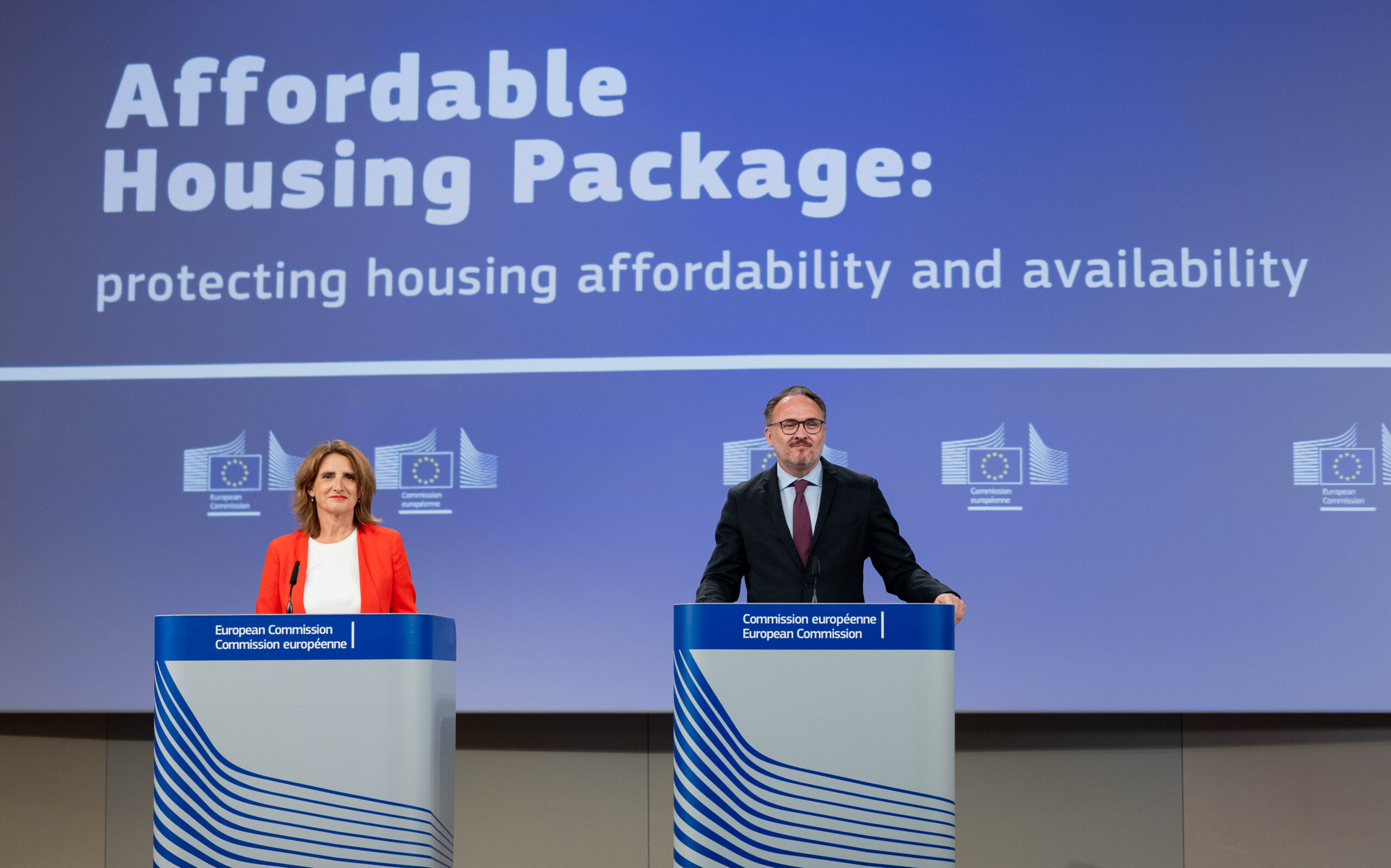
Brussels – Housing crisis: what can be done? Responsibility for this matter remains with the individual Member States of the European Union, but the situation has become “serious and urgent”, and the Commission wishes to have its say. It is doing so through the Affordable Housing Act, adopted today (9 September) by the College of Commissioners, which will be considered by the Parliament and the Council—and is therefore subject to changes and amendments—as part of the ordinary legislative procedure. The crux of the proposal lies in a set of criteria that will define the “areas under housing pressure,” giving local authorities the option to introduce restrictions on short-term lettings.
“51 per cent
of city residents consider the ‘lack of affordable housing’ an urgent and immediate problem,” stated today the European Commissioner for Energy, Dan Jørgensen, at the press conference to present the regulation. There is little more to add: “We are in the midst of a housing crisis” and “we must take action.” The problem is multifaceted: there are short-term lettings, but also the more general issue of high rents and the presence of too many empty houses and flats. The issue of short-term rentals affects cities and popular tourist destinations, “where pressure on the property market is greatest” and where “the growing use of homes for purposes other than as a main residence can exacerbate the situation in terms of availability and affordability,” the Commission explains. Beyond short-term rentals, however, it is the overall “price trend” that is “rather worrying,” according to Jørgensen. “The figures speak for themselves: over the last ten years, rents have risen by 59 per cent in Berlin, 75 per cent in Madrid and 103 per cent in Lisbon,” he explained. This means “that ordinary people with normal jobs (such as nurses, teachers or police officers) are often unable to live where they work,” he added. As well as prices, the lack of housing is also a cause for concern. According to the Commissioner, “in some cities, between 20 and 30 per cent of homes are vacant.”
Accordingly, the proposal adopted today by the EU executive aims to provide a response to “highly localised” issues, “offering public authorities legal certainty should they decide to intervene, in accordance with EU law.” In fact, some Member States have already adopted measures designed to alleviate these pressures, but have come into conflict with the EU due to their incompatibility with EU law. The proposed text introduces “for the first time, a common European framework for assessing housing measures that affect the single market.” In particular, the process of assessing the situation begins with a preliminary evaluation based on the price-to-income ratio (PTI) to determine whether house prices are becoming less affordable relative to incomes. Specifically, it will be assessed whether the average house price is equivalent to at least eight years’ per capita disposable income. This will be followed by a more in-depth analysis of local housing market conditions, including housing supply and demand, as well as demographic and population trends. In particular, whether the price-to-income ratio has risen over the last ten years. Furthermore, where available, the authorities may use more detailed local data to identify pressures that regional or national averages might mask. Finally, it must be demonstrated that the situation is unlikely to improve over the next three years without the planned intervention.
However, the decision on whether to intervene and what measures to adopt remains the responsibility of the relevant authorities. In any case, the assessment of the current situation carried out by the competent national, regional or local authority must be based on concrete data, geographically targeted, transparent, and subject to periodic review, taking into account the specific conditions of the local property market. The Commissioner summarised: “It is not for us, in Brussels, to make this decision, because our role is to enable such measures to be adopted—should that be desired—in accordance with the rules of the single market.”
Under the new rules, therefore, the competent authorities will be able to identify “areas characterised by housing pressure” and demonstrate, on the basis of concrete evidence, that a problem exists. The solution to the problem proposed by the Regulation “does not ban or restrict short-term lettings,” the EU executive points out. However, the focus will be on activities which, due to their scale, frequency, or commercial nature, are most likely to reduce the availability of accommodation intended for long-term residential use. It is in this context that today’s measure comes into play, establishing that a “common European framework which authorities are required to comply with should they decide, in the exercise of the powers conferred on them by national law, to adopt measures affecting the purchase or use of housing for purposes other than a main residence, for reasons relating to affordability and housing availability.” The justification underlying these measures will therefore be harmonised at EU level, as the assessment criteria will be the same.
The measures will be based on evidence demonstrating “a significant negative impact on the affordability or availability of housing” for at least three years and shall be “non-discriminatory, necessary, and proportionate, appropriately targeted and limited in time” up to a maximum of five years, and must “respect fundamental rights, including the right to property.” Therefore, if the authorities decide to restrict the use of housing—for example, short-term or vacant properties—they must, on the one hand, “demonstrate that such a practice contributes to local housing pressure” and, on the other hand, “ensure that any measures are targeted, necessary, and proportionate.” Finally, the Commission has also published recommendations to address these requirements.
For Commissioner Jørgensen, the text provides “Member States and local authorities with the tools to introduce measures aimed at tackling” the issues of affordability and housing availability in the areas most affected. Alongside Jørgensen was the Executive Vice-President for Competition, Teresa Ribera, who pointed out that “there is no magic bullet capable of solving this problem” as “this is a highly complex crisis that requires the use of various tools.” However, at the same time, the President of the European Commission, Ursula von der Leyen, noted that she had “promised a year ago to tackle the issue of affordable housing in Europe.” And “today we are taking a step in that direction.”
English version by the Translation Service of Withub