![[Berlino, 10 settembre 2026. Foto: Lorena Deidda/ECB. Copyright: (c) 2026 European Central Bank www.ecb.europa.eu]](https://www.eunews.it/wp-content/uploads/2026/09/lagarde-vucic-260910.jpg)

Brussels – “The conflict in the Middle East continues to put pressure on inflation, which is expected to remain well above the 2 per cent target for an extended period.” It is on the basis of these considerations that the Executive Board of the European Central Bank unanimously decided today (10 September) to raise interest rates by 0.25 per cent. This is the second time in 2026 that the Eurotower has raised the cost of borrowing. Developments, particularly in Iran, are driving up the cost of living ever further, leaving no alternative but to try to stabilise price levels through more decisive monetary policy measures.
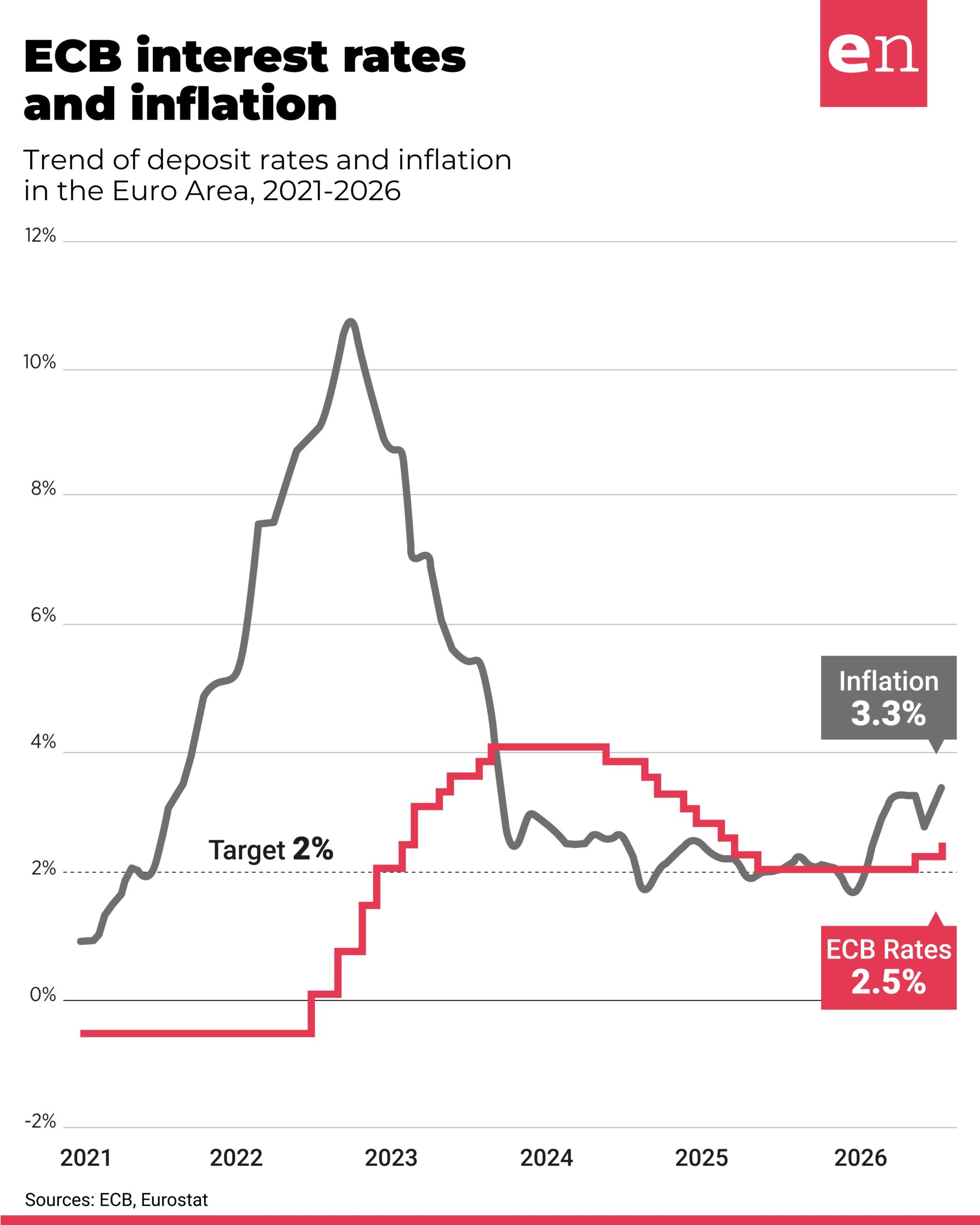
The ECB President, Christine Lagarde, reiterates that decisions are taken and will continue to be taken “on the basis of the data” available, and “on a case-by-case basis.” This time, the data indicate that, in the baseline scenario of the Eurotower experts’ new projections, headline inflation is expected to average 3 per cent in 2026, 2.5 per cent in 2027 and 2.1 per cent in 2028. “Compared with last June, the inflation projections remain unchanged for 2026, but have been revised upwards for 2027 and 2028”, Lagarde emphasises, and this justifies the decision.
What does a rise in interest rates mean, and what are its implications?
From 16 September, therefore, the interest rate on deposits with the central bank will rise to 2.50 per cent, the rate on main refinancing operations will rise to 2.65 per cent, and the rate on marginal lending facilities will rise to 2.90 per cent. This situation reflects decisions that were widely anticipated and expected: the decision not to adjust interest rates in July had been dictated by data that did not take the inflationary shock into account, caused by the rise in energy prices. A more significant impact was expected over the summer, and this is exactly what happened.
More growth, but risks to demand remain
“The outlook remains highly uncertain, with risks tilted to the upside for inflation and to the downside for economic growth,” admits Lagarde. However, in the baseline scenario of the projections, economic growth is expected to stand at 0.9 per cent in 2026, 1.4 per cent in 2027 and 1.5 per cent in 2028. The ECB President emphasises that these figures reflect an “upward revision for 2026 and 2027, which mainly reflects the euro area economy’s greater resilience than expected.” However, Lagarde warns that everything—or almost everything—hinges “on the intensity and duration of the shock.”
Lagarde warns: “Rising energy prices are expected to feed through to core inflation and food price inflation gradually.“ This means that unless a way out of the ongoing war and its repercussions is found, the situation could worsen. In this scenario, she continues, “a deterioration in global financial market conditions or knock-on effects on international bond markets could lead to a tightening of credit conditions, thereby dampening demand.” Hence the renewed call to countries—which applies particularly to Italy, with its high level of public debt: “Higher potential growth requires structural reforms and must be underpinned by sound public finances.”
The call to press ahead with the reform agenda is not limited to national governments: “The simplification and harmonisation of rules within the Single Market, the acceleration of the energy transition and the completion of the Savings and Investment Union are fundamental elements” for securing the EU and its eurozone, insists Lagarde. The President of the European Central Bank has made a call that is no different from the one coming from Mario Draghi and his new Rhine Group, and which aims to renew the invitation to leaders to stop procrastinating and take the necessary steps to give Europe momentum and competitiveness.
Lagarde and the crux of her mandate
Lagarde also has time to reflect on her future, and in particular on the natural end of her term of office, scheduled for 31 October 2027. Speculation has begun to circulate about her resignation, perhaps to stand in the French presidential election. She herself has not fully clarified the rumours regarding an early end to her term of office, while remaining cryptic on the subject. In any case, she replied to a reporter who brought up the subject again: “When there is something to be written about me, you will be the first to know. After my grandchildren, of course. And there is nothing you need to know.”
English version by the Translation Service of Withub

![[foto: European Central Bank]](https://www.eunews.it/wp-content/uploads/2022/04/risparmi-famiglie.png)


![[Berlino, 10 settembre 2026. Foto: Lorena Deidda/ECB. Copyright: (c) 2026 European Central Bank www.ecb.europa.eu]](https://www.eunews.it/wp-content/uploads/2026/09/lagarde-vucic-260910-120x86.jpg)