
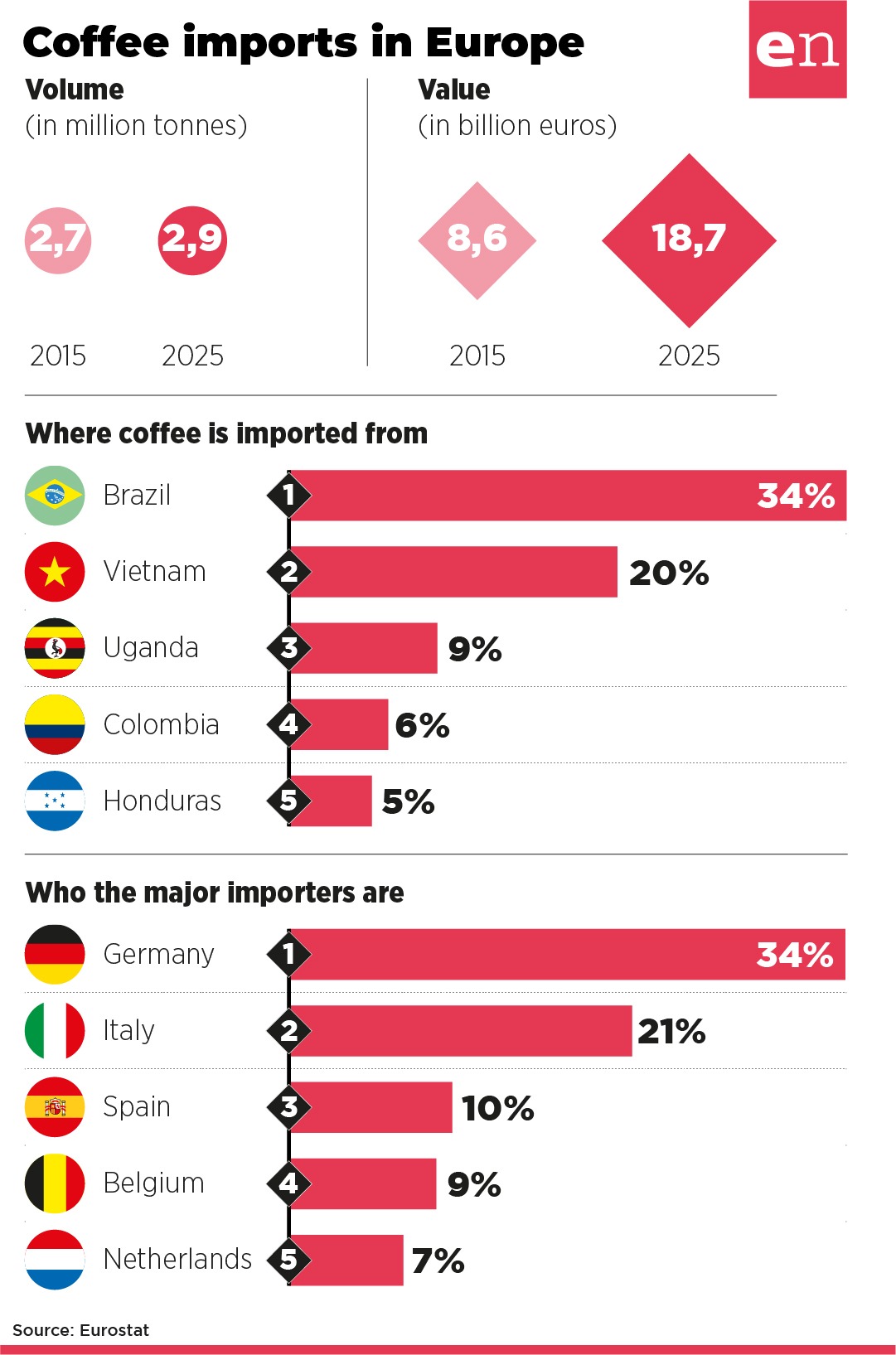
Brussels – Whether lungo, ristretto or macchiato, the value of coffee imports into the European Union – that is, the total monetary cost of the transaction – has risen significantly. According to Eurostat, the EU’s statistical office, in 2025 the EU imported 2.9 million tonnes of coffee from non-EU countries. Compared with ten years ago, the volumes have increased slightly – 2.7 million tonnes were imported in 2015 – while the value of the transactions has more than doubled, rising from 8.6 billion euros in 2015 to 18.7 billion euros in 2025.
Most of the coffee imported in 2025 came from Brazil (1,005,200 tonnes, accounting for 34 per cent of total non-EU imports) and from Vietnam (587,500 tonnes, 20 per cent). Next came Uganda (262,400 tonnes, 9 per cent), Colombia (162,900 tonnes, 6 per cent) and Honduras (136,500 tonnes, 5 per cent). Around one third of the imports arrived in Germany (1,010,500 tonnes imported, 34 per cent of total non-EU imports), followed by Italy (608,000 tonnes, 21 per cent), Spain (281,600 tonnes, 10 per cent), Belgium (269,200 tonnes, 9 per cent) and the Netherlands (216,600 tonnes, 7 per cent).
In 2025, over 2.2 million tonnes of coffee, both decaffeinated and roasted, were produced in the EU. Production volumes rose by 12 per cent compared with 2015 (2 million tonnes), at a cost of approximately 19 billion euros. Among the Member States that provided data, Germany was the largest producer (561,200 tonnes, accounting for 25 per cent of total EU production), followed by Italy (514,200 tonnes, 23 per cent).
English version by the Translation Service of Withub