Brussels – The proposal to introduce new taxes in the European Union’s multi-annual budget has divided Europeans, with 40 per cent in favour and 42 per cent against. Eighteen per cent are undecided, and political parties will target this section of the population. This is according to the latest survey by Polling Europe Euroscope – a Brussels-based market research and polling organisation, a joint venture between SWG and OpinionWay – previewed exclusively by Eunews.
In its proposal for the Multiannual Financial Framework for the 2028-2034 seven-year period, the European Commission proposed introducing taxes on high-carbon imported goods, unrecycled electronic waste, emissions, and tobacco, as well as a levy on large companies, to finance the EU’s next budget and investments. When asked specifically whether they agree or disagree with the idea, Europeans surveyed are fairly evenly split (40 per cent to 42 per cent). Still, differences emerge when looking at the five largest countries, for which the survey provides more detailed findings. The proposal for new taxes is popular in Italy and Spain, with 41 per cent and 44 per cent in favour, respectively, compared with 34 per cent and 41 per cent against, while it fails to win over Germans (48 per cent against, 37 per cent in favour), Poles (46 per cent against, 38 per cent in favour) and the French (42 per cent against, 36 per cent in favour). The picture, however, includes a not insignificant proportion of people who are unable to express an opinion, perhaps because the issue has not been adequately explored in the national public debate. Italy has the highest proportion at 25 per cent – one in four respondents. France (22 per cent), Poland (16 per cent), Germany and Spain (both at 15 per cent) follow.
In terms of political alignments, the most ardent supporters of new EU funding are Green voters (61 per cent in favour), Renew Europe (51 per cent), Socialists and Democrats (S&D) (50 per cent), and The Left (48 per cent). Opinion is split among those who vote for the European People’s Party (EPP): 43 per cent are in favour and 43 per cent against. Among right-wing voters, the picture is reversed. Here, those opposed have the upper hand: in the Europe of Sovereign Nations (ESN), they account for 64 per cent; in the Patriots for Europe (PfE), 58 per cent; and in the European Conservatives and Reformists (ECR), 51 per cent.
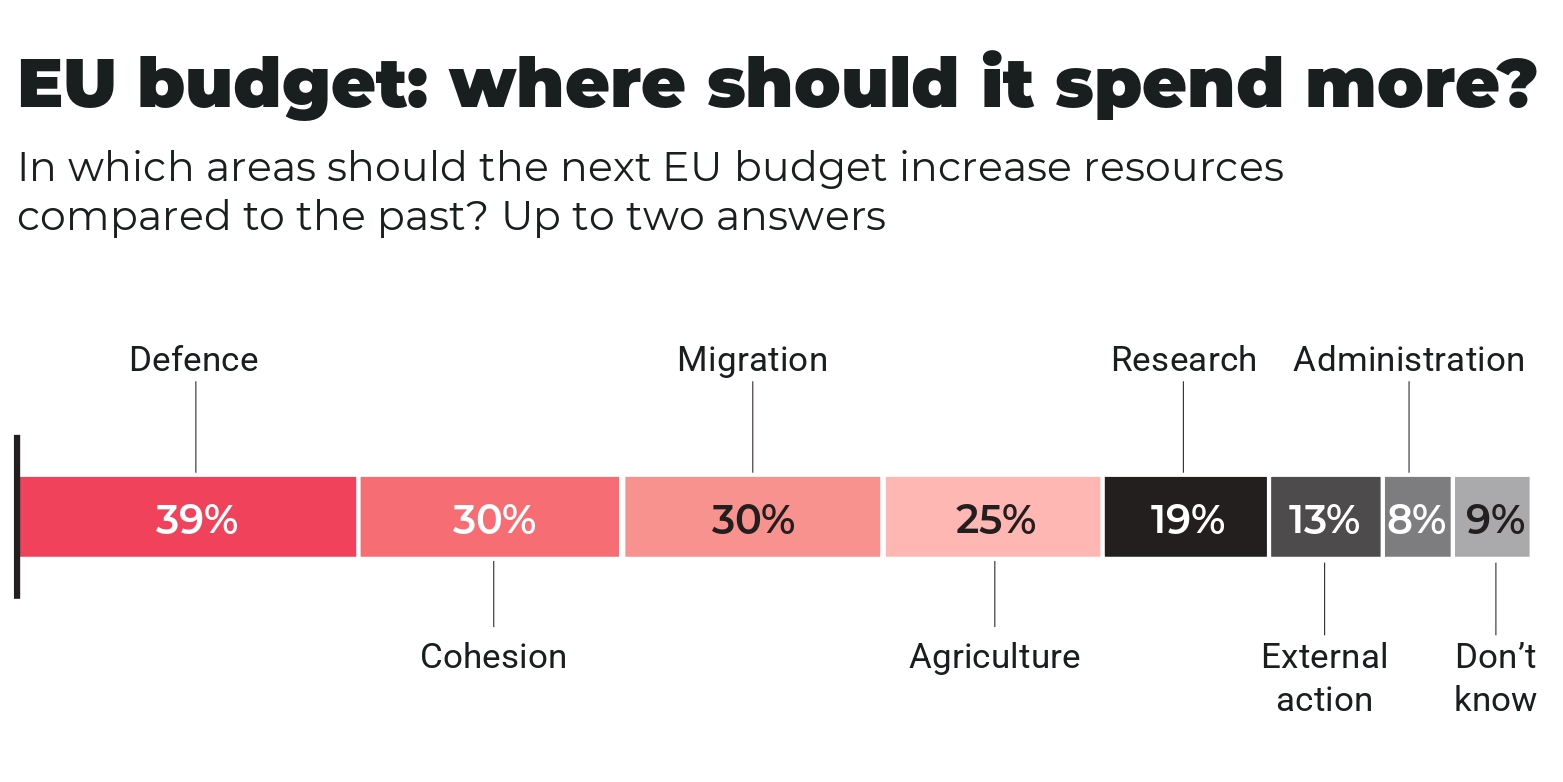
The survey also asked a second question on the EU’s next long-term budget, focusing on which sectors should receive more funding than in the past. Each respondent could express two preferences. In the end, the most popular choices were “Security and defence” (with 39 per cent of responses); “Economic, social and territorial cohesion, and crisis response” (30 per cent); “Migration and border management” (30 per cent); “Agriculture, fisheries and environmental protection projects” (25 per cent); “Research, digital transformation, transport and energy networks, and small businesses” (19 per cent); “External action, international development and humanitarian aid” (13 per cent); “European public administration, EU institutions” (8 per cent).
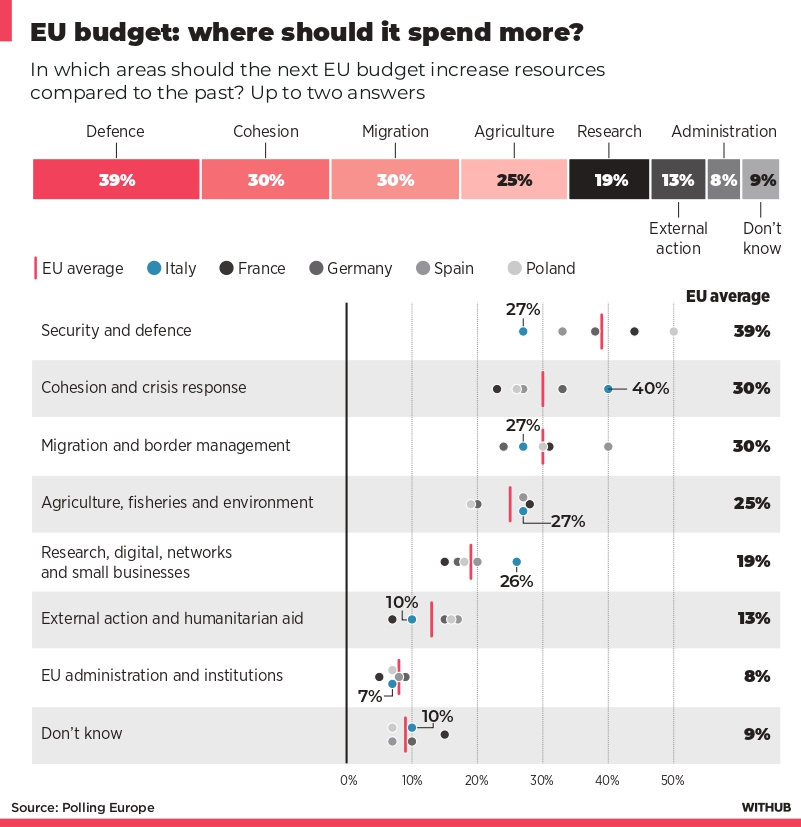
However, this spending priority scale for the upcoming EU budget changes when looking at individual countries. In Italy, for example, it appears to be the other way round. For respondents in Italy, the next MFF must allocate more resources than in the past to “Economic, social and territorial cohesion, and crisis response” (40 per cent), followed by the three categories “Migration and border management”, “Agriculture, fisheries and environmental protection”, and “Security and defence”, all at 27 per cent. The choice of “Research, digital transformation, transport and energy networks, and small businesses” stands at 26 per cent, while that for “External action, international development and humanitarian aid” is at 10 per cent.
In the other countries, the priorities are on security – 50 per cent for Poland, 44 per cent for France, 38 per cent for Germany and 33 per cent for Spain; the issue of migration – 40 per cent in Spain, 31 per cent in France, 30 per cent in Poland and 24 per cent in Germany; the economy, after Italy, Germany is the country where this is felt most keenly, with 33 per cent of respondents citing it, followed by Spain at 27 per cent, Poland at 26 per cent and France at 23 per cent; and agriculture, most prominent in France with 28 per cent of responses, followed by Spain at 27 per cent, Germany at 20 per cent and Poland at 19 per cent.
Lastly, regarding political affiliation, the priorities are security and defence (39 per cent) and the economy (38 per cent) among voters for the Socialist Group (S&D); the economy (40 per cent) and agriculture and fisheries (34 per cent) among the Greens; the same order of priorities is found amongst supporters of The Left (37 per cent and 34 per cent, respectively); security and defence (46 per cent) and the economy (35 per cent) among the liberals of Renew Europe. The priorities differ for those who identify as right-wing, for whom the two main priorities are security and defence and migration: 48 per cent and 35 per cent, respectively, among the People’s Party (EPP); 45 per cent and 39 per cent among the Conservatives (ECR); 47 per cent and 48 per cent among the Patriots (PfE); and 37 per cent and 38 per cent among the Sovereigntists (ESN).
The survey was conducted online using the CAWI (Computer-Assisted Web Interview) method on a representative sample of the European Union population aged 18 and over. The total sample size is 5,067 complete interviews, distributed proportionally across the populations of the 27 EU countries, with a slight adjustment to enable pan-European analysis of the data, broken down by the five largest countries (Germany, France, Italy, Spain and Poland) and across three different regions: Central and Eastern Europe, Northern Europe and Southern Europe. Proportional quotas for age and gender were set for each country. The quotas were calculated based on the most recent parameters provided by Eurostat. The interviews were conducted between 21 and 30 September 2026.
English version by the Translation Service of Withub