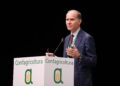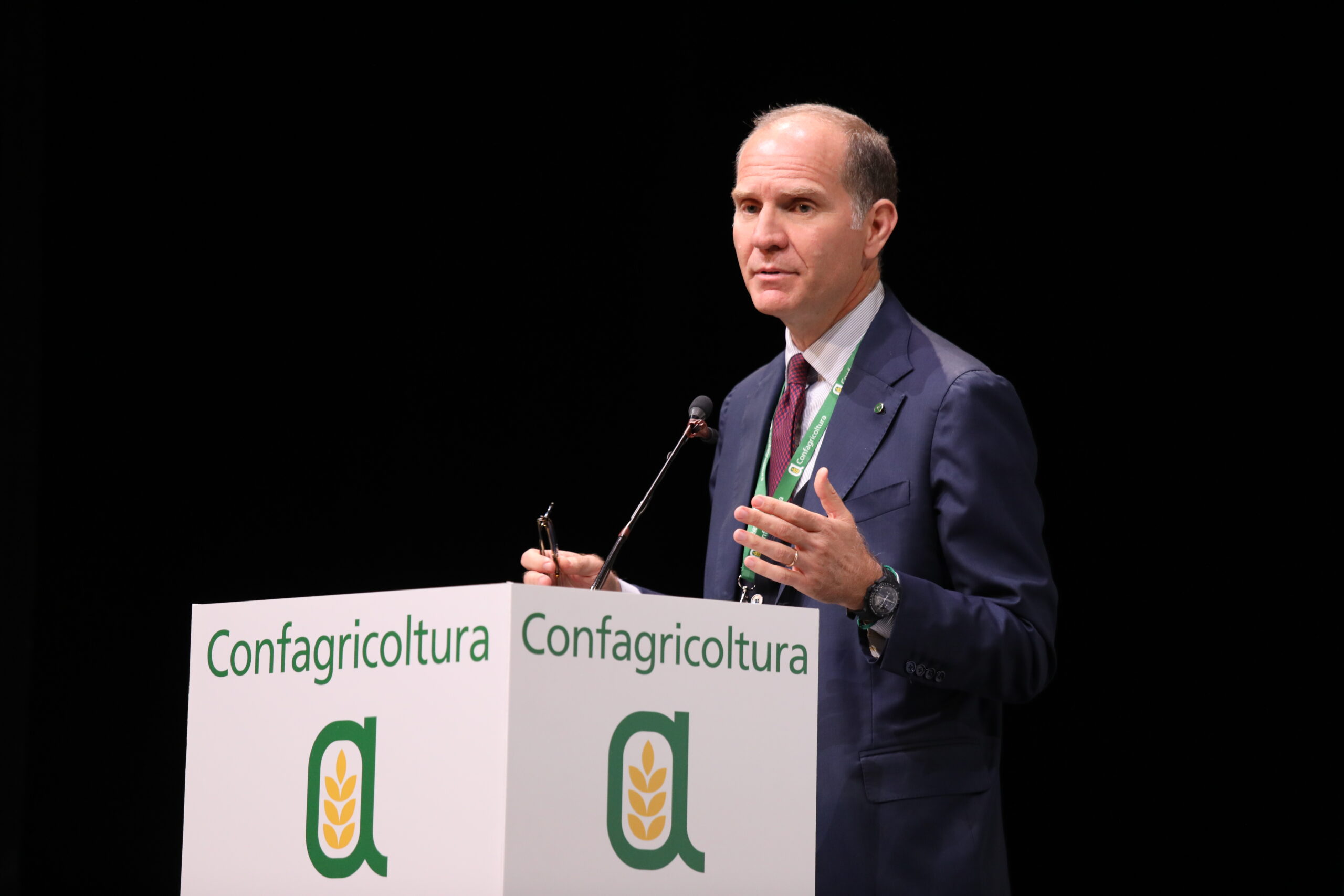
Brussels –Inflation is taking its toll on the two weakest links in the food chain – the producer and the consumer – and unless action is taken with flexibility, resources, and a common budget ready to respond to challenges and threats, the entire European agricultural and production system will suffer. Unanimously reelected as head of COPA, the association bringing together Europe’s leading professional agricultural organisations, the president of Confagricoltura, Massimiliano Giansanti, clearly states to Eunews that “in terms of energy, the whole of the European Union is currently experiencing an extremely difficult period, caused by the effects of the wars on Europe’s doorstep,” while “the prolonged summer and the heat have reduced the expected and hoped-for yields of winter and summer crops“, and that all this requires a suitable instrument: a Temporary Aid Framework that allows Member States to take action.
E.: President Giansanti, what impact is the energy crisis having on agricultural work?
Massimiliano Giansanti: “The situation varies from place to place and is also the result of the spending capacity of each Member State. Faced with a period of crisis, heavily influenced by markets, it is clear that Member States that can directly support the agricultural sector, other sectors of the economy, or the consumer sector have an advantage in both domestic and international markets. In a time like this, I don’t think we can afford it, and that’s the reason why I asked for a special Temporary Framework to be adopted as soon as possible, which goes beyond the one due to expire at the end of the year, and that provides greater flexibility to Member States, which can and must take action to prevent the rise in energy and fertiliser costs.”
E.: What is the specific situation regarding fertilisers and fuel?
M.G.: “There is an issue with product availability, because both agricultural diesel and fertilisers are starting to become scarce. And there is also the issue of food inflation, as the cost of the shopping basket continues to rise every day. In the case of Italy, then, Istat data tell us that as early as 2025 – that is, before the Strait of Hormuz crisis – Italians had cut their food spending by 30 per cent. Food inflation is now the biggest problem of all; it is causing difficulties for the two segments of the food chain: consumers and producers. Action must also be taken on this front, with a comprehensive plan at both the European and Italian levels. I hope and trust that, alongside the initiative launched by ENI, the other refineries that currently hold stocks of agricultural diesel will also be able to take similar action, helping to reduce the cost of agricultural diesel, because there is also the risk of the country’s production capacity being reduced.”

E.: A few days ago, the European Commission pushed back against Prime Minister Meloni’s requests for further flexibility, explaining that it had already been granted. What do you think?
M. G.: “I fully support President Meloni’s proposal, and not because she is the Italian Prime Minister. I believe that ‘If not now, when?’ It’s clear that with everything that’s happening around us, with the pressure on the markets, with climate change, are we experiencing a significantly more difficult season than in 2020 and 2022? I understand the rigidity of the treaties and Brussels’ regulations, but the European Union cannot remain stifled by its own rigidity. We need greater flexibility and to allow businesses and citizens to weather a difficult period. I believe it is time to take action; in fact, we are already late.”
E.: In recent months and weeks, part of the European debate has centred on the European Union’s 2028–2034 budget (MFF) and, within that, the Common Agricultural Policy (CAP). We are witnessing the usual outcry from those in favour of fiscal discipline, the so-called ‘frugal’ countries, and their constant game of tweaking down figures. What are your greatest hopes and fears in this regard?
M. G.: “If we do not start from a fundamental premise, namely that agriculture is of fundamental and strategic importance, it is clear that talking about MFF and CAP is merely a mathematical exercise, and we must not make that mistake. We hope that we start from a baseline of von der Leyen’s initial proposal, to which 10 per cent of the Rural target is added, the additional 50 billion from the advance payment of two-thirds of the agriculture and cohesion funds, as set out in the medium-term notification, which are fully guaranteed for farmers but not for rural areas. So, a total of 390 billion, to which we must necessarily add automatic inflation indexation. We also support a 480 billion euro COPA proposal, which is not far off that of the European Parliament, and is aimed at ensuring for all European citizens high quality standards in our production, to safeguard agriculture from climate change and ensure that agriculture can be one of those sectors that actually helps to significantly mitigate the effects of climate change, ensuring a fair income for farmers. So, between the COPA’s, the European Parliament’s, and von der Leyen’s proposals, a solution must be identified.”
E.: So, absolutely no to the cuts proposed, for example, by the ‘Nego-Box’ of the previous EU Council presidency – the Cypriot one – right?
M. G. “An unambitious financial framework pushed forward by the frugal countries is not what the European Union needs right now. We need to rediscover our European vocation based on solidarity and shared participation in the strategic vision of the European Union’s values. There is no country in Europe today that can compete on its own against the United States, China, Russia, or South America. In this context, therefore, the European Union must regain its central role.”
E.: “Would you like to hear President von der Leyen say that the agricultural sector is a matter of national security, and therefore deserves special attention?”
M.G.: “I would very much like to hear President von der Leyen say that the agricultural sector is a matter of national security. Just as President Trump has repeatedly stressed – having welcomed farmers to the White House on numerous occasions to reiterate that agriculture is a matter of national security for the United States of America, I believe this is true for the United States just as it is for Europe, because the war we are experiencing today is a hybrid war consisting not only of cannons and soldiers in the trenches, but also of the sinking of ships carrying grain from Ukraine to Europe, to North Africa, speculation on financial markets in agricultural commodities, and the availability of products and commodities in excess of actual needs. It also involves the use of hard power tools that certain countries, such as Russia, employ to shape political action and raise political awareness in certain parts of the world. I would also like to remind President von der Leyen that next year will mark the 70th anniversary of the Treaties of Rome, when six visionary Member States, luminaries who believed in unity and the spirit of cooperation, came together to harmonise agricultural and steel policies. Seventy years have passed; steel is no longer produced as it was then, yet agriculture, just as it was, remains central to the stability of food supplies. So, when it comes to food security and product quality, the agricultural sector is a major economic reality. In this context, the question that needs to be addressed is whether the president of the Commission considers agriculture to be a strategic sector or not.”
E.: Let’s get back to the 2028–2034 budget – are there any figures you’d like to see on paper?
M. G. “I hope and trust that the frugal countries will make this effort and meet the President’s request, meaning a budget of at least 2,000 billion. I realise it’s difficult, but we’re still talking about 1.3 per cent of GDP; in other words, we’re discussing an additional 0.3 per cent of GDP compared to the current allocation, which is effectively nothing. Certainly it is pleasing to see how 17 countries – the cohesion countries – support the Common Agricultural Policy. I had a meeting with the French minister, who has assured me that France, too, will support the Common Agricultural Policy, even though it has not signed the document drawn up by the cohesion countries. So, 18 of 27 countries are taking a strong, radical stance by supporting the Common Agricultural Policy. At the weekend, when they arrive, we’ll read the proposals from the ‘Nego-Box’ of the Irish Presidency of the Council, and then we’ll see what to do and what sort of measures to put in place”.
E.: “So are you prepared, if necessary, to take to the streets again?
M. G.: “We already demonstrated in December last year that we are capable of taking to the streets in a

peacefully, to put forward our ideas, to make our case. This in turn led President Meloni and President von der Leyen to increase CAP resources, which had initially been cut by 20 per cent. We are always ready for any form of mobilisation. The mobilisation also involves the necessary steps we must take within the Member States. We’re not afraid to go back to Brussels if we have to: we’ve done it before, and if there’s a need to protect farmers’ futures, we won’t hesitate for a second to make our voices heard.”
E.: Another issue is the future enlargement of the Union and Ukraine’s accession to the European family. It is a large, predominantly agricultural country – how do you see its future?
M. G.: “Ukraine’s entry into the European Union, in terms of agriculture, this will need to be properly assessed across all its effects, using, of course, impact studies. We’re talking about 40 million hectares of super-productive land, which forms part of a total of 120 million hectares in the EU – not all of which is productive, as we have mountains, hills and different agricultural models. The impact of Ukraine, if not clearly defined and properly protected, risks causing real difficulties not only for agricultural policy but also for European agriculture. Importing goods from Ukraine at zero tariffs is already affecting some sensitive sectors. Just talk to farmers in Poland, Romania, Bulgaria, Hungary, the Czech Republic, Croatia and Slovenia. It’s hard to imagine that a set of transitional rules would not be introduced. So there will inevitably be a capping issue (a cap on payments, ed.), because it is clear that the size of Ukrainian farms is not comparable to ours. We will have to understand how to prevent the exclusive or largely exclusive concentration of economic resources in favour of Ukraine. Therefore, within the European Union, it will take a long time to establish a transitional phase.”
E.: At the start of this debate, there did not seem to be much interest in the CAP on the Ukrainian side, but recently, however, interest appears to have grown…
M.G.: “I see that as deadlines approach, the stakes rise, but it is equally true that we cannot allow a heritage such as that of European agriculture to be destroyed simply for the sake of a possible enlargement.”
E.: In her State of the Union address in September, von der Leyen defended Brussels’ trade policy, in contrast to that of Donald Trump’s in the US. But trade agreements often raise concerns and even harsh criticism in the agricultural sector. What is your view on that part of the speech and this European Union policy?
M. G.: ““Over the years, we have set extremely high standards. Let’s not forget that during the years when (Franz) Timmermans was Vice-President (of the European Commission for the Green Deal), farmers were asked to make sacrifices and efforts that were almost impossible. They were made; today we cannot undermine that path and trajectory that must lead us to gain a competitive advantage. If we enter into commercial agreements with those who do not have standards, it is clear that, rather than an advantage, these become a competitive disadvantage. We have long been trying to take action in a careful and timely manner on international agreements that focus on reciprocal standards. In the case of Mercosur, we had put it plainly: this is not about saying no to Mercosur. We all buy soya from South America today, but we also need to develop models that are comparable to our own. I realise that in a geopolitical or strategic framework alliances must be forged. Still, within those alliances, we must build a model in which there must be mutual respect for the reciprocity of production zones.”