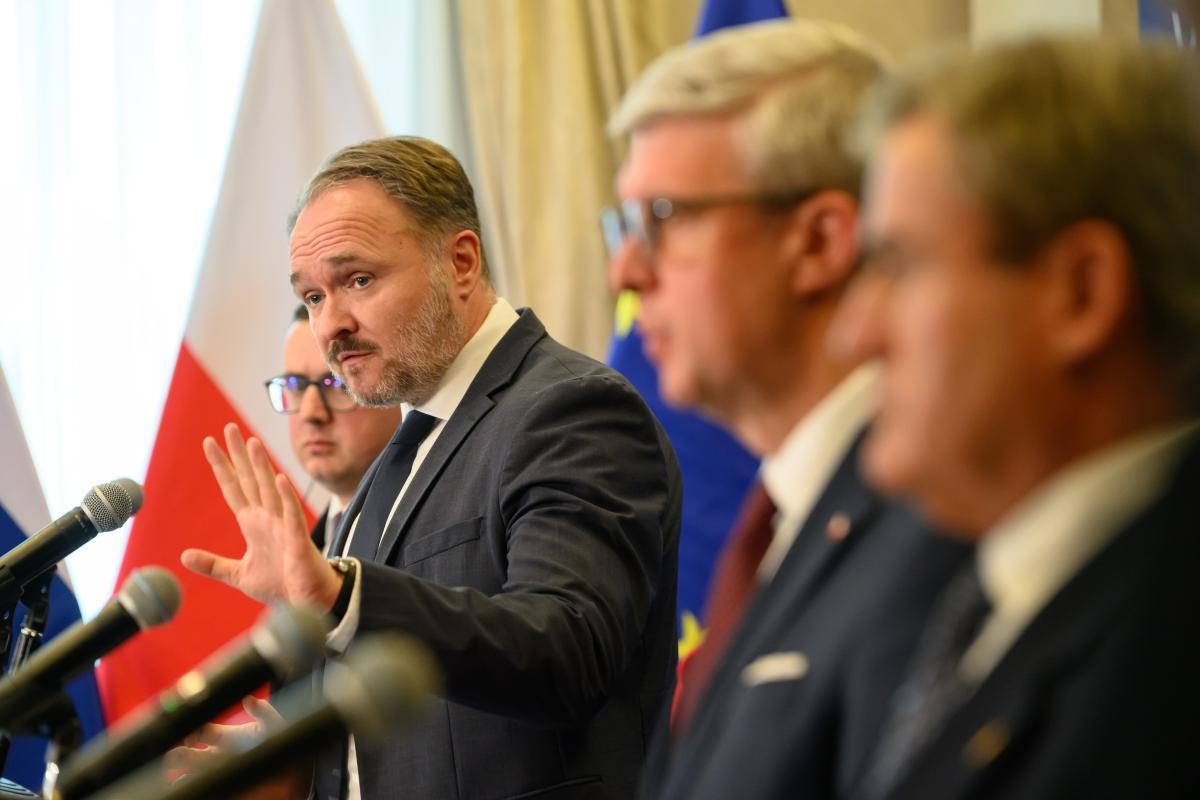
Brussels – The approaching winter will be very difficult in terms of energy for citizens and businesses, and the European Union is working to assess additional measures to bring prices down, as agreed at last week’s European Council by the leaders of the 27 Member States. This was emphasised by the European Commissioner for Energy, Dan Jørgensen, in Bratislava, where he met with the energy ministers of the Visegrad Group (the Czech Republic, Hungary, Poland, and Slovakia).
In the press conference from the Slovak capital, Jørgensen points out that energy prices are “extremely high” and that citizens are feeling the pinch of this situation “on a daily basis” – “at the petrol pump”, “when paying their bills” or “when turning on the heating.” A situation in which the work done so far by Europe does not seem to be enough. On the one hand, “we are better prepared than we were in 2022 – when Russia launched its terrible, large-scale invasion of Ukraine” – because “we have greater diversification of our energy sources” and “we are more energy-efficient,” given that “we are using 18 per cent less gas than in 2022.” So without the adoption of these kinds of measures, “we would have found ourselves in an even worse situation.” On the other hand, however, “we find ourselves in a very difficult period,” where “the global geopolitical situation is now affecting the Union as a whole.” Furthermore, “we are heading into a winter that will be very difficult for many of our citizens,” and “our businesses are struggling to compete.” In fact, “an extremely serious situation” emerged at last week’s European Council, where leaders concluded that it is necessary to consider “further efforts to bring prices down.” And “we are doing just that,” the Commissioner assures.
In a crisis situation, the EU must “do its utmost to help citizens, with targeted and temporary measures,” but without losing sight of the long-term strategy, which is “very clear” and aims to make Europe free from its dependencies. “We used to depend on Russia; now we are moving away from that dependence, and that is a positive development,” Jørgensen emphasises. “But the current situation shows us that we are now dependent on the global market,” he adds. Therefore, what is happening in the Middle East “can have repercussions for European citizens” “because we import too much.” For this reason, “our strategy is clear: we must break free from this dependence.” Which, in short, means “renewable energy, nuclear power, diversification, and energy efficiency.”
Finally, the Commissioner believes that the energy issue affects not only citizens’ pockets, but also their security. “In a turbulent world such as the one we live in today, energy security is also the security of our societies as a whole,” he points out. And for this reason, he insists: “Decarbonisation remains at the top of our political agenda,” not least because “this summer we saw how record temperatures caused problems even for some nuclear power stations in Europe, including in this region.” These are “extremely serious” problems. But for Jørgensen, “solutions do indeed exist,” and the EU knows “the way out.”
English version by the Translation Service of Withub