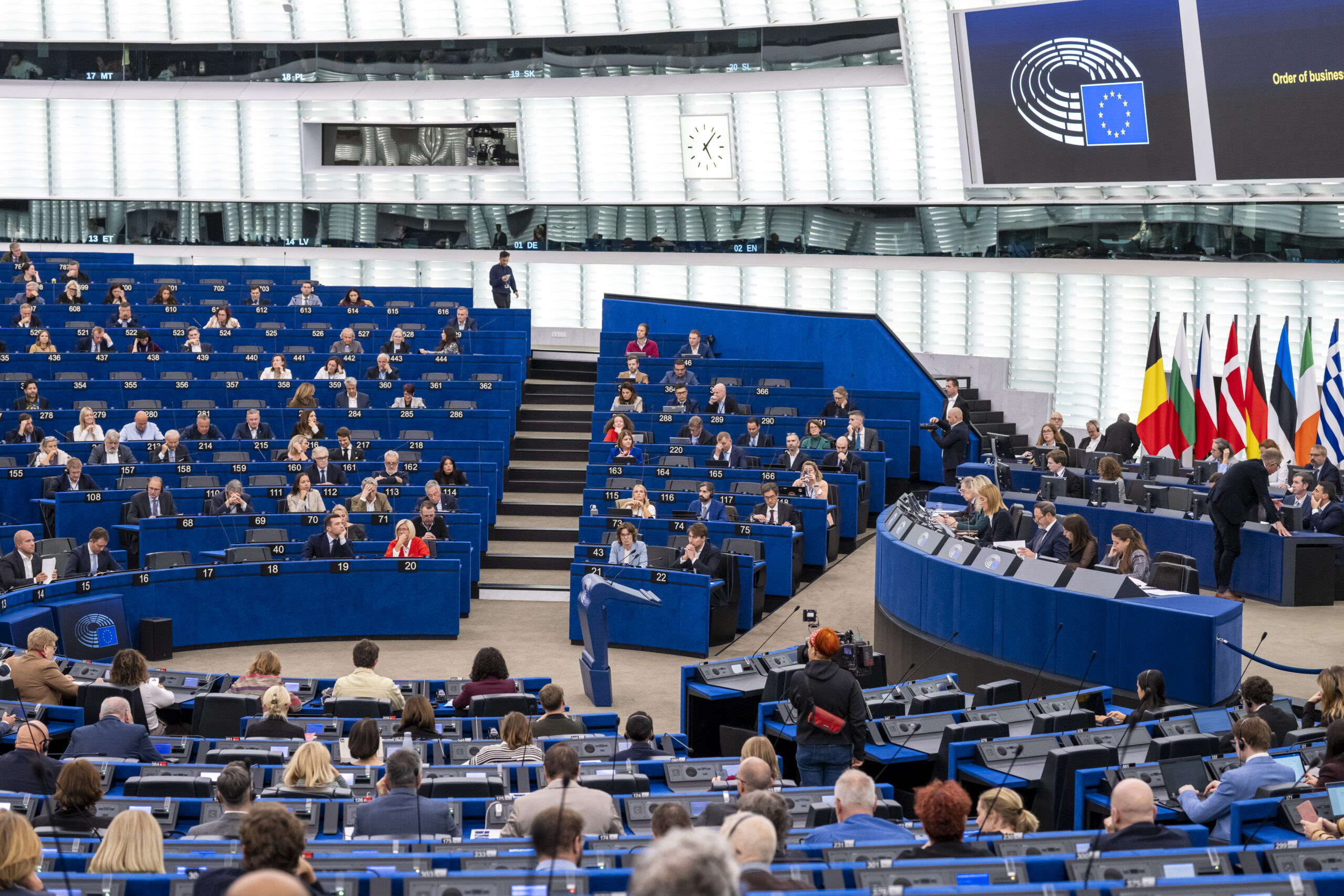
Brussels – The issue of poverty amongst Europeans takes centre stage in the European Parliament’s plenary chamber in Strasbourg, which opens today, 19 October. Following a weekend marked by protests against the high cost of living, today, to mark the International Day for the Eradication of Poverty, established by the United Nations General Assembly in 1992, MEPs have dedicated a brief debate to the situation in Europe: eight MEPs, one from each political group, have expressed their views on the issue.
MEP (S&D), Gabriele Bischoff, emphasised that the EU’s focus on the issue of poverty must be “reflected in the next MFF.” Therefore, “20 billion for children” and “100 billion for affordable housing” must be allocated. The Renew MEP, Hristo Petrov, also agreed with these figures and urged “the Commission, fellow MEPs and European leaders to address this issue” because “children cannot wait for the next budget.” The MEP for the European Conservatives and Reformists (ECR), Małgorzata Gosiewska, took the opportunity to highlight the severity of the situation in her country, Poland, where “over two million Poles live in extreme poverty and 15 million below the subsistence level.”
According to João Oliveira, MEP for La Sinistra, in order to eradicate poverty, it is “necessary to change policies and put an end to hypocrisy” – for example, by “investing not in defence, but in tackling poverty amongst the EU population.” Martine Kemp, a MEP from the European People’s Party, argued that “when the cost of living puts pressure on household budgets, even the most basic necessities become difficult to afford.” Therefore, “we must break this vicious circle by promoting access to quality jobs, easing the financial burden on families, and making essential services accessible,” she observed. “Ninety-three million Europeans are living in poverty,” explained the Greens MEP, Marie Toussaint, calling on her fellow MEPs “not to limit themselves to promises, but to take action: to guarantee decent wages, adequate housing, and a budget geared towards social justice.” The MEP for Europe of Sovereign Nations, Irmhild Bossdorf, on the other hand, criticised the weekend’s protesters for “damaging public property,” attributing “poverty to immigration.” The MEP for the Patriots, Mathilde Androuët, shared this view, accusing “migrants of being the main recipients of EU aid.”
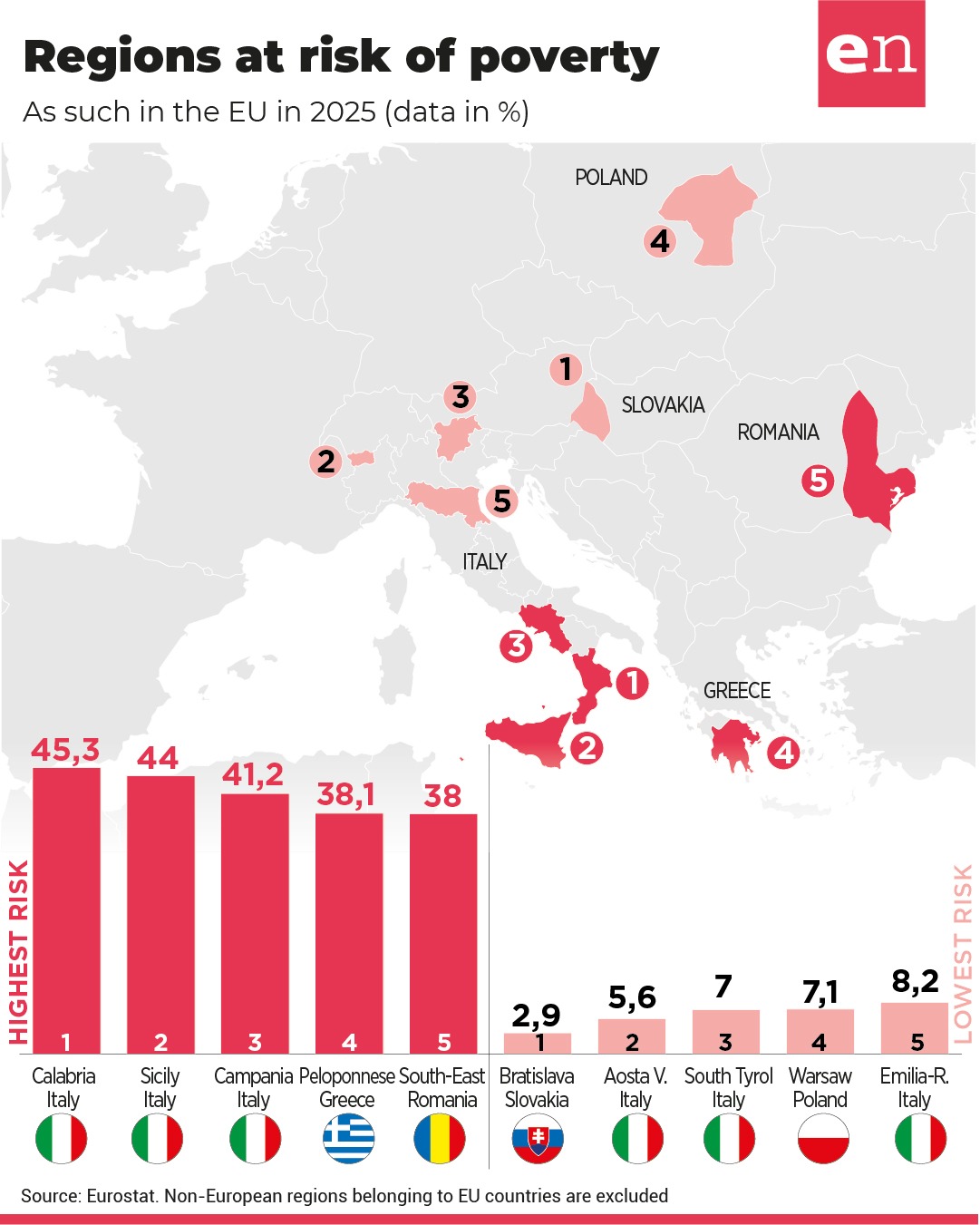
According to Eurostat, the European Union’s statistical office, in 2025 there were 92.7 million people in the EU at risk of poverty or social exclusion, accounting for 20.9 per cent of the total population. In 24 of the 243 EU regions for which data are available, and which are classified at level 2 of the Nomenclature of territorial units for statistics
(NUTS), at least 31.5 per cent of the population was at risk of poverty or social exclusion. NUTS is a geographical classification that divides the Union’s economic territory into three different levels of regions, NUTS 1, 2 and 3 respectively, ranging from larger to smaller territorial units. Above NUTS 1 lies the “national” level of the Member States. The highest at-risk rates were observed mainly in the southern, eastern, and outermost regions of the EU. These regions were located in Spain (five regions), Bulgaria, Greece, Italy (four regions in each of the three countries), France (three outermost regions), and Romania (two regions). The group also included two predominantly urban regions in Western Europe: the capital region of Belgium (Région de Bruxelles-Capitale / Brussels Hoofdstedelijk Gewest) and Bremen in north-western Germany.
In five regions, the proportion of people at risk of poverty or social exclusion was more than double the EU average. The highest proportion was recorded in the French outermost region of French Guiana, where 54.8 per cent of the population was at risk. In southern Italy, the neighbouring regions of Calabria and Sicily recorded the second and third highest rates (45.3 and 44.0 per cent, respectively). The group also included another French outermost region, La Réunion (42.3 per cent), and the Spanish autonomous region of Ciudad de Melilla (43.7 per cent).
English version by the Translation Service of Withub