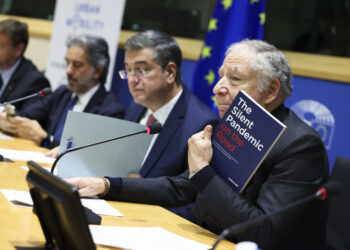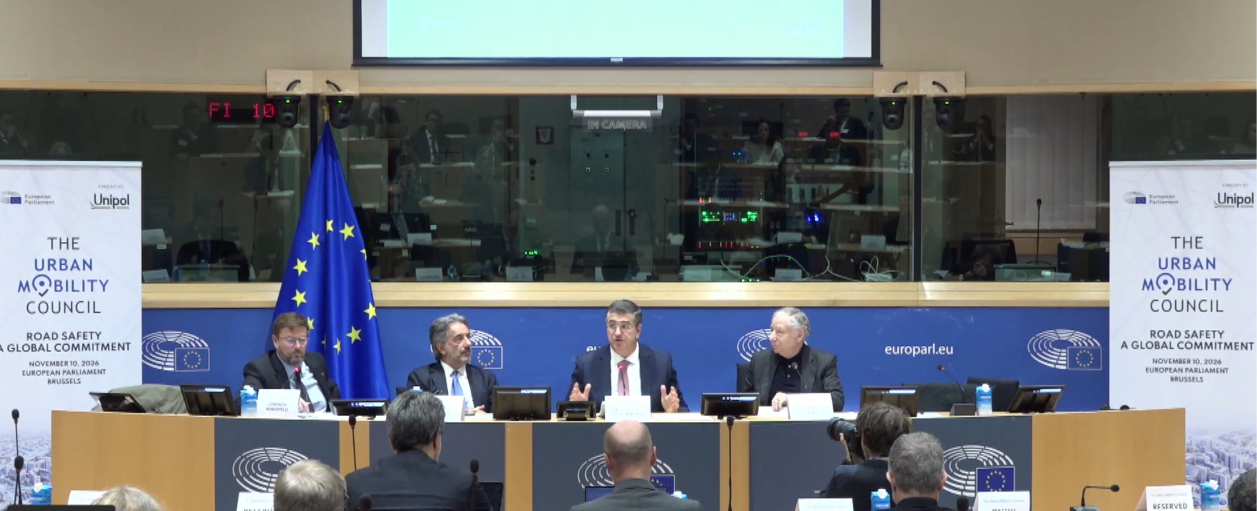
Brussels – Road safety must become a political and governmental priority. The European Union’s aim in road safety is to create “concrete cooperation, by harmonising legislation, linking funding instruments and building a global community of professionals who learn from one another,” with a view to achieving zero road deaths by the middle of the century. This was the message delivered by the European Commissioner for Transport, Apostolos Tzitzikostas, at “Road Safety, a Global Commitment”, the event held on 10 November at the European Parliament, organised by The Urban Mobility Council, the think tank promoted by Unipol, and hosted by the vice-presidents, Pina Picierno and Antonella Sberna. The concept of working as a team to save lives on the roads was also emphasised by the European Commission’s Executive Vice-President for Reforms and Cohesion, Raffaele Fitto: “At the European level, we are working to strengthen synergies between different policy areas, particularly between cohesion and transport, to provide increasingly comprehensive and effective responses to complex challenges that directly affect citizens’ lives,” he said, inviting The Urban Mobility Council think tank “to continue the research and in-depth analysis you are carrying out, providing institutions with knowledge and useful proposals to guide public policy.”
For Fitto, mobility is one of the priorities for improving the quality of life in cities and regions; it concerns not only travel, but also public safety, access to services, environmental sustainability, and opportunities for development. It is “an issue to which we have devoted particular attention in the new European agenda for cities as well, to support concrete solutions to citizens’ needs,” he explained. In this context, “road safety is a fundamental component”, and the research activities proposed by the Urban Mobility Council confirm the importance of two aspects. “The first is the design of urban infrastructure, which can help prevent accidents and make our cities safer. The second is the role of new technologies, including artificial intelligence, which offer increasingly effective tools for identifying risks, improving mobility management and also helping to reduce air pollution. These are areas where it is important to strengthen collaboration between institutions, the research community and the business sector,” said Fitto, highlighting the role of European cohesion policy in helping to achieve these objectives “by supporting investment in safer, more accessible, and more sustainable mobility.”
Commissioner Tzitzikostas began his address to the chamber by pointing out that it is the stories of those who have fallen victim to road accidents that “guide the work” of the European Union, because “behind every road victim there is a family, a community, and a future that has been changed forever” and “behind every statistic lies a human tragedy that, in many cases, could have been avoided.” For this reason, “the European Commission’s immediate objective is crystal clear: to drastically reduce the number of fatalities and serious injuries by the end of this decade,” moving towards “zero road deaths on European roads by 2050.” According to Tzitzikostas, the figures show “progress” because “compared with 2019, there were 3,400 fewer fatalities on our roads in 2025.” However, this improvement “should not be confused with success: last year alone, nearly 20,000 people lost their lives on EU roads” and “this is simply unacceptable.”
From a legislative perspective, with regard to European roads, “we have updated the rules on infrastructure safety management to cover a wider part of our network” and “we require Member States to carry out regular risk-based assessments.” As for vehicle safety, however, “all new vehicles must now incorporate specific advanced safety technologies” and “we also have rules on periodic inspections and roadside checks, designed to ensure that vehicles remain safe for as long as they are on the road,” the Commissioner explained. “We have also revised the legislation on driving licences, so that drivers face more severe consequences if they drive after consuming alcohol, and so that their fitness to drive can be monitored over time. Furthermore, new cars sold in the European Union must be fitted with automatic emergency call systems, known as eCall,” which, since its introduction in 2018, has significantly reduced the time between contact with the emergency services and their arrival at the scene.”
A key point for Tzitzikostas is, however, that of “irresponsible behaviour” on the part of individuals. He points the finger at clear culprits: “Speeding, the use of alcohol or drugs, using a mobile phone while driving, failing to wear a seatbelt in a car or a helmet when riding a motorbike or bicycle: all these factors increase the fatality rate,” highlighting that speeding is, “on its own, a contributing factor in around 30 per cent of fatal accidents,” while “in many towns, fewer than half of drivers adhere to speed limits.” Hence, the alarm raised by Tzitzikostas regarding the patchy compliance with the rules and the difficulty in enforcing them. “In some Member States, law enforcement agencies and local authorities lack the staff or equipment needed to carry out consistent checks. Specific budgets for road safety are often lacking, and responsibilities are fragmented across different ministries,” he noted. In this context, “political commitment comes into play” because “road safety cannot be regarded as a secondary issue within the transport sector; it must become a government priority, backed by adequate resources, rigorous enforcement and a clear definition of responsibilities.” Among the measures Brussels has begun to implement to tackle the problem are the establishment of the High-Level Group on Road Safety and the “European Union Road Safety Exchange”, and among the first results listed by the Commissioner is that of Greece, which “has reduced urban speed limits to 30 kilometres per hour, while also working on measures to protect motorcyclists.” Therefore, “change is possible,” because “it is not always necessary to reinvent solutions,” but what is needed is “the political will to implement what we already know works.”
Finally, taking a broader view, Tzitzikostas cited global figures showing that road traffic accidents cause over one million deaths each year worldwide and injure around 50 million people. “Over 90 per cent of these fatalities occur in low- and middle-income countries, despite the fact that these countries account for only around 60 per cent of the world’s vehicles. The economic cost of road traffic accidents often amounts to 3 per cent or even 5 per cent of GDP, diverting resources that could have been invested in education, healthcare, or innovation. And when road traffic accidents are among the leading causes of death among young people, we are not simply talking about transport policy. We are talking about human lives, economic development, and the future of entire societies,” he pointed out. Against this global backdrop, “I firmly believe that Europe has a responsibility to lead by example and to share our experience with our partners around the world,” he said, highlighting the EU’s support for various international initiatives.
English version by the Translation Service of Withub