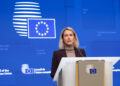

Brussels – Following the fall of Bashar al-Assad, a new association agreement with Syria is on the way. The news was announced by the High Representative of the European Union for Foreign Affairs and Security Policy, Kaja Kallas, during a press conference following today’s (16 November) Foreign Affairs Council meeting. The EU aims “to substantially strengthen its ties with Syria” and, to this end, “the ministers have expressed their support for continuing the process relating to the EU-Syria Association Agreement,” she said. “Together with the Member States, we will work on the technical and legal aspects to prepare the agreement for signature,” at a time when “Syria needs investment and a successful transition,” said Kallas. The aim is to provide “a framework for trade, political dialogue, and closer cooperation, as soon as possible” for both the EU and the Middle Eastern country.
Until 2011, bilateral relations between the EU and Syria were governed by a Cooperation Agreement signed in 1977. Syria and the EU had also negotiated a new Association Agreement, intended to replace the Cooperation Agreement. That text was drawn up in 2008, but was never signed due to concerns regarding the al-Assad regime’s respect for human rights. “It has been a long time since those negotiations, so the question is whether we need to make any changes. The European Union has its own timetable: that is why the compromise is to sign the 2008 Association Agreement immediately, as it provides us with the framework for addressing issues of common interest,” the Estonian official clarified. The Council will then work “on a new mandate for a modernised agreement,” in which regard the 27 foreign ministers “raised several points, including the need for clear conditionality on human rights and the non-recognition of the occupied Ukrainian and Georgian territories recognised by the Assad regime, as well as other proposals.” Kallas underlined that today’s initiative was unanimously welcomed by the ministers: “Everyone emphasised the need for engagement with Syria, as otherwise that vacuum would be filled by other actors,” she concluded.
English version by the Translation Service of Withub